Rescued by Christ, husband to @curlykjo05, dad, former engineer, Reformed Catholicity & Ref Scholasticism, licentiate in the Presbytery of Ohio (@OrthodoxPC)
Anthony Tuckney on 2 Peter 1:4
Anthony Tuckney (Westminster divine and chairman of the Assembly’s committee for the Larger Catechism) on 2 Peter 1:4 (and yes, he does affirm that Adam had this grace):
“8. As Nature sometimes anticipates Reason, so this Divine Nature [i.e., as he describes, a created participation of the divine nature/life, primarily consisting of habitual grace in the soul] always exceeds and goeth beyond that which is only humane. Divinity is above Humanity, Grace above Nature. A Christian is not ��ιλὸς ἄνθρωπος a bare man, but more than a man. And therefore to have or express no more than what Nature can work, or natural men by other helps can attain to, κατ' ἄνθρωπον περιπατεῖν, to walk as [mere] men with the Apostle, 1 Cor. 3. 3. terminus minuens, or (as Cap. 6. 7. he calls the like) it's ἥττημα a defect, in which we fall much short of, and below that which a man of God that is made partaker of the Divine Nature, should arrive at, and come up to. For as man by nature and kind is and acts above other creatures, so a Christian man should even above himself, as a man, and above other men that want that Divine Principle.
[…]
[A]s long as the sanctifying Spirit acts and abides in us, we are true Nazarites, as by our holy Vows separated to God, so we should be (though not wholly separated, yet) very much distinguished from other ordinary men. Christ expects from us a τι περισσόν, Mat. 5. 47. something singular, eminent, and transcendent.
[…]
[Gasparo] Contarini (de Justificat.) makes the comparison of the manners of a Rustick and of a Citizen or Courtier: and a like difference he saith there is between the carriage of an earth-born sinner and a Saint made partaker of the Divine Nature. The Sons of Princes should not be in the garb of Peasants children; but that comparison is too low. Between Nature and Grace there should be a more vast distance. A Child of God should be as much above a natural man as heaven is above the earth, and as much above a fouler sinner, as heaven is above hell.”
- Anthony Tuckney, Forty Sermons, 246-247 [2nd of 4 sermons on 2 Peter 1:4, in which he discourses at length on this text and on this topic].
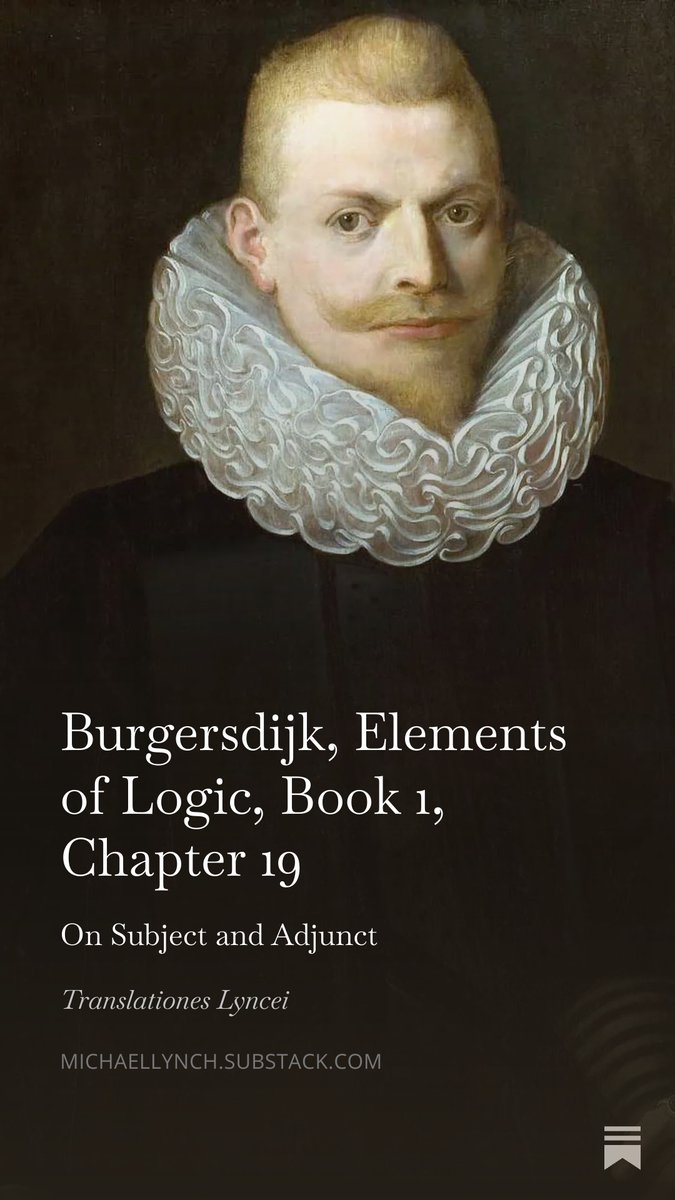
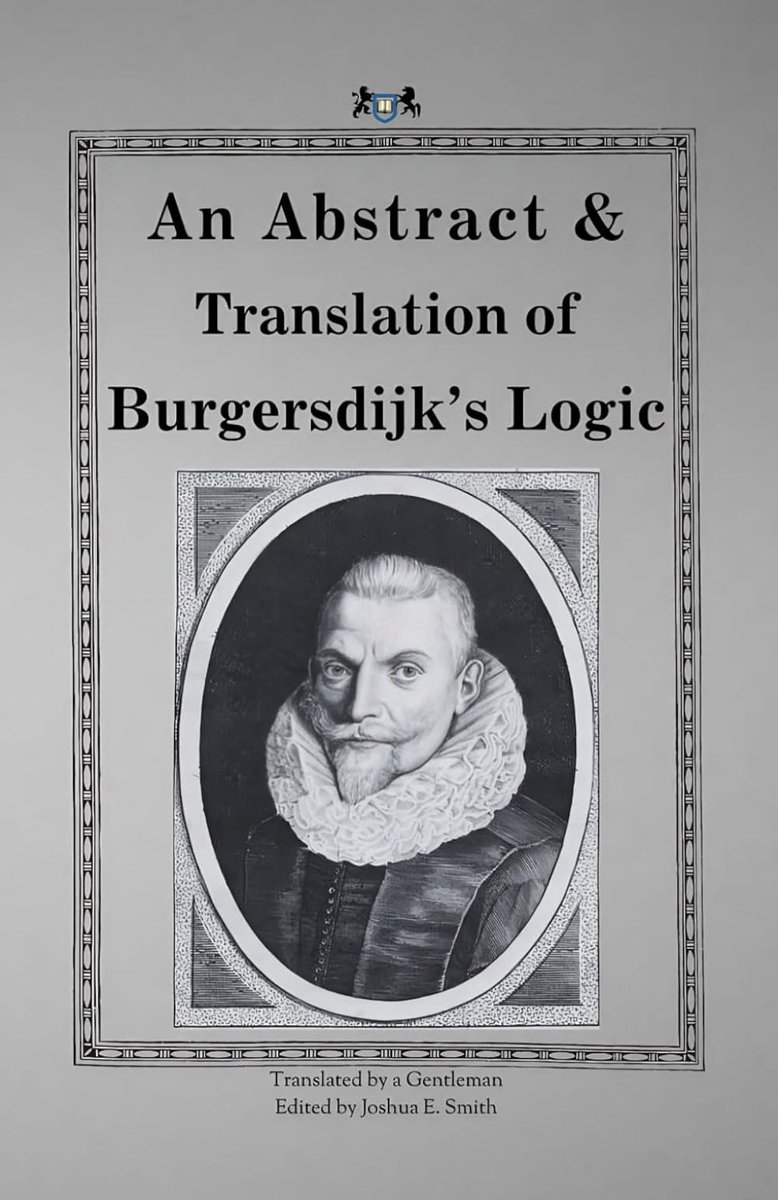
For the next couple months I will be reading one chapter of "An Abstract & Translation of Burgersdijk's Logic" each day and adding to this thread what I leaned. The reasons are 1) accountability, 2) explaining things helps you learn, 3) you can correct me if I get things wrong.
Ars Syllogistica - Now with Reminders
Learn scholastic logic
— in an integrated and guided way,
— with exercises that adjust to you and proceed toward mastery,
— first while you practice and then over intervals for recall and deeper mastery.
Free.
Link \/
He still appears to conflates nature and grace, signifying the former under the name of the latter:
“I just believe He graciously created us in His image with this ability and didn’t allow us to ever lose it (ie the ability to respond positively to His own revealed truth and appeals).
What is the HUGE difference here really? We both affirm our ability to respond positively is from God. Right? You just believe we all lost it for a time and got it back. I believe God created us with it and we never lost it.”
"2 OF THE MEANING OF THE WORD GRACE.
[...]
It need not seeme strange that the Arminians make Nature to be Grace, who maintaine that there is a generall grace imprinted in all men without exception. Which what can it bee else but Nature, and her endowments? Now if any shall obiect, that this in effect is nothing but an idle strife about wordes, let him consider, that this is the hidden spring of the most pestilent poyson of Pelagins. For out of this may they wash away and put off any thing, that is brought by the maintainers of Grace. If allegetion be made against him, that We are saued by grace. Their answere is ready. True. To witt by nature, which is the first and generall grace. By grace I am that I am. True. By grace, that is by nature, whereof God is the free Donor. Faith is the gift of God. True. Because out free-will, by which we ascent, is the gift of God the Creator. And if St. Austen himselfe shall presse against them, that Grace onely discernes a beleeuer from an vnbeleeuer. Why may they not answere. True sir. That is, onely Free-will, which is most freely giuen vs by God."
- Daniel Featley, A Parallel: Of New-Old Pelgiarminian Error (1626), 5.
Nature-Grace-Dualism Maxxing in Mastricht and De Moor?
"The threefold love of God toward his creatures
IX. From this emerges a threefold love of God, that is, toward his creatures: (1) a universal love (Ps. 104:31; 145:9), through which he created, conserves, and governs all things (Ps. 36:6; 147:9). (2) A common love, extending itself particularly to men, certainly not to each and every individual, but yet indiscriminately to anyone, as much the reprobate as the elect, of which kind is also the love that dispenses the benefits that are mentioned in Hebrews 6:4–5 and 1 Corinthians 13:1–2. (3) A love proper to the elect, by which he dispenses saving benefits to them, benefits that accompany salvation (Heb. 6:9), which accordingly are different from nature and natural benefits. For it is most terrible to confuse nature and grace.
[...]
What grace is, as far as its substance
XIV. Grace, if you consider its substance, is nothing but undeserved love. Since it is called love, everything we have already said about love applies to it. Insofar as this love is undeserved, or entirely free and independent of all worth and merit of the creature, it is specifically called grace (Rom. 11:6), such that the whole rationale of his dispensing it, according to the Scriptures, is in the good pleasure of his will (Matt. 11:26; Eph. 1:5). This grace accordingly considers each and every creature, all the way up to the blessed angels, for whatever they have, they have it by the pure and unadulterated grace of God, for who before him has given to him that he might be repaid? (Rom. 11:35) At the same time, those things are specifically attributed to grace which are different from nature. For nature must not be confused with grace, because natural things, since they are owed as it were from the benevolent constitution of God to every creature, if not individually at least insofar as it belongs to a species, are not customarily considered as grace, inasmuch as grace, being added to nature, is by all means un-owed.
What is universal grace and what sort is it?
XV. Now we would not repeat concerning grace what we just above taught concerning love, if a manifold controversy, one that has been in every age most vexing, did not urge us to do so. There is, then, first, universal grace, by which God dispenses natural things to each and every creature and is thus named the Savior of all (1 Tim. 4:10), the one who saves beasts and men (Ps. 36:6) and takes cares that his sun rises over the field of the just and the unjust (Matt. 5:45), concerning which see above. This grace particularly confers to man his free choice and whatever sort of strength he has for natural good, and also stirs up and encourages that strength by its influence. And all these things, although they come forth from the gratuitous love of God, and thus from grace, yet in the use of Scripture, and also of all ancient orthodoxy, rarely and less properly are they called grace. For the latter tradition cautiously distinguished nature from grace against the Pelagians."
- Petrus van Mastricht, TPT (RHB ed.), 2:351, 353–354.
--------------
"The Grace of God, taken in a general way for divine Favor [which produces its effects in the creaturely subject], is also able to be attributed to Adam in the State of Integrity; but commonly is referred to the Sinner, who through the Fall became less Worthy of the Grace of God; and it is also opposed to Nature and Natural Beneficence, which two things the Pelagians erroneously confound."
- De Moor, Didactico-Elenctic Theology, IV:22 [https://t.co/cLhEnGYYeo].
"Pelagius heretically called humane nature grace; we may piously and truly call saving grace divine nature; to be Godly is to be God like. God is holy, just, wise, good, spiritual, heavenly, and it is his very nature to be so. And he that is of such an heavenly spirit and carriage... though otherwise he be a poor weak man subject to humane infirmities, yet by this his conformity to God he is raised to divine perfection."
- Tuckney, Forty Sermons, 238.
@jdahlxn Thank you! I got the physical copy when it came out, but I’ve not yet read it. Those formats would make it easier to read in the meantime. But this topic (especially among the early modern RO) has been a pet topic of mine and it looks like you’re of the same mind on this as I am.
OPC ruling elder Sanjay Patel shares his testimony. Mr. Patel survived a violent plane hijacking and later came to Christ thanks to the godly fellowship of believers around him.
Edward Reynolds (Westminster Divine and later bishop of Norwich) on natural vs supernatural knowing/science:
"There is a great difference between the manner of yielding our assent unto natural and supernatural verities. The principles of the one are ingrafted, and suitable to the native seeds, and original notions of reason natural: but the principles of the other are revealed; and, without such revelation, could never have been sifted out by our implanted light, or by any human disquisition been discovered. For the gospel being a supernatural science, the principles thereof must needs transcend the reach of natural faculties, till raised and enabled by divine grace. And then indeed reason is an excellent instrument to use those principles of faith unto our further proficiency in sacred knowledge, which, without divine revelation, proposing the object, and divine grace disposing the faculty, it could never have either known or used."
- Edward Reynolds, A Treatise of the Passions and Faculties of the Soule of Man (1658 ed.), 9-10.
-----
"There is a great difference betweene the manner of yeelding our assent unto God and Nature: For in Philosophie, we never resigne our beleefe, nor suffer our judgements to be wholly carried to any Conclusion, till there be a demonstrative Argument grounded on Induction from the Sense, for the enforcement thereof. But Divinitie, on the other side, when God speakes unto us, worketh Science by Faith, making us so much the more assured of those Truths which it averreth, than of any Naturall Conclusions, (notwithstanding they may seeme sometimes to beare opposition to humane Reason) by how much Divine Authoritie is more absolute and certaine, than any Naturall demonstration."
- Edward Reynolds, A Treatise of the Passions and Faculties of the Soule of Man (1640 ed.), 9-10.
(Note: These are from the same chapter/section, but from two different editions of the same work.)
Edward Reynolds (Westminster Divine and later bishop of Norwich) on natural vs supernatural knowing/science:
"There is a great difference between the manner of yielding our assent unto natural and supernatural verities. The principles of the one are ingrafted, and suitable to the native seeds, and original notions of reason natural: but the principles of the other are revealed; and, without such revelation, could never have been sifted out by our implanted light, or by any human disquisition been discovered. For the gospel being a supernatural science, the principles thereof must needs transcend the reach of natural faculties, till raised and enabled by divine grace. And then indeed reason is an excellent instrument to use those principles of faith unto our further proficiency in sacred knowledge, which, without divine revelation, proposing the object, and divine grace disposing the faculty, it could never have either known or used."
- Edward Reynolds, A Treatise of the Passions and Faculties of the Soule of Man (1658 ed.), 9-10.
-----
"There is a great difference betweene the manner of yeelding our assent unto God and Nature: For in Philosophie, we never resigne our beleefe, nor suffer our judgements to be wholly carried to any Conclusion, till there be a demonstrative Argument grounded on Induction from the Sense, for the enforcement thereof. But Divinitie, on the other side, when God speakes unto us, worketh Science by Faith, making us so much the more assured of those Truths which it averreth, than of any Naturall Conclusions, (notwithstanding they may seeme sometimes to beare opposition to humane Reason) by how much Divine Authoritie is more absolute and certaine, than any Naturall demonstration."
- Edward Reynolds, A Treatise of the Passions and Faculties of the Soule of Man (1640 ed.), 9-10.
(Note: These are from the same chapter/section, but from two different editions of the same work.)
For instance, every time I compared the modern translation of Ames with the 17th century one the 17th century one was better, especially when some technical theological issue was being discussed. But the 17th century one is extremely archaic in spots so there's a big barrier.


![DordtyHylemorph's tweet photo. Nature-Grace-Dualism Maxxing in Mastricht and De Moor?
"The threefold love of God toward his creatures
IX. From this emerges a threefold love of God, that is, toward his creatures: (1) a universal love (Ps. 104:31; 145:9), through which he created, conserves, and governs all things (Ps. 36:6; 147:9). (2) A common love, extending itself particularly to men, certainly not to each and every individual, but yet indiscriminately to anyone, as much the reprobate as the elect, of which kind is also the love that dispenses the benefits that are mentioned in Hebrews 6:4–5 and 1 Corinthians 13:1–2. (3) A love proper to the elect, by which he dispenses saving benefits to them, benefits that accompany salvation (Heb. 6:9), which accordingly are different from nature and natural benefits. For it is most terrible to confuse nature and grace.
[...]
What grace is, as far as its substance
XIV. Grace, if you consider its substance, is nothing but undeserved love. Since it is called love, everything we have already said about love applies to it. Insofar as this love is undeserved, or entirely free and independent of all worth and merit of the creature, it is specifically called grace (Rom. 11:6), such that the whole rationale of his dispensing it, according to the Scriptures, is in the good pleasure of his will (Matt. 11:26; Eph. 1:5). This grace accordingly considers each and every creature, all the way up to the blessed angels, for whatever they have, they have it by the pure and unadulterated grace of God, for who before him has given to him that he might be repaid? (Rom. 11:35) At the same time, those things are specifically attributed to grace which are different from nature. For nature must not be confused with grace, because natural things, since they are owed as it were from the benevolent constitution of God to every creature, if not individually at least insofar as it belongs to a species, are not customarily considered as grace, inasmuch as grace, being added to nature, is by all means un-owed.
What is universal grace and what sort is it?
XV. Now we would not repeat concerning grace what we just above taught concerning love, if a manifold controversy, one that has been in every age most vexing, did not urge us to do so. There is, then, first, universal grace, by which God dispenses natural things to each and every creature and is thus named the Savior of all (1 Tim. 4:10), the one who saves beasts and men (Ps. 36:6) and takes cares that his sun rises over the field of the just and the unjust (Matt. 5:45), concerning which see above. This grace particularly confers to man his free choice and whatever sort of strength he has for natural good, and also stirs up and encourages that strength by its influence. And all these things, although they come forth from the gratuitous love of God, and thus from grace, yet in the use of Scripture, and also of all ancient orthodoxy, rarely and less properly are they called grace. For the latter tradition cautiously distinguished nature from grace against the Pelagians."
- Petrus van Mastricht, TPT (RHB ed.), 2:351, 353–354.
--------------
"The Grace of God, taken in a general way for divine Favor [which produces its effects in the creaturely subject], is also able to be attributed to Adam in the State of Integrity; but commonly is referred to the Sinner, who through the Fall became less Worthy of the Grace of God; and it is also opposed to Nature and Natural Beneficence, which two things the Pelagians erroneously confound."
- De Moor, Didactico-Elenctic Theology, IV:22 [https://t.co/cLhEnGYYeo].](https://pbs.twimg.com/media/HFGo0WcbEAAh2y8.jpg)



![DordtyHylemorph's tweet photo. Anthony Tuckney on 2 Peter 1:4
Anthony Tuckney (Westminster divine and chairman of the Assembly’s committee for the Larger Catechism) on 2 Peter 1:4 (and yes, he does affirm that Adam had this grace):
“8. As Nature sometimes anticipates Reason, so this Divine Nature [i.e., as he describes, a created participation of the divine nature/life, primarily consisting of habitual grace in the soul] always exceeds and goeth beyond that which is only humane. Divinity is above Humanity, Grace above Nature. A Christian is not ��ιλὸς ἄνθρωπος a bare man, but more than a man. And therefore to have or express no more than what Nature can work, or natural men by other helps can attain to, κατ' ἄνθρωπον περιπατεῖν, to walk as [mere] men with the Apostle, 1 Cor. 3. 3. terminus minuens, or (as Cap. 6. 7. he calls the like) it's ἥττημα a defect, in which we fall much short of, and below that which a man of God that is made partaker of the Divine Nature, should arrive at, and come up to. For as man by nature and kind is and acts above other creatures, so a Christian man should even above himself, as a man, and above other men that want that Divine Principle.
[…]
[A]s long as the sanctifying Spirit acts and abides in us, we are true Nazarites, as by our holy Vows separated to God, so we should be (though not wholly separated, yet) very much distinguished from other ordinary men. Christ expects from us a τι περισσόν, Mat. 5. 47. something singular, eminent, and transcendent.
[…]
[Gasparo] Contarini (de Justificat.) makes the comparison of the manners of a Rustick and of a Citizen or Courtier: and a like difference he saith there is between the carriage of an earth-born sinner and a Saint made partaker of the Divine Nature. The Sons of Princes should not be in the garb of Peasants children; but that comparison is too low. Between Nature and Grace there should be a more vast distance. A Child of God should be as much above a natural man as heaven is above the earth, and as much above a fouler sinner, as heaven is above hell.”
- Anthony Tuckney, Forty Sermons, 246-247 [2nd of 4 sermons on 2 Peter 1:4, in which he discourses at length on this text and on this topic].](https://pbs.twimg.com/media/Gf1PAbtW0AA2eGo.jpg)


![DordtyHylemorph's tweet photo. "2 OF THE MEANING OF THE WORD GRACE.
[...]
It need not seeme strange that the Arminians make Nature to be Grace, who maintaine that there is a generall grace imprinted in all men without exception. Which what can it bee else but Nature, and her endowments? Now if any shall obiect, that this in effect is nothing but an idle strife about wordes, let him consider, that this is the hidden spring of the most pestilent poyson of Pelagins. For out of this may they wash away and put off any thing, that is brought by the maintainers of Grace. If allegetion be made against him, that We are saued by grace. Their answere is ready. True. To witt by nature, which is the first and generall grace. By grace I am that I am. True. By grace, that is by nature, whereof God is the free Donor. Faith is the gift of God. True. Because out free-will, by which we ascent, is the gift of God the Creator. And if St. Austen himselfe shall presse against them, that Grace onely discernes a beleeuer from an vnbeleeuer. Why may they not answere. True sir. That is, onely Free-will, which is most freely giuen vs by God."
- Daniel Featley, A Parallel: Of New-Old Pelgiarminian Error (1626), 5.](https://pbs.twimg.com/media/G3twZoEW8AAOaiQ.jpg)
![DordtyHylemorph's tweet photo. Nature-Grace-Dualism Maxxing in Mastricht and De Moor?
"The threefold love of God toward his creatures
IX. From this emerges a threefold love of God, that is, toward his creatures: (1) a universal love (Ps. 104:31; 145:9), through which he created, conserves, and governs all things (Ps. 36:6; 147:9). (2) A common love, extending itself particularly to men, certainly not to each and every individual, but yet indiscriminately to anyone, as much the reprobate as the elect, of which kind is also the love that dispenses the benefits that are mentioned in Hebrews 6:4–5 and 1 Corinthians 13:1–2. (3) A love proper to the elect, by which he dispenses saving benefits to them, benefits that accompany salvation (Heb. 6:9), which accordingly are different from nature and natural benefits. For it is most terrible to confuse nature and grace.
[...]
What grace is, as far as its substance
XIV. Grace, if you consider its substance, is nothing but undeserved love. Since it is called love, everything we have already said about love applies to it. Insofar as this love is undeserved, or entirely free and independent of all worth and merit of the creature, it is specifically called grace (Rom. 11:6), such that the whole rationale of his dispensing it, according to the Scriptures, is in the good pleasure of his will (Matt. 11:26; Eph. 1:5). This grace accordingly considers each and every creature, all the way up to the blessed angels, for whatever they have, they have it by the pure and unadulterated grace of God, for who before him has given to him that he might be repaid? (Rom. 11:35) At the same time, those things are specifically attributed to grace which are different from nature. For nature must not be confused with grace, because natural things, since they are owed as it were from the benevolent constitution of God to every creature, if not individually at least insofar as it belongs to a species, are not customarily considered as grace, inasmuch as grace, being added to nature, is by all means un-owed.
What is universal grace and what sort is it?
XV. Now we would not repeat concerning grace what we just above taught concerning love, if a manifold controversy, one that has been in every age most vexing, did not urge us to do so. There is, then, first, universal grace, by which God dispenses natural things to each and every creature and is thus named the Savior of all (1 Tim. 4:10), the one who saves beasts and men (Ps. 36:6) and takes cares that his sun rises over the field of the just and the unjust (Matt. 5:45), concerning which see above. This grace particularly confers to man his free choice and whatever sort of strength he has for natural good, and also stirs up and encourages that strength by its influence. And all these things, although they come forth from the gratuitous love of God, and thus from grace, yet in the use of Scripture, and also of all ancient orthodoxy, rarely and less properly are they called grace. For the latter tradition cautiously distinguished nature from grace against the Pelagians."
- Petrus van Mastricht, TPT (RHB ed.), 2:351, 353–354.
--------------
"The Grace of God, taken in a general way for divine Favor [which produces its effects in the creaturely subject], is also able to be attributed to Adam in the State of Integrity; but commonly is referred to the Sinner, who through the Fall became less Worthy of the Grace of God; and it is also opposed to Nature and Natural Beneficence, which two things the Pelagians erroneously confound."
- De Moor, Didactico-Elenctic Theology, IV:22 [https://t.co/cLhEnGYYeo].](https://pbs.twimg.com/media/HFGo-IDWsAAh-bh.jpg)