I love that randomness can, in of itself, be a form of computation.
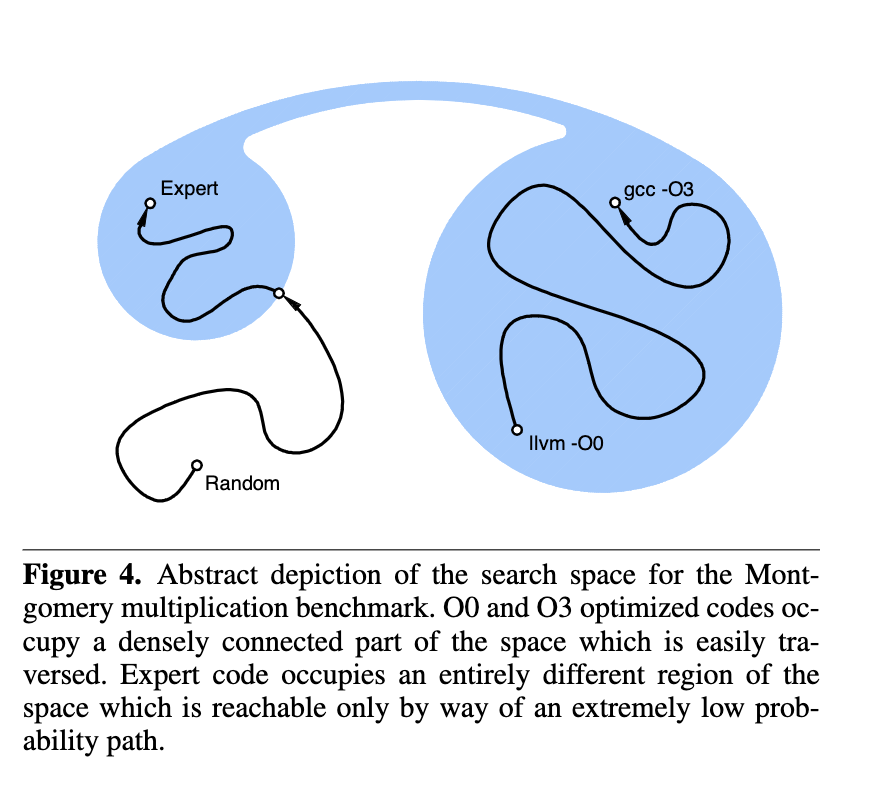
Superoptimization tries to find the best possible machine-code for a given function by searching. A lot.
But what if you just…randomly changed the assembly of a program. Sure, 99+% would be incorrect, but there’s a chance you find something interesting!
This was the idea behind STOKE, some Stanford research that, on occasion, would beat out human-written x86 assembly!
For a little snippet of OpenSSL’s big-number library, STOKE found an 11 instruction solution.
LLVM -O0 was 116 instructions. Even GCC -O3 was 27 instructions.
The tradeoff of course is, insane computational cost. They gave 40 dual core Opteron a budget of 30 minutes of search for each small function. The OpenSSL optimization took about 17 minutes, resulting in a ~1.6x speedup over GCC.
Not a bad optimization, but compilation was about uhh…10,000x slower. I do think it’s (at least theoretically) interesting for hot-path optimization, where you might be willing to spend the compilation budget to save a few nanoseconds.
I like to imagine a very unusual (but possible!) processor. Custom hardware that does a randomized search for machine-code optimizations with extremely quick formal verification.
A chip solely designed to make the software on…other chips faster!
Introducing DeepRSI, a new industry standard for measuring recursive self-improvement.
On preexisting benchmarks, tasks are contributor-based and short-horizon (~12 hrs). In DeepRSI, we push agents to work 48 hours on ML tasks actually derived from ongoing proprietary research.
@EricBeltt Hm, I'm not sure if human <-> human modelling is analogous to agent <-> agent modelling provided the agents are capable of representing each other from scratch
For me, this question illustrates the scale and structural weirdness of what superintelligence may be, more than it does a tractable game-theoretic puzzle. Though the latter certainty informs the former