I mean there'd be a lot more than one byte, obe byte is just the number of participants. Somewhere you've got e.g. a 256-bit bitmap on every message storing which participants it's been delivered to or not, that sort of thing.
I also wouldn't be surprised if restrictions on the number of participants are downstream of the cryptography, being end to end encrypted on a per-participant basis presumably has some restrictions. IIUC it's many-to-many, so there could be a 256x256 data structure somewhere for every pair of participants (maybe not, but as a plausible example)
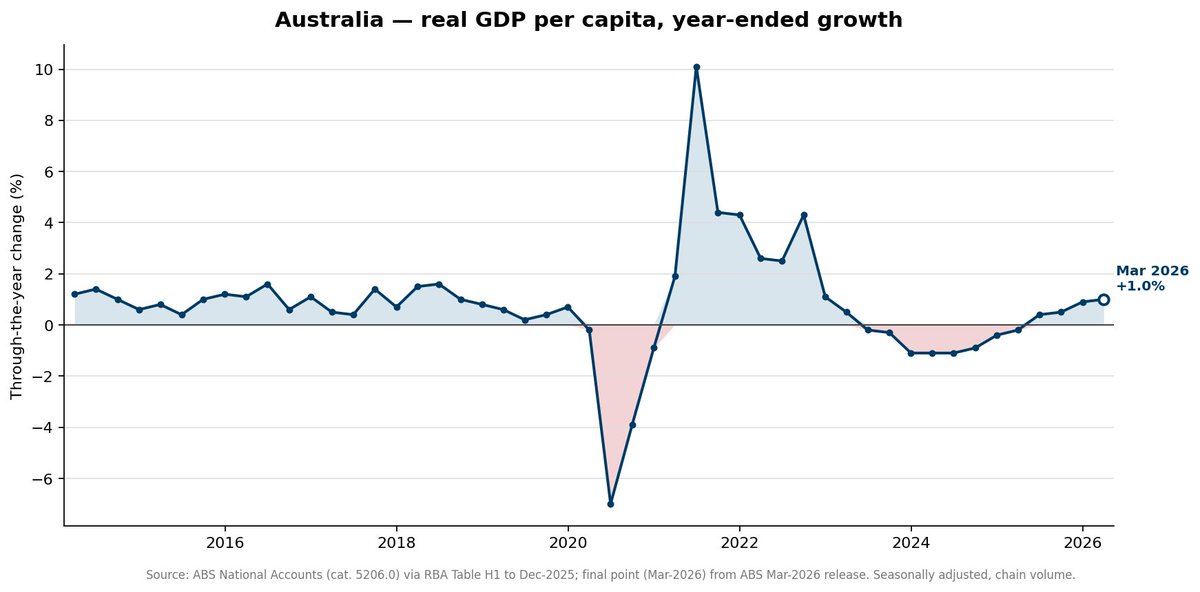
@PeteWargent@Larryjamieson_ True, though this plot makes it look like we have returned to the pre-covid trend after a period of running the economy above capacity. If so, remaining at the higher level was never an option and returning to the previous trend is the best that can be hoped for. Not bad!
@AvidCommentator -0.1% change in real GDP per capita.
This is a noisy number and the previous quarterly values were +0.6%, 0%, +0.5%, -0.1%, current annual value is +1.0%.
That's better than I thought!
We did spent some time in a per-capita recession, but seems to be over. Excellent news!
@PEWilliams_ This whole conversation is people being asked to imagine a hypothetical where going to the store is fast, and rejecting it because in their experience, going to the store is slow
Breakfast question situation
@micsolana On the other hand I've heard that humans are especially prone to cancer, that some tradeoff was made that gave us ridiculously good immune systems, at the expense of higher cancer rates. So maybe whales are closer to baseline cancer susceptibility and don't need explanation
People say evolution isn't this linear march towards greatness, but I think the conclusion that evolution is totally undirected is kind of false, such that it shouldn't be too surprising if various extremes were in the present
I sometimes play this web game called metazooa, a wordle-style game where you have to guess the species of the day based on phylogeny.
The way it works makes it a good strategy to pick the "most evolved" kind of animal as your first guess ("human" or any other placental mammal is a good first guess) and as you get better at the game, it becomes very obvious that "more evolved" and "less evolved" is like, a meaningful dimension. And humans are near one extreme!
Of course humans made the taxonomy, it could just be biased. But I think it's not, I think evolution building on the past has actually ratcheted up to higher complexity and is able to create more extreme organisms now, given selective pressure.
For whales specifically, if we scaled humans up to whale size, everyone would die young from cancer, because in humans the probability of cancer scales quite closely with the number of cells in your body.
I don't think it's known why whales don't get cancer as often as human per-cell cancer rates would imply, but perhaps it suggests some innovation in anti-cancer mechanisms, maybe these took a long time to evolve and precluded such large organisms in previous eras.
Literally the picture in my mind for when the AI companies IPO. You think AI is going to continue to pop off, these are your counterparties - do you buy?
Why does one of them usually need to find a new job? Can't say I've noticed this, but generally the relationships that turned serious didn't end up with marriage or babies until people had moved to new jobs anyway - but this always seemed to me like just the normal job churn in early careers.
Are employers not a fan of couples working together? My employer just hired a married couple, are we doomed?
I could imagine a world where Georgism went a slightly different direction and advocated taxing the gains on land instead of the rent. I think this might even be equivalent (in the long run, on expectation), since land value is just the capitalised form of rent.
So it seems like there's a sense in which a rent consumption tax vs an unrealised gains tax is maybe a bit of a blurry distinction.
Taxing rents probably the better policy if you're a government, though, since it's less variable with market swings. On the other hand, increasing tax take during booms and decreasing during declines would be an automatic stabiliser. Hm.
@maiab In my experience the answer is either that the app is very simple, or that the human is keeping the agent on a tight leash, vetting changes, making judgement calls over architecture, etc.
So far, that is. I'm sure agents will continue to improve rapidly.
Flathub has updated their policy to explicitly ban the usage of AI / LLM in the development of any software.
“Applications containing AI-generated or AI-assisted code, documentation, or other content are not allowed.”
Flathub is a Flatpak powered “App Store for Linux”, popular among GNOME users.
There's an adverse selection element. In a world where normal men ask women out, the man who asks you out is probably normal. In a world where asking out is a norm violation, the man who asks you out is a norm violator. Who knows what other rules he will break.
A large mass ratio is the least of one's problems, I suspect. A Saturn V's launch mass was 500× that of the command module, so mass approaching ~1000× are already within the realms of what we've done before.
The mass ratio itself isn't a problem, it's whether you can make that much antimatter. If a ten-tonne dry mass sounds too small, then take a 100-tonne dry mass and 100,000 tonnes of fuel. This has the energy content of ~50ms of total solar output.
Is that practical? I don't know, we currently neither have a Dyson sphere nor an efficient way to make antimatter, so we have no real basis to say how many thousands of tonnes of antimatter a future civilisation can make. Only that the energy itself is there in principle.
I think it matters to them, but we're talking mostly about the wealth effect, they'll feel poorer and this can have implications for aggregate demand in the economy, not to mention that they might resent the government that caused it so there are political ramifications there.
In the scheme of things though unless the wealth effect is strong enough to cause a recession, this is a problem mostly in their heads. Buying assets for their growth potential involves risk and it's not like this will bankrupt anyone - and nominal house prices will very likely increase in the long run still. They'll be fine. Not to mention that they'll benefit from being in a society where others can afford housing more easily - that's a better society to live in!
(I say this as a recent first home buyer, with the value of my home likely being flat or down since I bought. I'm fine! And very happy to have a house!)
@GarrettPetersen Age gaps to the rescue! The income preference can be satisfied even in the presence of a zero gender pay gap if women marry men further advanced in their career.
I conceive of "social surface area that can lead to marriages" as a public good that we have mismanaged. If two people meet at a coffee shop and get married, the couple benefits enormously, the community benefits somewhat, and the coffee shop just gets $10 for 2 lattes.