The “Pranayama Effect” is mindblowing.
When experienced breathworkers slow their nasal breathing to just 2.5 breaths per minute, they enter non-ordinary states of consciousness
with measurable increases in theta-high beta brain connectivity.
Theta waves (4–8 Hz) are the brain’s “twilight” state, that dreamy, relaxed zone between wakefulness and deep sleep.
They’re most prominent during light meditation, hypnosis, creative flow, and early stages of sleep.
Mouth breathing at the exact same slow rate? Doesn’t happen.
It’s not just the slowness. It’s the nasal pathway lighting up the brain.
Ancient yogis figured this out centuries ago. Modern neuroscience is finally catching up.
Ever tried slow nasal breathing? What did you notice?"
Source:
Zaccaro et al. (2022), Front Syst Neurosci. doi:10.3389/fnsys.2022.803904
#Pranayama
#Breathwork
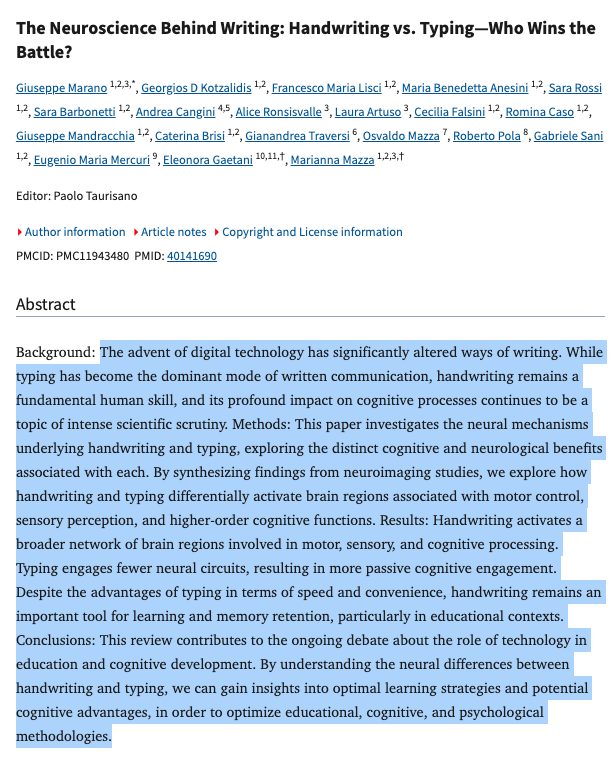
Your brain physically rewrites itself every time you pick up a pen.
Neuroscientists at Norwegian University scanned students' brains while they handwrote letters versus typing the same letters on a keyboard.
The results shattered decades of assumptions about how we process information.
Handwriting activated massive networks in the sensorimotor cortex, the visual processing centers, and the hippocampus simultaneously. Complex neural symphonies lit up across multiple brain regions, creating rich interconnected pathways between motor control, visual recognition, and memory formation.
Typing the same letters? The brain activity looked like someone had dimmed the lights across entire cognitive districts. The neural networks that flourished during handwriting simply went dark.
The difference?
When you form letters by hand, your brain constructs elaborate spatial maps of each character. The motor cortex learns the precise pressure, angle, and trajectory needed to create an 'A' versus a 'B.' Your visual system tracks the ink flowing from pen to paper in real time. Your parietal lobe integrates hand position with eye movement. Your hippocampus encodes not just what you wrote, but how the writing felt, where you paused, which words required more pressure.
Typing activates almost none of that circuitry. You press a key, a letter appears. The motor movement is binary. The visual feedback is uniform. The spatial relationship between thought and symbol gets mediated by a machine that standardizes every character into identical fonts and spacing.
Your brain treats these as fundamentally different cognitive tasks.
The evolutionary context makes this obvious once you see it. Human hands developed for manipulation, creation, and fine motor control over millions of years. We painted on cave walls, carved bone tools, and shaped clay vessels long before we invented written language. When writing emerged 5,000 years ago, it built on top of existing neural infrastructure that already connected hand movement with symbolic thinking.
Keyboards appeared 150 years ago. Touchscreen typing maybe 20 years ago. From an evolutionary timeline perspective, we started using them approximately yesterday. Our brains are still running ancient software that expects physical engagement with symbols.
That software produces dramatically different learning outcomes.
Students who take handwritten notes consistently outperform students who type the same information on memory tests, comprehension assessments, and creative applications of the material. The difference persists even when researchers account for typing speed, note length, and time spent studying.
The act of forming letters by hand forces deeper processing at the moment of information encounter. You cannot handwrite as fast as someone speaks, so your brain must actively filter, summarize, and prioritize information in real time. The motor effort required to form each word creates additional memory traces that typing does not generate.
Children who learn to write letters by hand develop reading skills faster than children who learn letters primarily through typing or screen interaction. The sensorimotor experience of creating letterforms helps their brains recognize those same letterforms when they encounter them in text.
Adults who handwrite shopping lists, daily schedules, or meeting notes remember the information better than adults who type identical lists into phones or computers. The spatial memory of where you wrote something on a page provides retrieval cues that digital text does not offer.
These findings collide directly with how education and work environments have evolved over the past two decades. Schools replaced handwriting instruction with typing classes. Offices converted from paper systems to fully digital workflows. Students take notes on laptops. Professionals draft documents on screens.
We optimized for speed and efficiency while accidentally severing the neural pathways that evolution spent millions of years developing.
The implications reach beyond memory and learning into fundamental questions about human cognition. If the physical act of forming symbols changes how your brain processes ideas, what happens to thinking itself when you remove the physical component?
Digital text is infinitely searchable, instantly editable, and perfectly shareable. But it may be creating brains that process information more superficially, store memories less durably, and connect ideas more weakly than brains that regularly engage in handwriting.
The neuroscience suggests we traded cognitive depth for technological convenience without realizing what we were giving up.
Some of the most innovative thinkers across history were obsessive handwriters. Darwin kept detailed handwritten journals. Einstein worked through complex theories in handwritten notebooks. Virginia Woolf wrote her novels by hand before transcribing them. Steve Jobs famously took handwritten notes during Apple meetings even as he was building the most advanced computers on Earth.
Perhaps they intuited something about the relationship between hand, brain, and insight that we measured in brain scanners but somehow forgot in practice.
Your pen is literally a cognitive enhancement device that activates neural networks digital keyboards cannot reach.
BREAKING: A major study has found that 92 of 172 diseases including dementia and type 2 diabetes were 20% traceable to poor sleep.
Start taking your sleep seriously.
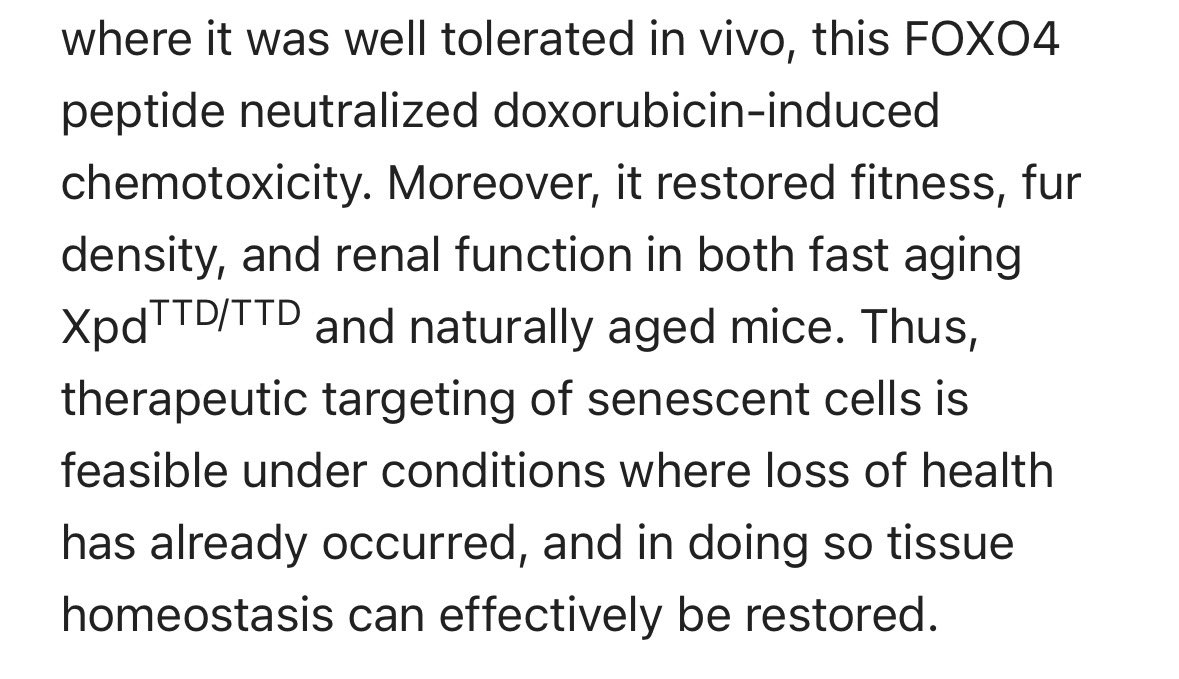
Aged mice received ONE peptide — FOXO4-DRI — for 3 weeks.
Fur grew back. Kidneys healed. Fitness returned.
The aging REVERSED.
(PMID: 28340339 — published in Cell)
Right now there are MILLIONS of dead cells rotting inside your body.
They can’t divide. They can’t repair. They REFUSE to die.
They just sit there POISONING every tissue around them.
Scientists call them zombie cells. The single biggest driver of aging ever discovered.
→ joints rotting with inflammation
→ skin collapsing as collagen disappears
→ wounds taking weeks instead of days
→ testosterone crashing year after year
→ energy vanishing no matter what you try
Your doctor calls this “getting older.” It’s not.
FOXO4-DRI is a synthetic peptide your body can’t break down. It does ONE thing.
Zombie cells survive by TRAPPING p53 — your body’s kill switch. FOXO4-DRI frees it. The zombie cell self-destructs.
Healthy cells don’t use this trick. Untouched.
Every day you wait, more zombie cells accumulate. More tissue dies.
Your body has a self-destruct button for broken cells.
Age jammed it. FOXO4-DRI unjams it.
The studies are below.
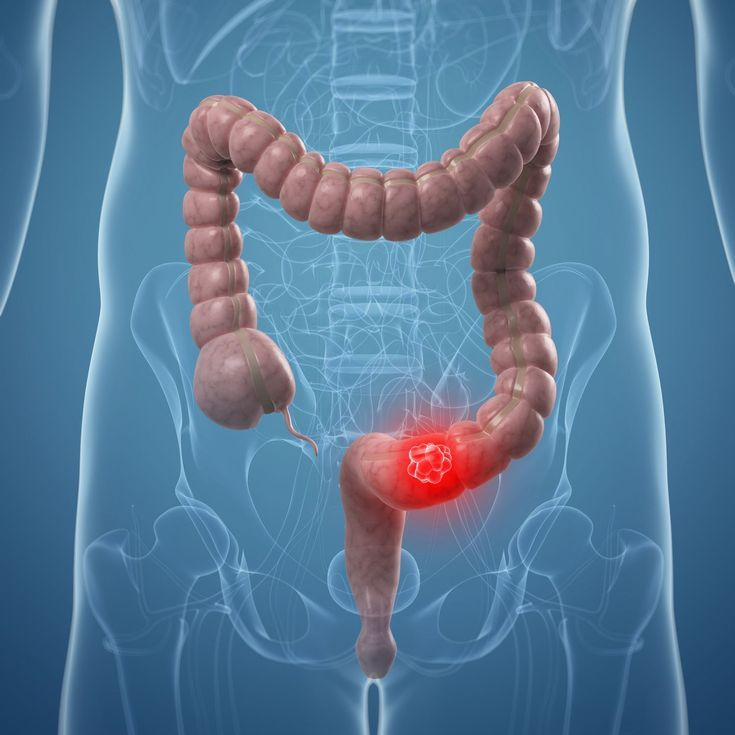
🚨 BREAKING
Scientists just cracked one of cancer's hardest problems.
A new therapy called KIR-CAR just showed — for the first time in humans — that it can fight solid tumors that NO approved CAR-T therapy has ever beaten.
Zero serious side effects.
Tumors shrinking.
Here's what happened 🧵
One of the easiest ways to activate your vagus nerve to reduce symptoms of anxiety, insecurity and always worrying about what others think of your skin is to EXPAND YOUR VISION
Tunnel vision = threat mode.
Peripheral vision = safety.
Try this for 30 seconds:
• Soften your eyes
• Let your vision spread wide
• Keep your breath slow and steady
Mobile phones and computers have you locked in central vision but by doing this you will feel calmer and more confident as a result