Three times when China paused a new technology it was racing to build:
1) High-speed rail projects after 2011 Wenzhou crash
2) Nuclear plant approvals after Fukushima
3) Robotaxi licenses after Baidu Apollo Go robotaxi freeze in Wuhan this April
In these cases, China wasn’t racing with the US like with AI.
But it’s still interesting to consider these cases where a major incident caused China to unilaterally decide to pause temporarily.
And one incident—Fukushima—didn’t even take place in China.
The big story is not Chinese EVs everywhere—but Chinese EV factories everywhere.
This will help Chinese EV makers jump over rising trade barriers. But they will need to share the pie and play by other countries’ rules.
The College is very sad to learn of the death of Sir Anthony Kenny, Emeritus Fellow of St John’s and formerly Warden of Rhodes House and Master of Balliol College, on 3 August 2026 at the age of 95.
https://t.co/D04KzXpggF
A move by Beijing to tax offshore trusts could pose a risk to stocks, namely Hong Kong equities.
Our expert @dpcchiu expects “one-off, episodic selling pressure rather than a sustained market crash.”
https://t.co/pn0W6X4cuW
Spain’s biggest Chinese industrial investment will rely on workers brought in from China during construction, according to a Spanish government report that lays out Madrid’s auto industry blueprint
CATL & Stellantis JV will rely on “expatriate workers” until Q4 of 2028
This is also why China is, and will remain for the foreseeable future, the most reliably globalist major power in the world: it needs access to foreign consumption, especially from wealthy economies. There’s frankly a somewhat higher chance that the U.S. becomes industrially self-sufficient than China becomes self-sufficient in terms of consumption. Neither is at all likely, but the former at least isn’t fighting essentially irreversible demographic trends.
Very interesting piece by Tsinghua University's Feng Kaidong in which he argues that the state's role in fostering technology is to use large projects and industrial policy to connect firms, universities, suppliers, and research institutes, creating the networks through which innovation occurs. Once these networks are established, government intervention should gradually recede and allow market competition to take over.
https://t.co/DpeZ6Uz2cd
As I see it, the real problem for Germany is that if the Mittelstand is destroyed, such a dense and complex network will be almost impossible to rebuild.
https://t.co/Hw1mPelY9t
PRC banks and insurers have been told to stop adopting AI for its own sake. On 18 June, the banking and insurance regulator, NFRA (National Financial Regulatory Administration), issued guidance with 32 measures, urging firms to weigh costs against benefits and suppress the urge to invest in AI to look ‘modern’.
Responsibility is one of NFRA’s concerns. Under the principle of ‘whoever uses it is responsible’, the institution that deploys a model owns the risk, even where another firm built it. High-risk uses must keep a person able to oversee and step in.
The other concern is self-reliance, and it targets hardware more than software. PRC banks already run on home-grown models. State lenders such as ICBC and Postal Savings Bank moved onto DeepSeek through 2025, and US models from OpenAI and its peers are mostly blocked inside China in any case. The dependency Beijing wants to break sits beneath the models, in the chips and computing power that still lean on Nvidia and the wider US-built stack. That is where ‘autonomy and controllability’ bites. The guidance reads as an instruction to get bank AI off American silicon.
Larger institutions are also encouraged to share computing power with smaller firms, a sign the regulator wants AI adopted across the sector without small lenders leaning on commercial cloud vendors.
The guidance carries the usual scaffolding, from Xi Jinping Thought to the State Council’s ‘AI+’ action and the call to serve the real economy. Yet the tone runs more to caution than promotion. A regulator does not warn against ‘new for the sake of new’ unless banks are already buying AI they do not need, and it does not demand human oversight unless it doubts what the models produce.
source: https://t.co/WVTXwOV58q
read more like this—link in bio
Why did private firms, not state-owned enterprises (SOEs), come to dominate China’s EV sector?
My new @ChinaJournal article (co-authored with Xiao Ma @maxiaoalex) challenge the "top-down industrial policy" narrative.
The real engine? Strategic alliances between local governments and private capital. 🧵
Based on 3+ years of fieldwork, 60+ interviews (with officials, entrepreneurs, and engineers), and rich first-hand accounts, we show how strict central regulations inadvertently drove local states to bet big on private EV players.
Here is the story: (1/15)
Reminder, designations of Chinese firms as "military companies" are:
a) minimal impact. No export controls or investment restrictions/sanctions
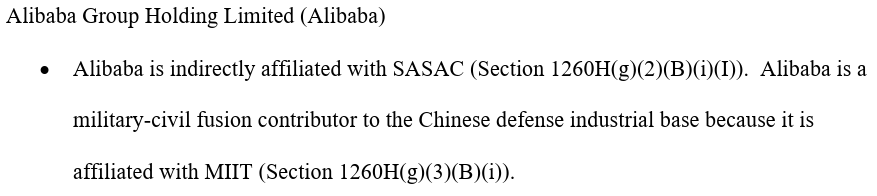
b) near zero signal on security risk/mil links. If they have evidence on real military links for Alibaba, it isn't in here.
The Pentagon has a poor record (at best) for rigor when listing Chinese firms. For example, the investment restriction list was moved to Treasury after a US judge found some of its listings "arbitrary and capricious", based on IMHO laughably weak evidence.
Many of the most publicized listings in this batch are no different. Alibaba is listed b/c of "indirect" links with SASAC (which manages state assets yes including sensitive sectors but also salt, forestry, and tourism), and MIIT, China's main technology regulator. The latter is akin to saying a US firm is a military company because it's regulated by the FCC/Commerce Dep't or got Chips Act grants. Similar weak justifications for Baidu, China Mobile, China Telecom, and more.
https://t.co/O3E1vH02GA
Notably, the regulation also outlines countermeasures targeting unfair foreign business practices. Should foreign entities or individuals undermine China’s sovereignty and development interests, arbitrarily cut business ties with Chinese firms or impose discriminatory restrictions on Chinese outbound investors, relevant central authorities may impose restrictive measures. These include curbing their China-related import and export and investment activities, barring Chinese parties from striking deals with them, and limiting entry, work and residence rights of their relevant staff.
"If you exclude semiconductors and AI servers, Taiwanese exports have actually fallen by 40% since 2022. In South Korea, non-AI exports have stagnated and Japan’s industry is in decline." 1/5
https://t.co/v7R4m3lKKL
Chinese investors are rushing to find alternative ways to buy and sell overseas equities after Beijing launched its most forceful crackdown on illicit cross-border stock trading to stem capital outflows. Read more: https://t.co/RWw8achlnt
📷️: Qilai Shen/Bloomberg
From Coherent and Nvidia to Visa and Micron, I run through the litany of commercial issues the CEOs that attended the China summit were hoping to resolve with Beijing -- and some of the drama surrounding the CEO delegation -- in this new piece today
https://t.co/N2370u3HRe
New: The AI exec. order was postponed because David Sacks called Trump this morning and argued that having the federal government review models before their public release would slow down innovation and harm the U.S. in its AI race with China.
David Sacks was read in on the EO this week and senior White House officials believed he was good with it.
“Then, he called POTUS this morning unbeknownst to anybody, his own staff included, and derailed it,” a senior White House official told me.
w/ @cheyennehaslett@jacob_wendler
https://t.co/0GLIe4M4uj