Today is the day for advancing positive change in Dallas: City Plan Commission should vote on whether to advance parking reform (including full elimination of minimums) to City Council.
It's been 5 years since we first discussed at committee. Let's see it through!
Great urbanism is about proportions, not specific architectural styles
There is a correlation between walkability & traditional architecture, but that's simply because that was the default pattern before the car
You can have great urbanism with contemporary architecture, too!
@jmassengale@theurbaneist@mattyglesias @the I think there's another tier of cities, including all the big Midwestern and Southern ones, where the pressure-release valve for affordability has so far been greenfield sprawl, and urban zoning reform is necessary for healthy central-city growth w/o pricing huge populations out.
@jmassengale@theurbaneist@mattyglesias @the Places where extreme demand for well-located housing (not way out in suburbia) has driven the price of land skyward precisely because the vast majority of lots are *not* legally developable to that missing-middle / mid-rise walkup density you talk about.
A lot of discourse problems would be ameliorated by everyone working as some sort of practitioner, preferably at least some of the time in the public sector, in a field relevant to that which they would like to discourse about
@jb_reefer I remember the first time I heard about an apartment building having a golf simulator... I asked the speaker to repeat herself in case I'd misheard.
But what you're saying about awkward spaces actually makes some sense. Find a way to turn it into a selling point.
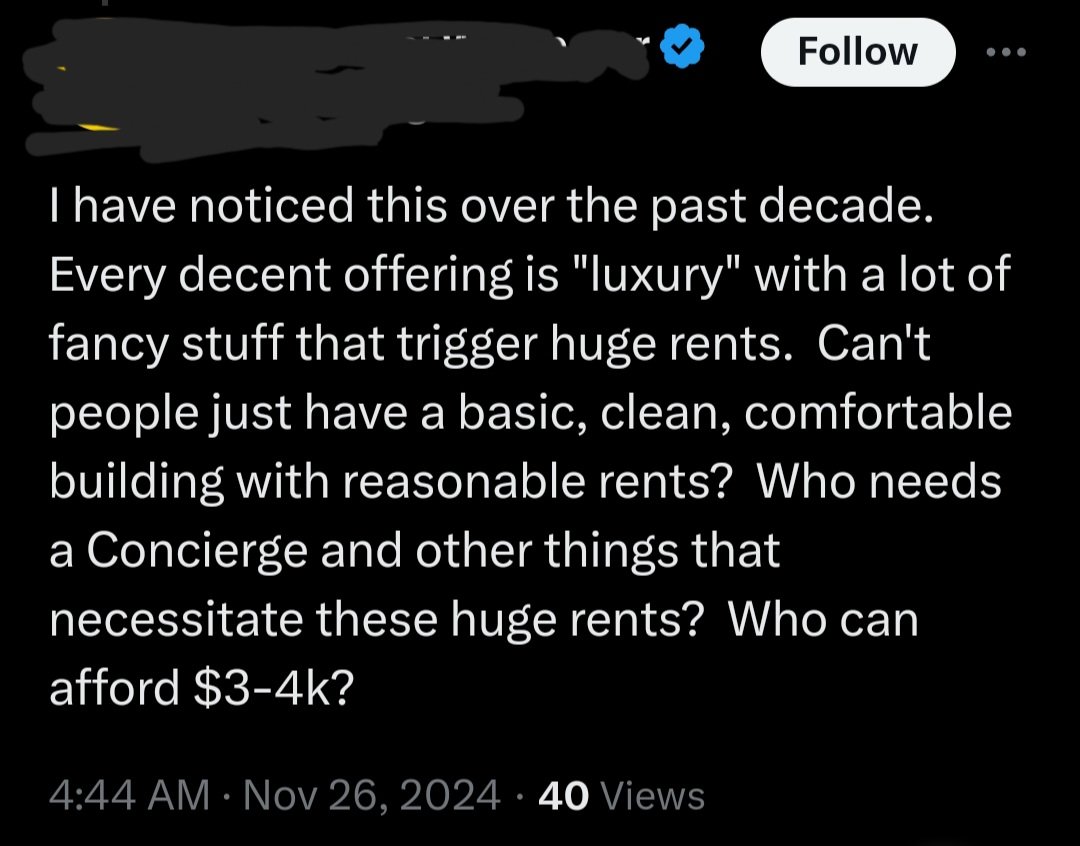
It's a common belief that high-end amenities are driving up the price of new apartments.
The reality is high rents are driven much more by fundamentals: a low number or available rental units and high construction costs.
There's an interesting nuance, though.
Debate time! New episode out with Chuck Marohn from @StrongTowns and Nolan Gray with @cayimby. I found them disagreeing here on X—which surprised me as I assumed they’d be on the same side—so I asked them on the podcast to hash out their ideas.
It’s a great (and friendly) episode. Though for better or worse, I started out by reading their disagreement on X out loud, which is probably a painful experience to hear your own words in a heated moment repeated back. Nolan said it felt like he just went through a deposition. Having just been through a real life deposition myself the week before, I felt kind of bad. Sorry guys :) but to be fair, it does set the stage for a good convo! And a friendly one at that.
Each of these guys have made significant contributions to the built environment via real policy changes and shifting culture and conversation.
Thanks for coming on @clmarohn and @mnolangray
Check out their latest books Arbitrary Lines and Escaping the Housing Trap.
Trailer below:
If the only thing you can build profitably is a building whose rents are only affordable to the top 20%, then you will market that building to the lifestyle and expectations of the top 20%.
But that's downstream of the basic development cost problem.
If we had lower land, construction, and financing costs, it would become more viable to build new apartments targeting modest-income tenants.
And the marketing and amenities would also target those tenants.
The psychological distance from South FL to Atlanta is way more aligned with the actual distance if you make the drive in the winter, because there's a pronounced temperature drop.
In the summer the same trip just feels interminable for no reason.
@salimfurth Probably, all else equal. Obviously lots of other things factor into antisocial behavior, but I suspect at a micro level (one block to the next) it becomes pretty determinative. The inverse of the well-known observation that vacant properties are a magnet for drug/crime activity.
Front porches are pro-social but it's important to recognize how. It's not that they encourage you to befriend your neighbors—lots of suburbanites with big front-loading garages will do that anyway.
It's that they induce serendipitous, friendly interaction with *strangers*.
When I've lived in suburbia and driven for all my errands, I could go a week where every interaction I had was either with someone I knew, or a retail / business transaction.
Much harder to fall into that when you ride the bus and walk your neighborhood habitually.
And the reason it does that is because it generates spontaneous, pleasant, low-stakes interaction with *strangers*.
Not with people you've made an effort to befriend and who have made an effort to befriend you, which can happen among neighbors anywhere.