So many people keep asking me about Continue. What is it? What are you up to? Here you go...
Continue started as a research effort two years ago, with the belief that if the human body is a system, it should also have its leverage points. The simple levers that, when adjusted, could fundamentally alter how we age and live.
Along with a team of initially skeptical researchers, we've been investigating a penny-drop insight about human aging. Something that's been hiding in plain sight for eternity. But more on that in a few weeks. We are at the tail-end of the research on this hypothesis, which if true, could fundamentally change our understanding of biology and aging.
But today isn't about that. It's bigger than that.
Today, we are expanding Continue Research to include a $25 million fund (entirely personally backed) to support researchers across the world who dare to ask simpler questions than anyone else. Who believe biology might be far simpler than we've made it.
For over a decade, I have believed that most of the world’s problems stem from our short human lifespans. Continue Research’s goal is to extend healthy human function long enough that humans stop making short-term decisions.
Read more about Continue’s purpose at – https://t.co/2jbRl1CHvq
This will be a multi-decadal journey. Our goal here is to become a small catalyst in humanity's journey of conscious evolution. To lead us into the Post-Darwin era.
Researchers, please look us up and apply for funding/grants at – https://t.co/3bbtOyXEPf
———
PS: Continue is not a part of Eternal
The largest GWAS for Alzheimer's disease is now out
👉109,479 cases, 74,141 proxy cases, 2,131,799 controls, 499,708 proxy controls
👉improved SNP-based heritability: 5% in previous studies --> 19%
👉127 loci, 48 novel with enrichment in microglia & neurons
When do machine learning models actually outperform standard polygenic scores? 🤔
In our new preprint, we benchmark how non-additive genetic effects (i.e, dominance deviations) shape polygenic prediction across simulated and UK Biobank traits.
👉 https://t.co/FMbNEkIQpw
🧵 1/6
Proud that the third GWAS for Alzheimer's dementia from the PGC-ALZ working group was just posted online! Huge amounts of work, and what a great collaboration! Check out our exciting findings below 👇 @PGCgenetics#ctglab#alzheimer#dementia#GWAS
Our new preprint on "The genetic landscape of heterogeneity in human functional brain connectivity" is available on medRxiv. Check it out! @MJ_Schipper, Christiaan de Leeuw, @cato_romero, @khelwegen, @DPosthu, Jeanne Savage and Martijn van den Heuvel.
https://t.co/ZcuZNKcmpY
#ctglab is hiring! We have #vacancies! 2 PhD and 2 postdoc positions, in #statistical#genetics and/or #bioinformatics - if you like GWAS, method development and linking with biology - check these out 👇
https://t.co/0Cy3KF75lI
https://t.co/ENI5KeI6yF
https://t.co/qOLaauKNLV
#ctglab is hiring! We have #vacancies! 2 PhD and 2 postdoc positions, in #statistical#genetics and/or #bioinformatics - if you like GWAS, method development and linking with biology - check these out 👇
https://t.co/0Cy3KF75lI
https://t.co/ENI5KeI6yF
https://t.co/qOLaauKNLV
Many drug targets in ongoing Parkinson's disease clinical trials have strong genetic links. We prioritized PD GWAS genes that may represent our next-best candidates for developing disease-modifying therapeutics.
https://t.co/rmPCPgAYsi
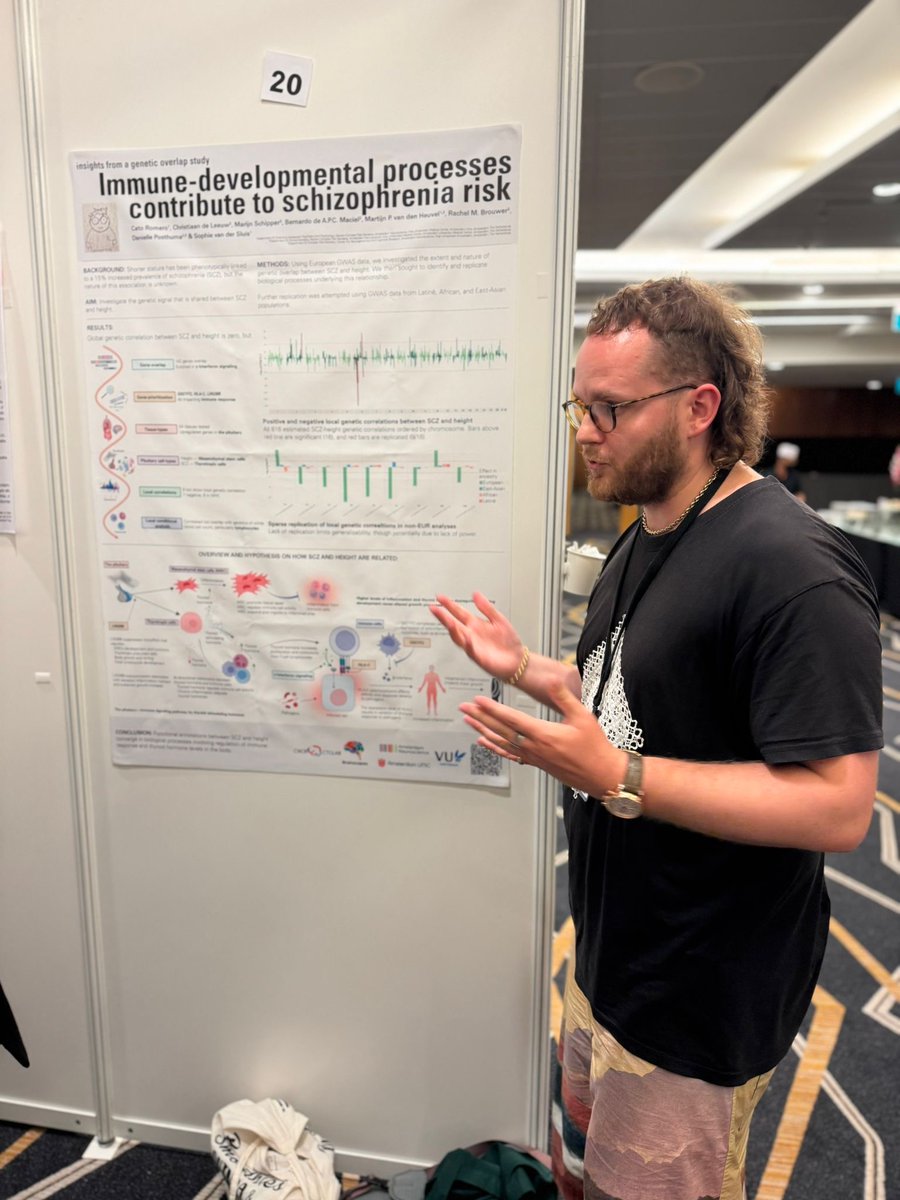
I'm so happy to share that our paper "Immune-developmental processes contribute to schizophrenia risk: insights from a genetic overlap study with height" has been published in Biological Psychiatry 🥳 https://t.co/dqGXiCntTB
Incredibly proud to see our latest work out in Nature Genetics: https://t.co/Sjyo9KOGBJ
Here we share our FLAMES framework, which predicts the effector genes in GWAS loci with state-of-the-art precision🔥
Special thanks to @DPosthu
Full thread describing findings below!
Just out from #ctglab by @MJ_Schipper - our new tool FLAMES 🔥🔥, to identify the most likely causal genes in GWAS loci, using machine learning techniques, thoroughly benchmarked and freely available
Paper: https://t.co/Zc5dHzkapC
Code: https://t.co/wp7R6s3OrP
New biotech launch (@TraceNeuro) targeting UNC13A in ALS with an ASO is another example of human genetics informing drug development🧬
UNC13A was among the first GWAS hits discovered for ALS https://t.co/ZQK1De658v
https://t.co/UzdeP2ycMH
Huge thanks to all the students @itumbgclub who organized and hosted a fantastic meeting - 17th international ITU Mulecular Biology and Genetics Student Congress. Well done! Hope to see some of you #ctglab@VUamsterdam!
Had an absolute blast at #wcpg2024 in Singapore ! ✨🥳 Thank you to everyone who came to check out my poster and for the nice discussions
And also the 🕺🎤🎵