I've coached over 30 Olympic gold medals.
I've worked with some of the greatest athletes in history.
Here are the lessons I wish more people understood:🧵
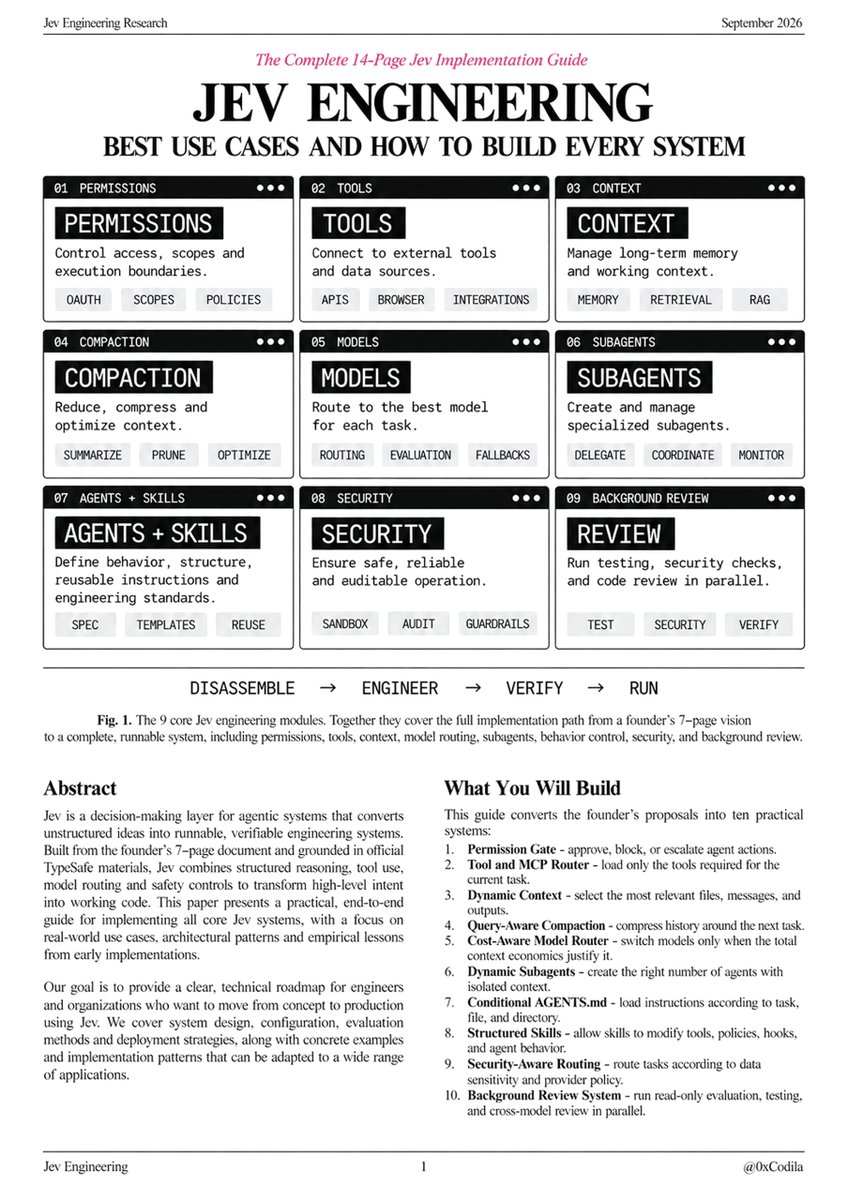
Jev Creator Diogo Almeida just released a 7-page document on how to use Jev better than ~95% of people
I built and tested the FULL list, wrote a 14-page PDF setup guide and ranked every use case from 0–10:
use case 1 → build a Permission Gate: Jev decides whether an agent action can run automatically, needs review or must be blocked before execution
9.5/10 - high safety value with relatively simple decision logic
use case 2 → route tools instead of loading everything: Jev selects the category, tool and MCP schema required for the current task
9/10 - reduces unnecessary tool exposure; its value grows with the number of tools
use case 3 → make context dynamic: Jev decides which files, messages and tool outputs should be included, summarized or excluded before every execution
10/10 - relevant to nearly every multi-file or long-running agent task
use case 4 → compact history around the next task: the same agent memory becomes a different summary for UI work, security review or testing
8/10 - most useful when histories become long or task intent changes
use case 5 → route models by total economics: Jev weighs difficulty, context, cache, latency and cost before deciding whether switching models is actually worth it
9/10 - high optimization potential, but dependent on reliable model metadata
use case 6 → spawn subagents only when needed: Jev chooses the specialists, isolates their context and decides how their results should be merged
8/10 - valuable for decomposable tasks, with meaningful coordination overhead
use case 7 → load AGENTS.md conditionally: give the coding agent only the rules required by the current task, file and directory
8.5/10 - low integration cost, impact grows with repository complexity
use case 8 → turn skills into structured modules: each skill can modify tools, permissions, hooks, context policy and agent behavior without rewriting the whole system
8/10 - high reuse potential, but requires maintenance and governance
use case 9 → route sensitive work safely: Jev classifies the data, selects an allowed provider or local executor and escalates high-risk actions to a human
9.5/10 - high risk-reduction value, effectiveness depends on policy quality
use case 10 → run review in the background: testing, security checks and code review execute in parallel while Jev decides which findings should block the result
9/10 - broad verification value, with additional compute and triage cost
overall score: 8.9/10
the result: Jev CEO showed you what to build - I tested the ideas, ranked what matters and turned everything into a Jev system better than what 95% of users are running
Copy my complete 14-page Jev engineering playbook - then read Jev CEO’s original 7-page vision below ↓
SpaceXAI just dropped a 12-page PDF on best GrokBot use cases - after reading you will use GrokBot better than 95% of people
What Grok Bot is, which use cases work today and how to deploy without burning trust in my 12-page research:
step 1 → every working use case follows one shape: read, check, apply rule, write draft. If your task fits this, the bot can handle it
step 2 → five criteria before handoff: repeatable, cross-system, rule-governed, draft-first, bounded error cost. Fails on any? Add a gate or wait
step 3 → start with sales. 36 LinkedIn drafts queued overnight. Zero sent without review. Highest density of agent-ready work
step 4 → engineering gets bug repro, CI/CD monitoring and dependency audits. Bot catches the ticket, hits staging, drops a repro pack
step 5 → operations runs inbox, expenses and travel. Bot signs into portals without APIs. Finance saves 8-12 hours at month-end
step 6 → marketing owns 13 of 56 roles. Paid media, content calendars, competitor watch. All overnight, all draft-first
step 7 → the approval boundary: every official use case stops before external action. Nothing sends, books or pays without you
step 8 → deploy in four weeks. Watch, review all, review flags, scheduled routine. Skip a week and risk compounds
step 9 → fleet pattern: Chief of Staff on top, specialists underneath, bots message each other. You stop being the middleman
step 10 → sort by cost of mistake. The bot nails 49 tasks then does something odd on the 50th with full confidence. Keep a human at every exit
the result: 56 roles, one playbook. The bot handles the 80% that repeats. You handle the 20% that matters.
this 12-page PDF learns you how to get best results from GrokBot
save now, then read how to build a 24/7 GrokBot agent team in the article below
Call Centers Will Go Bankrupt If People Start Building Their Own Voice AI Agents
The only thing you need to do to make thousands of dollars is:
1. Partner with salons, clinics, and other service-based businesses
2. Deploy a custom AI agent to handle FAQs and appointment bookings
3. Price it at $1000/m roughly one-third (or less) of what a human receptionist actually costs a business
This article is a complete playbook to do exactly that
Apollo charges $100 for 4,000 LinkedIn enrichments
Serper.(dev) charges $100 for 50,000-70,000 searches
same job. 92-94% cheaper. 89% hit rate on executive profiles.
everyone building outbound in 2026 is dramatically
overpaying because they never questioned the defaults
actual stack. pricing included.
FINDING PEOPLE
→ Apollo — $79/mo. use it for the database and
contact filters. do NOT use it for LinkedIn URL matching.
that's where the credits disappear
→ Serper — use this for LinkedIn URL matching instead.
$100 = 50-70K searches. Apollo as fallback for the 11%
that don't match
→ theorg — completely free org charts with API.
shows reporting lines, promotions, departures. LinkedIn
shows none of this. almost nobody has it in their stack
ENRICHING
→ Enrichly — $59/mo for 5,000 person enrichments.
primary fallback when Apollo misses.
→ waterfall: Apollo → Enrichly → Anymail Finder → Findymail
→ manual. never one source.
SIGNALS (mostly free)
→ Google News RSS — free. unlimited. real-time.
go to Google News, search your query, add /rss to the URL.
that's a live signal feed. replaced a $490/month
monitoring tool
→ f5bot — free. email alerts when your keywords
appear on Reddit. people write paragraphs about their
problems on Reddit they'd never say to a salesperson
→ visualping — monitors any webpage for changes.
hourly checks. set up 200 competitor pages and forget it
RUNNING OUTREACH
→ HeyReach — $79/account/mo. cloud-based LinkedIn automation.
dedicated IPs. 5-10% ban risk vs 23% for browser extensions.
runs 24/7 without your laptop open
→ never send cold email from your main domain.
one spam complaint tanks domain reputation entirely —
website deliverability, brand, everything.
deliveron: $49/mo, 100 Microsoft inboxes,
warmup, rotation included
full stack: under $500/month
the gap isn't tools. it never was.
I had one of the legends of angel and seed investing on Uncapped, @RonConway. He's the founder of SV Angel been an early backer of companies like Google, Facebook, Airbnb, and many more.
We talked about the evolution of tech, being an actively involved investor, the power of being a relationship broker, fighting hard for founders, and some of his stronger feeling in politics.
It was a pleasure to sit down with him. (Also fun to record a podcast episode at a live event, thank you TrueBridge)
(0:00) Intro
(1:50) From semiconductors to AI
(8:39) Two investments that changed everything
(11:46) Non-passive angel investing
(14:57) Becoming a relationship broker
(18:00) Building authentic relationships
(24:48) Going deep with OpenAI and Airbnb
(29:19) Fighting for founders
(31:39) Remarkable returns at seed
(33:20) The state wealth tax
(37:17) Tech and politics
@CollinRugg Shows how a single video doesnt always tell the real story. Without his helmet cam the world decided he was the aggressor in another state/county etc he’s be in jail. Likely terminated from jobs etc
@signulll@WestsideLAGuy Should probably focus on retiree / fake retired(wfh) crowd. This would be perfect for people really looking for the social element as opposed to prescribing it as better for everyone.
Randal Olson's 2015 "perfect" U.S. road trip optimizes visits to 50 top landmarks—one per contiguous state plus extras in California and D.C. using a genetic algorithm that evolves random routes via selection, crossover, and mutation to slash backtracking.
The full sequence kicks off at Grand Canyon (AZ), loops through Bryce Canyon (UT), Craters of the Moon (ID), Yellowstone (WY), and Pikes Peak (CO), then veers south to Carlsbad Caverns (NM), Alamo (TX), and beyond, ending near Hoover Dam (NV).
This flexible loop lets you jump in anywhere, dodging long hauls liike Nebraska's cornfields, with an extra Cleveland stop to skirt Canada borders. A city-focused variant hits TripAdvisor's top spots (e.g., skipping ND, VT, WV), trimming to 12,290 miles.
This 𝗖𝗟𝗔𝗨𝗗𝗘.𝗺𝗱 file will make you 10x engineer 👇
It combines all the best practices shared by Claude Code creator:
Boris Cherny (creator of Claude Code at Anthropic) shared on X internal best practices and workflows he and his team actually use with Claude Code daily. Someone turned those threads into a structured 𝗖𝗟𝗔𝗨𝗗𝗘.𝗺𝗱 you can drop into any project.
It includes:
• Workflow orchestration
• Subagent strategy
• Self-improvement loop
• Verification before done
• Autonomous bug fixing
• Core principles
This is a compounding system. Every correction you make gets captured as a rule. Over time, Claude's mistake rate drops because it learns from your feedback.
If you build with AI daily, this will save you a lot of time.
For me it’s clear. The govt in private partnership with corporations needs to be focusing their efforts on preparing for mass unemployment and re-deployment. Investments today can help us navigate later. End of the day, it falls on all of us to figure out together.