I hear this argument all the time that people in academia are not there "for the money" and therefore, so the implication, you can trust them.
It's true in the sense that academics didn't chose their profession to become rich-rich. But it's untrue in the sense that they want to keep their job because most of them haven't learned anything else.
They have very strong economic incentives to want to keep their job, even though it won't make them super rich, they probably have a cozy position. And that is why they exaggerate the relevance of their work and ignore shortcomings, because the show has to go on, they need the next grant, the next job, they need to publish the next paper.
No, you cannot trust them to be honest about the relevance of their work, and for the most part you can't trust them to be honest about their colleagues work either, because their income depends on what their colleagues think about them.
🤩 A huge success for Basia @dokkaebigirl!
🧐 Basia’s paper, “Reinventing the Corey–Fuchs Reaction under Ball Milling Conditions: A Mechanochemical Pathway to Bromoalkynes”, has just been published in ACS Omega @ACSPublications!
📲 LINK: https://t.co/7NIFzBqAIv
🧪 We have brought the classic Corey–Fuchs reaction—a well-known two-step name reaction used to convert aldehydes into alkyne derivatives—into the world of mechanochemistry! The developed protocol is carried out entirely without solvents and consists of two independent ball-milling steps:
1️⃣ the synthesis of 1,1-dibromoalkenes using only half the conventional amount of triphenylphosphine,
2️⃣ dehydrohalogenation, which—contrary to expectations—leads to 1-bromoalkynes rather than terminal alkynes.
😌 We were unable to develop a one-pot protocol, as the nature of the reaction and the by-products formed during the process essentially rule out such an approach. Another challenge was presented by aldehydes containing acidic protons (e.g. phenolic –OH or carboxylic acid –COOH groups), which caused the decomposition of the in situ generated dibromomethylenetriphenylphosphorane (Ph₃P=CBr₂).
🙂↕️ On the other hand, we significantly reduced the reaction time and achieved a clear improvement in green chemistry metrics, including the Process Mass Intensity (PMI) and E-factor. Our results demonstrate that both the electronic properties of the substrates and the milling parameters play key roles in determining the efficiency and selectivity of the process, further expanding the potential of mechanochemistry as a more sustainable approach to organic synthesis.
#mechanochemistry #namereactions #coreyfuchsreaction
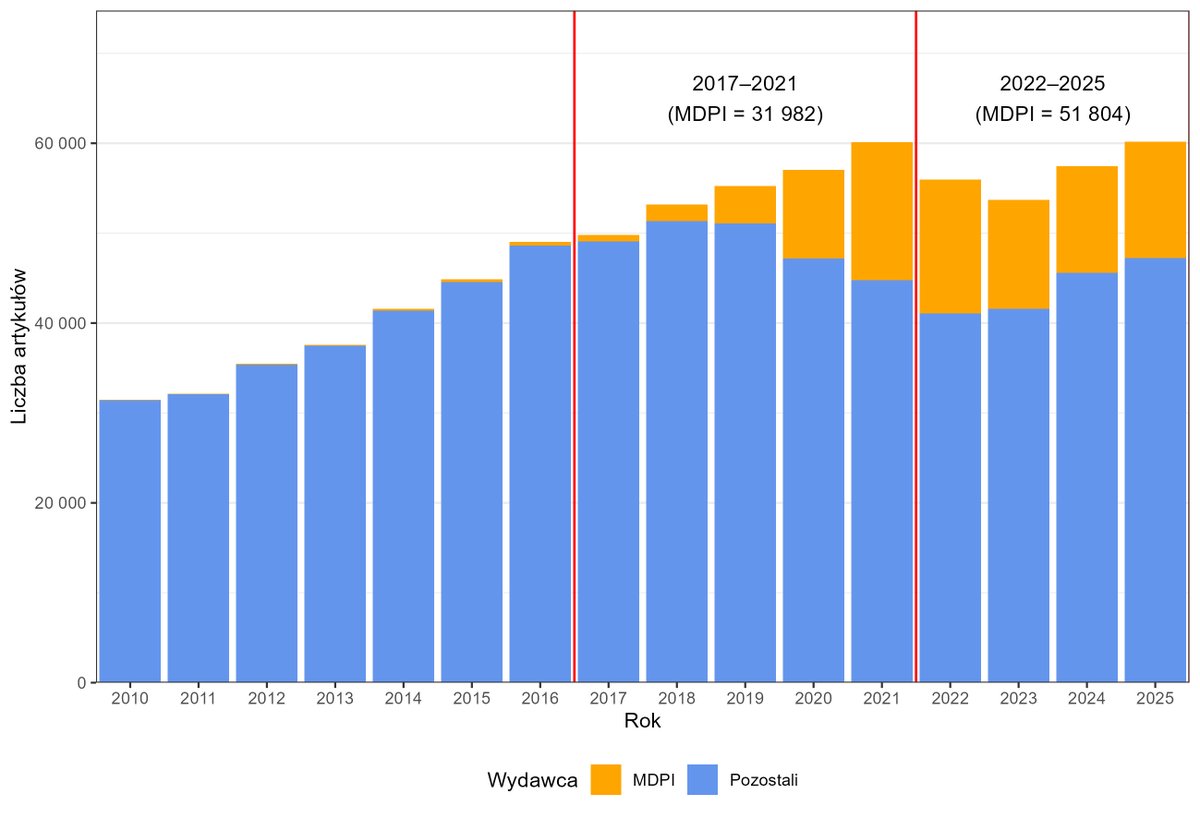
Ogłoszenie wyników ewaluacji to dobry moment by spojrzeć jak wyglądała liczba artykułów opublikowanych przez polskich naukowców w chińskim wydawnictwie MDPI.
W okresie poprzedniej ewaluacji (2017-2021) polscy naukowcy opublikowali w MDPI 31 982 artykuły, co stanowiło 11.6% wszystkich polskich publikacji indeksowanych w tym okresie w Web of Science.
W okresie ewaluacji 2022-2025 liczba publikacji w MDPI wzrosła do 51 804 (+62%), co stanowiło 22.8% wszystkich polskich artykułów.
Chwalenie się wynikami ewaluacji ogłoszonymi wczoraj wydaje mi się trochę niesmaczne.
Śmieszne, że wielu krytyków systemu teraz uznało,że wyniki to dowód na doskonałość ich jednostek i dyscyplin.
Fun fact: 89% ocenianych dyscyplin może nadawać doktoraty i habilitacje (B+ i wyżej)
https://t.co/isrczt68PW Ever use B2pin2? Then this paper is for you! . What started as a conversation about some irreproducibility issues has ultimately led to this publication from the Young and @R2G_UCSD labs on the origin of B2pin2 decomposition. Worth a read if you use B2pin2
A study of 110,303 manuscript submissions to two elite research journals has identified factors during the editorial and peer review stages that impact whether a paper is accepted for publication. https://t.co/xUGdwiWUrt
Algorytmy przejęły władzę nad nauką?
– To mit. Algorytm to tylko lustro, w którym odbija się akademicki konformizm. Zamiast walczyć z patologicznym systemem, nauczyliśmy się go „hakować” i masowo produkować naukowy fast-food – pisze Mariusz J. Figurski⬇️
https://t.co/vAQEcyk2YF
‘It’s ingrained belief, no one’s questioned it,’ says photophysicist Sarah Walden.
That is, until now.
A team of chemists and physicists have uncovered that a fundamental photochemical rule doesn’t hold true. Katrina Krämer reports:
https://t.co/c5ANRA3t52
„Gdybym miał podjąć jedną decyzję, która zwiększyłaby szanse Polski na Nobla w ciągu 10 lat – dwukrotnie zwiększyłbym finansowanie Narodowego Centrum Nauki."
Prof. Andrzej Jajszczyk, były dyrektor Narodowego Centrum Nauki mówi wprost: pieniędzy jest za mało, ale te które są – wydajemy fatalnie.
Academia. Dobrze wiedzieć.
https://t.co/mKVnHv5svZ
‘I rewrite it each time. I refresh it thoroughly. It’s partly because I see new ways of expressing things – I reckon I’ve got a literary style that survives with a half-life of about six months,’ says Peter Atkins.
https://t.co/b353p7zVzs
🤗 Prawdopodobnie najlepszy obecnie dostępny podręcznik do chemii nieorganicznej!
🫠 Pamiętam, że podczas studiów, aż do drugiego roku, uczyłem się wyłącznie z podręczników polskojęzycznych, m. in. "Chemii nieorganicznej" Bielańskiego czy "Zwięzłej chemii nieorganicznej" Lee. Dobrze pamiętam też, jak topornie były napisane i że w gruncie rzeczy trudno było nazwać je prawdziwymi podręcznikami. Zwłaszcza książkę Bielańskiego — stworzoną przez wybitnego chemika, ale niestety niezbyt przystępnie napisaną.
🤩 Kiedy podczas jednej z wizyt w bibliotece przypadkiem trafiłem na pierwsze wydanie "Inorganic Chemistry" autorstwa Catherine Housecroft, miałem wrażenie, jakbym przeniósł się do zupełnie innego świata! Świetna oprawa graficzna, aktualne dane i fakty oraz treści przedstawione w niezwykle przystępny sposób. 𝗧𝗼 𝗽𝗼𝗱𝗿𝗲̨𝗰𝘇𝗻𝗶𝗸, 𝗸𝘁𝗼́𝗿𝘆 𝗽𝗼𝗺𝗮𝗴𝗮 𝘇𝗿𝗼𝘇𝘂𝗺𝗶𝗲𝗰́ 𝗰𝗵𝗲𝗺𝗶𝗲̨ 𝗶 𝘂𝗰𝘇𝘆 𝗿𝗼𝘇𝘄𝗶𝗮̨𝘇𝘆𝘄𝗮𝗻𝗶𝗮 𝗽𝗿𝗼𝗯𝗹𝗲𝗺𝗼́𝘄, 𝘇𝗮𝗺𝗶𝗮𝘀𝘁 𝘀𝗽𝗿𝗼𝘄𝗮𝗱𝘇𝗮𝗰́ 𝗻𝗮𝘂𝗸𝗲̨ 𝗱𝗼 – 𝘄𝗰𝗶𝗮̨𝘇̇ 𝗻𝗶𝗲𝘀𝘁𝗲𝘁𝘆 𝘇𝗯𝘆𝘁 𝗽𝗼𝘄𝘀𝘇𝗲𝗰𝗵𝗻𝗲𝗴𝗼 𝘄 𝗣𝗼𝗹𝘀𝗰𝗲 – 𝗯𝗲𝘇𝗿𝗲𝗳𝗹𝗲𝗸𝘀𝘆𝗷𝗻𝗲𝗴𝗼 𝘇𝗮𝗽𝗮𝗺𝗶𝗲̨𝘁𝘆𝘄𝗮𝗻𝗶𝗮 𝗶𝗻𝗳𝗼𝗿𝗺𝗮𝗰𝗷𝗶.
📑 Ten podręcznik zmienił u mnie dwie rzeczy. Po pierwsze, zacząłem uczyć się niemal wszystkiego z anglojęzycznych książek. Po drugie, całkowicie zmienił moje podejście do nauki. Zamiast uczyć się „na pamięć”, zacząłem stawiać na zrozumienie mechanizmów i zależności.
😇 Efekt? Niejednokrotnie ścierałem się z prowadzącymi, ponieważ korzystałem z bardziej aktualnych źródeł i znałem informacje, które nie zawsze pokrywały się z tym, czego wymagano na zajęciach...
📘 Podręcznik "Inorganic Chemistry" Housecroft ukazał się po raz pierwszy 25 lat temu. W tym roku ukazało się jego szóste wydanie. 𝗗𝗼 𝘁𝗲𝗷 𝗽𝗼𝗿𝘆 𝗻𝗶𝗲 𝗽𝗼𝗷𝗮𝘄𝗶ł𝗼 𝘀𝗶𝗲̨ 𝗷𝗲𝗴𝗼 𝗽𝗼𝗹𝘀𝗸𝗼𝗷𝗲̨𝘇𝘆𝗰𝘇𝗻𝗲 𝘁ł𝘂𝗺𝗮𝗰𝘇𝗲𝗻𝗶𝗲. 𝗪𝗦𝗧𝗬𝗗! @PWNwydawnictwo
‘When I was a student, textbooks were very dry. They contained very few diagrams, very few pictures and lots of text,’ explains Catherine Housecroft.
https://t.co/RVSNKrZXOv
‘When we discuss amine basicity, texts often state the reason trimethylamine is more basic than ammonia is that the methyl groups make the nitrogen more negative, or the lone pair more available. This reasoning is incorrect,’ writes Mark Elliot.
https://t.co/kZb94IkAF0
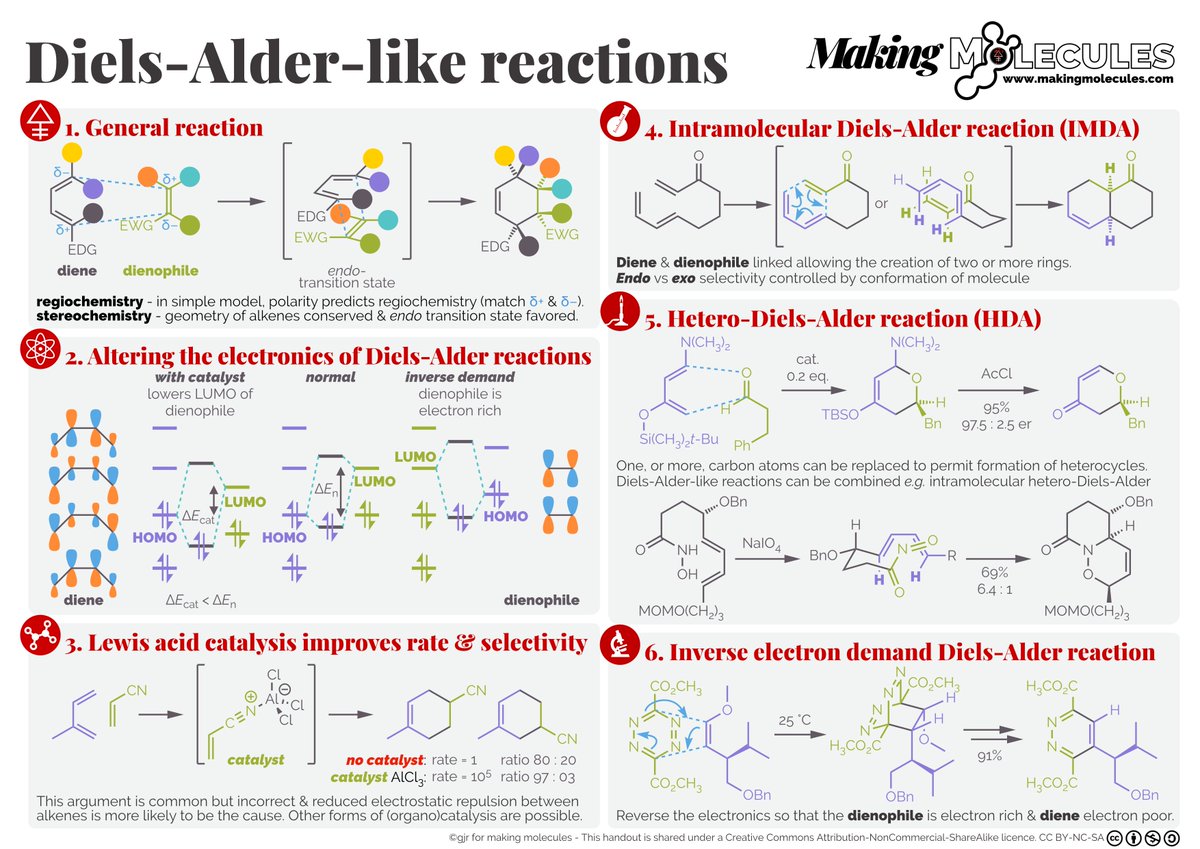
#ChemEd#Chemistry summary looks at modifications of the Diels-Alder reaction. It includes IMDA (tie the ends together), HDA (swap one (or more) carbons out) & IEDDA. It mentions the old explanation for LA catalysis (the more modern explanation is at https://t.co/lpz6IVXfgQ)
for small scale synthesis it is quite convenient to isolate in vials, and for rotary evaporation the vial is easily coupled by the use of a septum with a wide needle, or a hole for faster solvent removal. commercial screwcap adapters also exist but everyone has septa on hand
Nie dostałeś granciku na badanka? Nadal możesz zagrać w BINGO! Nieudolność polityków skutkuje finansowym wygłodzeniem @NCN_PL, najlepszej (bez ironii) agencji finansującej badania w Polsce. Braki kadrowe objawiają się spadkiem jakości ocen eksperckich i recenzji (1/4)