#WordsOfWisdom#GyanGanga – Episode 299
“Self-Reliant India: Our Journey Since Independence & the Road Ahead" - Discussion with Dr Subramanian Swamy
This Sunday At 8 pm IST – LIVE on the following Links 👇🏽
Youtube – https://t.co/tR16WcX0Yf
Facebook – https://t.co/AO3Ymx25MO
@Swamy39@vhsindia
@gurinipspb@AmarJit_IFS And you the uniformed babu , your co babus both in uniform & in civics plus the family of the fellow in your DP have a majority stake in this downward trend
Several countries - Australia, France, China, Indonesia, UAE - have imposed restrictions on the use of social media by children. Surprising, our country where social media is causing havoc, has yet to wake up. @GoI_MeitY
Why is it so difficult to be a KPS Gill in the system? It is difficult because the overwhelming number of them, be it a bureaucrat, a politician, a Cop or even a Judge fear the calumny and ad hominem that might come their way for doing their duty and upholding the integrity of the nation. Tough circumstances demand tough response. When terrorists have breached all bounds of civility and there is a large number cheering, sympathising and sheltering them, the state response cannot remain bound to probity and protocols. When terrorists have complete control over everything from clothing to spoken language, State cannot keep waiting for acts of terror to happen first before getting up and react. It will gear towards preventive action and discretion will be exercised. There will always be a possibility of excesses which in hindsight will constitute human right violations. It requires someone with extraordinary courage and commitment to stand up to the occasion and go for the charge. Such a person knows that he can be hounded by bleeding heart liberals once the embers have cooled. Such a person knows that there will be enough men and women who will curse and abuse him for shattering their secessionist and chauvinist dreams. Such a person knows there will be an Army of virtue signallers who, without knowing the circumstances, would villainise him just to appear cool and righteous. Added to that there is always a threat to life for not only the person but also his kith and kin. And yet this man risks all of it because for him nation and long term peace comes first. Unlike a fence sitting, risk averse, tightrope walker in the system who allows the tactical window to close and the crisis to spiral completely out of control, the call of duty tells this hero that “he who hesitates is lost”. KPS Gill was one such hero. While he was cleaning the mess he would have already anticipated the abuses and insults which would come his way one day. Gill risked ignominy for the sake of righteousness. That makes him an even bigger hero, a giant among pygmies and a worthy son of Mother India.
Next in who after the Ramanujan series?
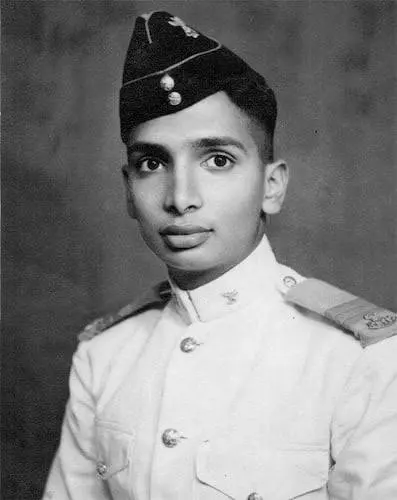
At a tender age of 16, a brilliant but completely unguided boy from Tamil Nadu joined the National Defence Academy & was commissioned into the Indian Navy's electrical branch . He did not have the luxury of a quiet university setting; he was trained in practical skills to maintain weapons systems on warships.
But Arogyaswami Paulraj possessed an insatiable, self-taught obsession with the advanced mathematics of signal processing, control theory & information theory. He studied advanced matrices & random variables by lamplight on naval ships.
By the late 1970s, India faced a serious strategic challenge. After the 1971 Indo-Pak War exposed weaknesses in imported sonars, the Navy needed an advanced anti-submarine warfare system but was blocked by international export restrictions. The Navy turned to Paulraj, then a rising officer with a PhD from IIT Delhi (earned while still in service). He was tasked with leading a major indigenous project to develop a world-class hull-mounted panoramic sonar from scratch.
Operating under intense resource scarcity, Paulraj’s mathematical genius took over. He designed complex signal-processing algos that could filter the chaotic, deafening acoustic noise of the ocean to pinpoint enemy submarines. The resulting system, APSOH (Advanced Panoramic Sonar Hull), inducted in 1983, completely stunned global military observers. It did not just work, it outperformed contemporary Western systems.
After setting up major defense labs in India, Paulraj retired from active naval service & arrived at Stanford University in 1991 as a research associate. This is where the story shifts from military history to modern legend. While working on signal separation experiments for airborne military reconnaissance, Paulraj noticed a strange, fleeting physical phenomenon.
When a radio signal is transmitted in a crowded area (like a city with buildings), it bounces off walls & scatters into 1000s of chaotic, distorted paths. Engineers treated this scattering as a nightmare, multipath interference that corrupted data.
Paulraj had a paradigm-shifting realization rooted in multi-variable calculus & spatial matrices: What if the scattering was not a bug, but a feature?
He realized that if we used multiple antennas at the transmitter & multiple antennas at the receiver, we could use advanced matrix mathematics to isolate those scattered paths & stream parallel, independent channels of data over the exact same frequency, at the exact same time.
He called it MIMO (Multiple Input, Multiple Output).
When he 1st proposed it, the academic world mocked him. Prominent profs & industry skeptics told him it violated the laws of physics & information theory. They claimed it was mathematically impossible to multiply data speeds w/o expanding bandwidth.
Paulraj did no back down. He built his own prototype, founded a startup & proved the mathematics in real-world silicon. He designed the microscopic architecture, the microchip algos that allowed small devices to execute these hyper-complex spatial matrix calculations in fractions of a microsecond.
If we look at the device we are using to read this right now, look at the top corners of our screen. We cannot see them, but embedded inside the frame of our phone are multiple microscopic antennas operating on Paulraj’s exact MIMO-OFDMA mathematics.
Every single modern 4G network, 5G network & high-speed Wi-Fi router on Earth is built entirely on the mathematical foundation invented by the self-taught Indian Navy officer who packed his bags for Stanford. He did not just solve a math problem; he built the invisible highway that carries nearly 100% of the world's mobile data traffic today.