🔴 BAVENO VIII – Portal Hypertension: What Changes Clinical Practice?
📌 Baveno VIII – Advancing Consensus in Portal Hypertension
The Baveno VIII consensus, developed across 9 expert panels, achieved strong consensus on 272 statements/recommendations and proposes 153 research priorities. The central message continues the paradigm shift from simply preventing variceal bleeding to identifying clinically significant portal hypertension (CSPH) early and preventing first and further hepatic decompensation.
🔑 1. CSPH remains the pivotal therapeutic threshold
CSPH = HVPG ≥10 mmHg, but invasive HVPG is no longer necessary for routine risk stratification in many compensated patients.
👉 Liver stiffness measurement (LSM), platelet count and increasingly spleen stiffness form the backbone of non-invasive assessment.
Clinical pearl: Do not wait for varices to appear before thinking about portal-hypertension-directed treatment.
🔑 2. The “Rule of Five” remains clinically powerful
Think progressively:
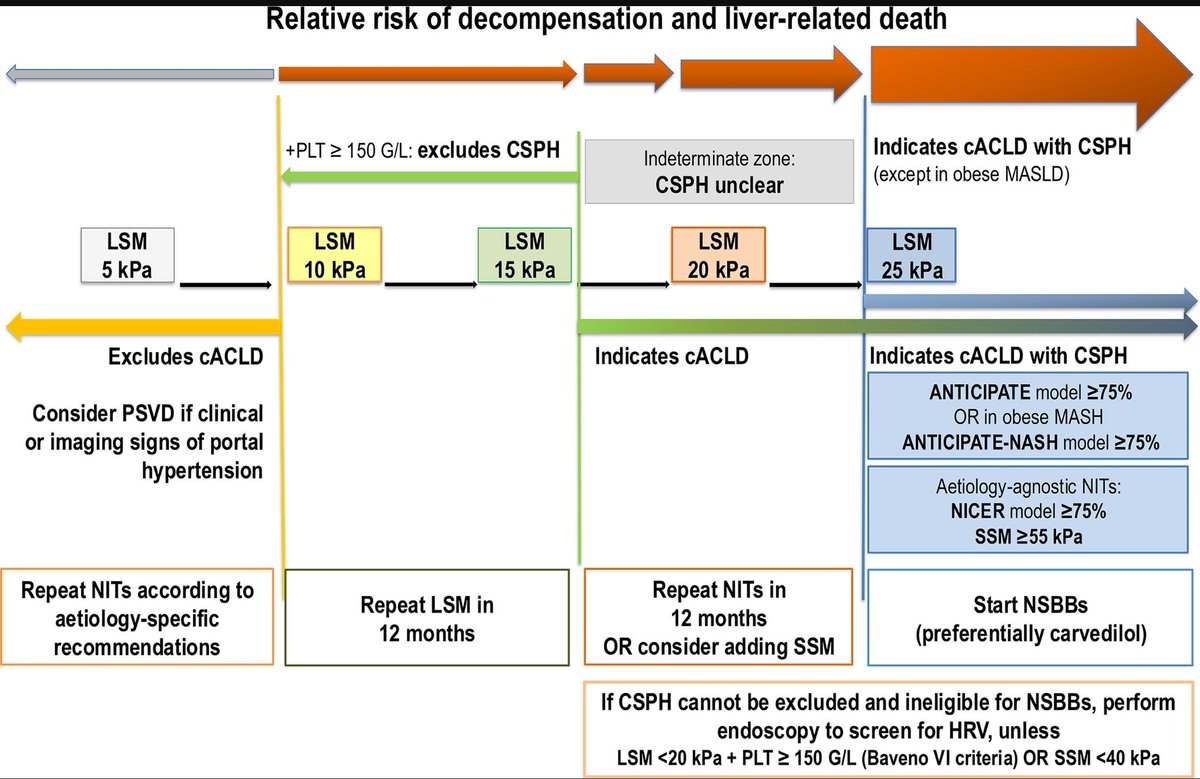
LSM 5 → 10 → 15 → 20 → 25 kPa
Increasing liver stiffness reflects progressively increasing probability of advanced liver disease, CSPH and clinical events.
The well-validated Baveno framework remains:
✅ LSM ≤15 kPa + platelets ≥150 ×10⁹/L → CSPH can generally be ruled out.
✅ LSM ≥25 kPa → strongly supports CSPH in appropriate populations.
But an important caveat is MASLD with obesity: an isolated LSM ≥25 kPa is less reliable for ruling in CSPH. Recent individual-patient meta-analysis showed that obesity materially reduces the reliability of this simple rule-in threshold.
🔑 3. The old 15–25 kPa “grey zone” is becoming smaller
Patients falling between the classical rule-out and rule-in thresholds should not automatically undergo invasive testing.
Additional tools such as:
➡️ platelet count
➡️ spleen stiffness measurement (SSM)
➡️ ANTICIPATE/ANTICIPATE-NASH probability models
➡️ selected biochemical algorithms
can further refine CSPH probability.
This is particularly relevant in steatotic liver disease and obesity, where a one-size-fits-all LSM threshold performs less well.
🔑 4. Carvedilol is not merely an “anti-variceal” drug
This is one of the most important conceptual messages for physicians.
In a compensated patient with CSPH, a non-selective β-blocker is used not only to prevent bleeding but to prevent hepatic decompensation, particularly ascites.
Carvedilol remains particularly important because of its additional α1-blocking action and greater portal-pressure reduction.
Thus the clinical thinking becomes:
CSPH identified → ask whether NSBB/carvedilol is appropriate, rather than waiting for large varices.
Baveno VII established this paradigm, and subsequent evidence has strengthened non-invasive identification of the patients most likely to benefit.
🔑 5. Endoscopy becomes more selective
A major evolution of Baveno guidance is:
Not every compensated patient with cirrhosis needs screening endoscopy solely to decide whether to start an NSBB.
If CSPH is established and the patient is an appropriate candidate for an NSBB, treatment may be initiated on the basis of the portal-hypertension risk assessment.
Endoscopy assumes greater importance when:
➡️ NSBBs are contraindicated/intolerable
➡️ the non-invasive assessment is uncertain
➡️ endoscopic therapy would alter management.
This represents a move from “find varices and treat them” toward “identify portal hypertension and prevent decompensation.”
🔑 6. MASLD changes the portal-hypertension equation
Baveno VIII gives increased importance to steatotic liver disease and its modifiers.
⚠️ Obesity can alter the diagnostic performance of VCTE.
Therefore:
LSM ≥25 kPa should not be interpreted mechanically in an obese MASLD patient.
BMI, platelets and other NITs may need to be integrated.
📖Next
.....https://t.co/eUHAxZLFku
A personalized endoscopic step-up strategy
📊 Predict re-intervention risk @ baseline
⚖️ Reserve upfront DEN for high-risk (large WON, high debris, paracolic extension)
✅ Drain & observe low-risk:most won't need DEN
🚫 Stop applying universal upfront necrosectomy to every WON
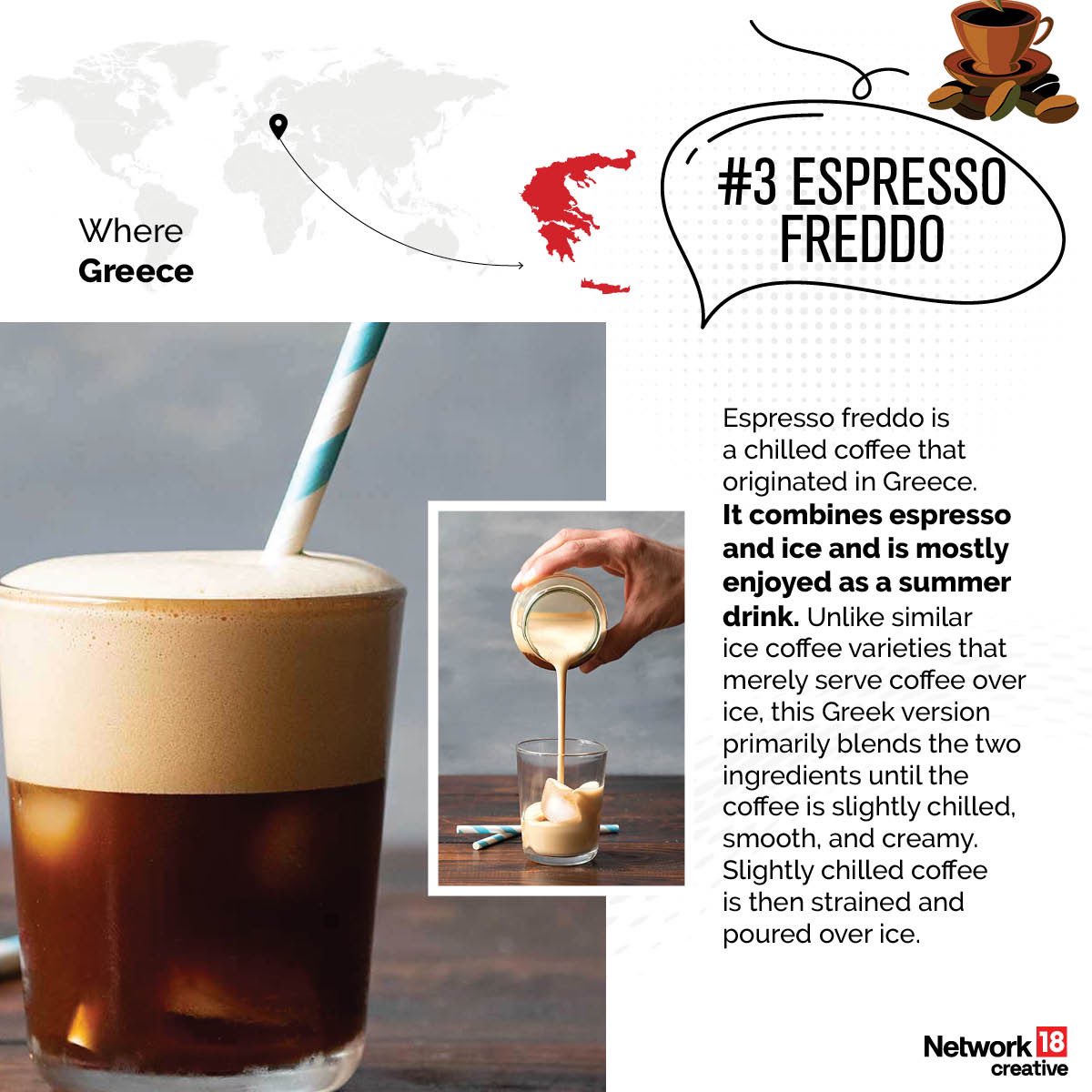
Caffeine metabolism and why coffee hits people differently
1️⃣ Absorption Is Fast
Caffeine is absorbed in the stomach & small intestine, peaking in blood within 30–60 min.
💡 why that morning espresso kicks in quick.
2️⃣ The Liver Is the Gatekeeper
CYP1A2 enzyme (a liver detox enzyme) breaks caffeine down.
💡 Some people have a “fast” version, others a “slow” one.
3️⃣ Three Metabolites Dominate
Paraxanthine → boosts alertness, fat metabolism.
Theobromine → widens blood vessels (and is in chocolate).
Theophylline → relaxes airways (like old asthma drugs).
4️⃣ Genetics Decide Your Buzz
Fast metabolizers clear caffeine quickly (need more cups).
Slow metabolizers keep caffeine in their system for hours (jitters, insomnia).
5️⃣ Lifestyle Tweaks It
Smoking speeds caffeine breakdown.
Pregnancy & certain meds slow it.
💡 Same coffee, different effects.
6️⃣ Half-Life Matters
Caffeine’s half-life = ~5 hours, but in slow metabolizers it can stretch to 9+.
💡 That 3 p.m. latte may still be in your bloodstream at midnight.
7️⃣ Tolerance Builds
Regular caffeine users adapt at the receptor level, needing more to feel the same effect.
💡 Why quitting leads to headaches & fatigue.
#Hepatitis facts you should know:
Hepatitis B
👉 Only 13% of people with hep B had been diagnosed
👉 Just 3% had received treatment at the end of 2022
Hepatitis C
👉 Only 36% had been diagnosed
👉 20% had received curative treatment
We have the tools. Let’s use them 🔗https://t.co/4hIFL9aTFV
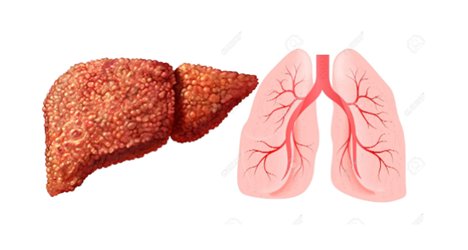
Hepatopulmonary Syndrome - or is Portopulmonary hypertension? What’s the diff (brief #tweetorial)
Pulm complications of #cirrhosis can be devastating. This month on rounds, I was reminded that these conditions are confusing.
#meded
Banu Mushtaq shines the spotlight on Kannada literature and makes the whole country proud by winning the prestigious #BookerPrize 👏👏👏👏 https://t.co/MCheORCtth
My heart aches for the victims of the Pahalgam terror attack. So much pain. So much loss. No reason, no cause can ever justify such brutality.
To the families left behind—your grief is beyond words, but you are not alone.
We are with you.
In these dark moments, may we find strength in each other, and never let go of the hope that peace will return!
As a hepatologist+endohepatologist, I concur
The “one stop shop”, with the current evidence, is being used indiscriminately
🎯EUS-PPG - we need much more data before it can be used in clinical practice
🎯EUS Liver Bx- the indications are selected. Need to make sure it is done for the right reasons, not just because we are already down there…and we can
🎯EUS elastography- hyped way too much. There are very limited situations where it actually adds to clinical decisions
We need to carefully curate our research questions to generate clinically meaningful data
#GITwitter #Endohepatology #LiverTwitter
⭐️Guselkumab is now approved for treatment of moderate-severe Crohn disease. This IL-23 inhibitor beats placebo and ustekinumab and has both IV and SQ induction options.
#MedTwitter#GITwitter#IBD
https://t.co/9Xl2oxsGOy
1.9 billion people are projected to be living with obesity by 2035, including a doubling of childhood obesity from 2020 levels by 2035.
On #WorldObesityDay, the latest Editorial from @TheLancetPH looks at how we can tackle the obesity crisis by addressing obesogenic environments: https://t.co/qz4vmZwyPP
2025 = 45^2
It's a perfect square. It will probably be the only perfect square year you ever get to live in.
The last time that occurred was in 1936. The next will be in 2116.
So, make 2025 a perfect year for you.
The fear one develops while starting a task/routine (after much deserved procrastination) thinking why I didn't start it earlier , which makes the now started task difficult to do should be named by the scientific community.
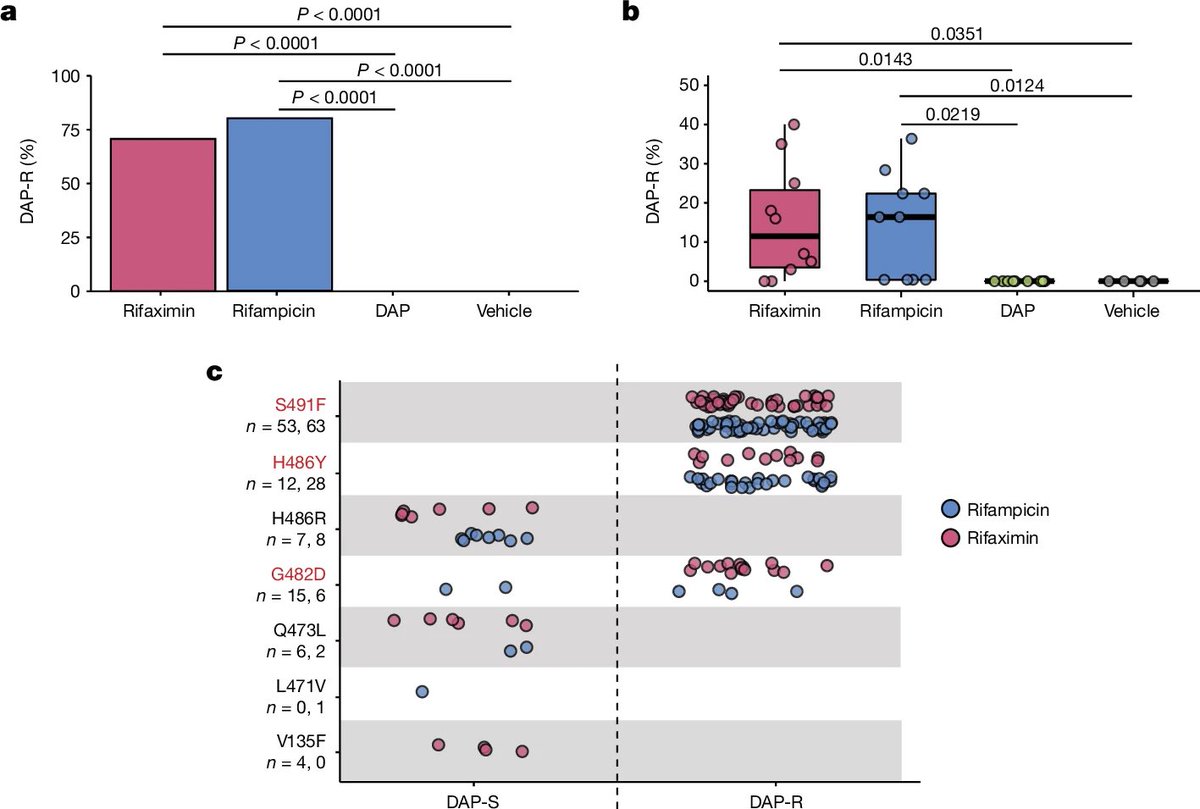
An antibiotic commonly prescribed for liver disease, #Rifaximin has led to global emergence of an almost untreatable form of antimicrobial resistant superbug vancomycin-resistant enterococcus faecium, which frequently causes serious infections in hospitalized patients 1/
Doctors please remember
For you it's just another appointment. Just another rounds visit.
But for patients those 10 minutes are the most important visit of their day. Sometimes of their lives.