Medical oncologist - early phase trials, lung cancer, diversity/inclusion, trainee welfare @Sydney_Uni @SWSLHD @NHMRC - ex @royalmarsdenNHS - views are my own
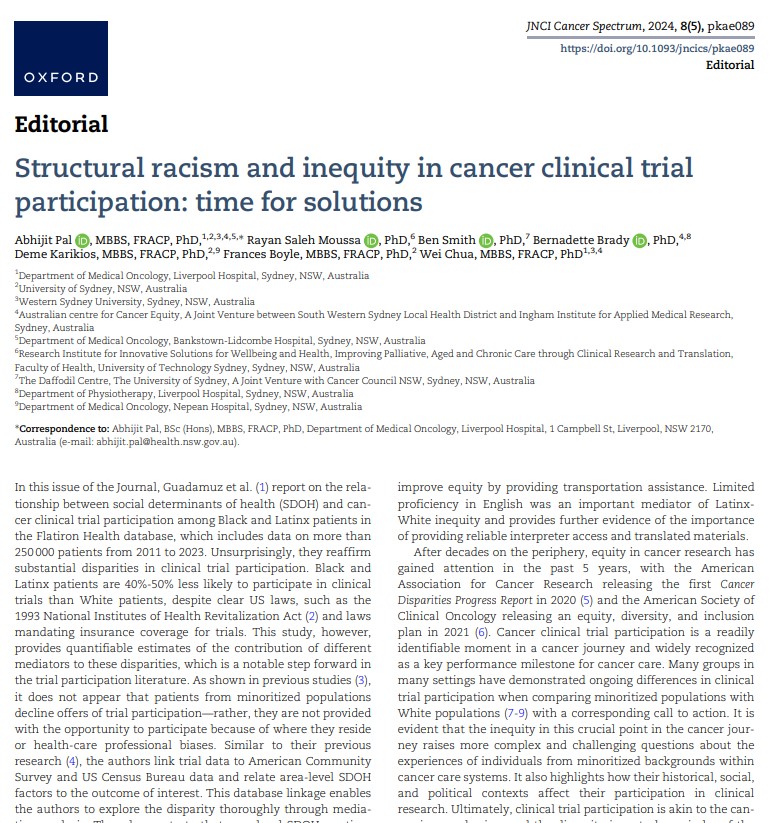
Happy to share our editorial about structural racism and inequity in cancer trials - https://t.co/dG9mdbmPtb - inequity is baked into the system. Time for greater uptake of solutions (Table 1) at site and sponsor level to improve equity @cancer_K2A@Dr_RSMoussa@DKarikios
CSO presents a webinar featuring guest speaker A/Prof Abhijit Pal about improving access to clinical trials for individuals from culturally and linguistically diverse backgrounds. A/Prof Pal is a part of the Australian Centre for Cancer Equity, a partnership between Cancer Institute NSW, Ingham Institute for Applied Medical Research and South Western Sydney Local Health District.
Join us online on May 27, 2026 at 7 pm AEST | 5 am EDT | 10 am BST!
Register on Zoom: https://t.co/xemTa7hl6Y
#CommonSenseOncology #CancerCare
🧠 Now in Cancer: A large international analysis of ~420,000 people found no strong link between psychosocial factors and cancer risk.
Results may help address common misconceptions about mental health and cancer.
Read the study:
https://t.co/bX9bW3QA3Z
@OncoAlert@WileyHealth
Telisotuzumab adizutecan (ABBV-400, Temab-A) in #EGFR NSCLC at #ASCO25. This is a cMET ADC like Teliso-V but with a topoisomerase 1 inhibitor. Safety notable for myelosuppression, 7% pneumonitis (1 fatal). RR 63%, DOR 9.8m, PFS 10.9m.
How do oncologists balance maintaining hope & truth-telling? When & how should they challenge unrealistic hope?
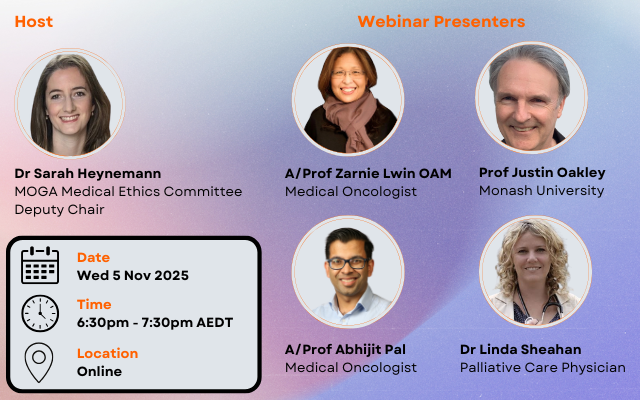
Less than 1 wk to go for this MOGA Medical Ethics Webinar. Participants can log CPD points for ethics & professional behaviour. Register today!
https://t.co/IXj33QoSjW
⏰ One week to go!
Join us for MOGA’s Medical Ethics Webinar 🖥️
“Hope, Truth-telling and Navigating Dilemmas When These (seem to) Contradict Each Other in the Everyday Practice of Oncology.”
📅Wed 5 Nov | 🕐 6:30pm AEST
🔗Register: https://t.co/PibTZJPfkS
Very proud to have co-authored this comment on the FDA’s new draft guidance for industry in @TheLancetOncol with @lateuwen and @oncology_bg. The draft guidance takes important steps forward, but there is room for even more improvement. Read more: https://t.co/ZepghSPHul
RESEARCH WEBINAR SERIES | Join us for a webinar hosted by the Daffodil Centre's Triple I (Innovation-Implementation-Impact) stream: Implementation of equitable care across the cancer continuum
📆 Thursday 11 September
🕝 2:30 - 4:00PM AEST
📍 Online (Zoom)
REGISTER TODAY https://t.co/oFQzem6Yiz
This webinar will showcase three early career researchers (including Daffodil Centre researcher Dr Verena Wu) leading the way towards implementation of equitable care across the cancer continuum.
We welcome all people (consumers, clinicians, researchers and policymakers) with an interest in equitable cancer control and care to learn how these researchers have applied an equity lens to implementation research to conduct research with important implications for implementation of equitable cancer care.
🩺 Many patients with advanced cancer report receiving treatment focused on living longer, even when they prefer comfort. New research in Cancer shows the importance of goal-aligned care: https://t.co/sIXwzPUi6J
@Manan_P_Shah@UCLAHealthJCCC@PCORI@OncoAlert @WileyOnc_Hem
𝐔𝐬𝐞 𝐨𝐟 𝐭𝐡𝐞 𝐃𝐄𝐅𝐓-𝐀𝐈 (𝐃𝐢𝐚𝐠𝐧𝐨𝐬𝐢𝐬, 𝐄𝐯𝐢𝐝𝐞𝐧𝐜𝐞, 𝐅𝐞𝐞𝐝𝐛𝐚𝐜𝐤, 𝐚𝐧𝐝 𝐓𝐞𝐚𝐜𝐡𝐢𝐧𝐠) 𝐅𝐫𝐚𝐦𝐞𝐰𝐨𝐫𝐤 𝐭𝐨 𝐏𝐫𝐨𝐦𝐨𝐭𝐞 𝐂𝐫𝐢𝐭𝐢𝐜𝐚𝐥 𝐓𝐡𝐢𝐧𝐤𝐢𝐧𝐠 𝐝𝐮𝐫𝐢𝐧𝐠 𝐚𝐧 𝐀𝐈 𝐈𝐧𝐭𝐞𝐫𝐚𝐜𝐭𝐢𝐨𝐧
After recognizing an AI interaction, the educator engages the learner in a structured educational moment to discuss the interaction, evaluate it, provide feedback, and teach clinical reasoning, as well as the use of AI. The discussion encompasses the learner’s clinical reasoning process and approach to using AI, including the prompts used. The educator probes the learner for the use of supporting and opposing evidence to evaluate the learner’s clinical and AI knowledge. This process helps determine whether the learner used AI to replace clinical reasoning or to inform it and offers a window into the learner’s AI literacy. The educator then guides the learner in reflecting on growth opportunities and encourages critical thinking about AI interactions and clinical reasoning. Finally, the educator provides focused teaching on using AI effectively, selecting the right tools, and refining prompts. The learner is encouraged to adapt the use of AI to the task, switching between reliance on AI output (cyborg strategy) and confirmation of AI output (centaur strategy).
Learn more about this framework in the Review Article “Educational Strategies for Clinical Supervision of Artificial Intelligence Use,” the latest in the Medical Education series, by Raja-Elie E. Abdulnour, MD (@BageLeMage), Brian Gin, MD, PhD, and Christy K. Boscardin, PhD, from @BrighamWomens, @harvardmed, @uiccom, and @UCSF: https://t.co/EdUr9EDqIZ
Congratulations to @realbowtiedoc and @MazieTsangMD on this excellent editorial highlighting the future of performance status assessment in oncology 👏 Thank you for the kind shout-out; honored to see our work cited @JCOOP_ASCO
https://t.co/yHdSTxlnwc
Great to share this first piece from my @csoncol fellowship, written with @oncology_bg. We use some issues with CodeBreaK300 to argue that the promise of precision medicines are only fulfilled when coupled with precision in design, analysis and reporting of trials.
Advancing the science and practice of oncology requires representative populations in research and subpopulation analysis and reporting. Guidance for @JCO_ASCO Authors on Subgroup Representation and Reporting.
https://t.co/dTC1JmBkEF
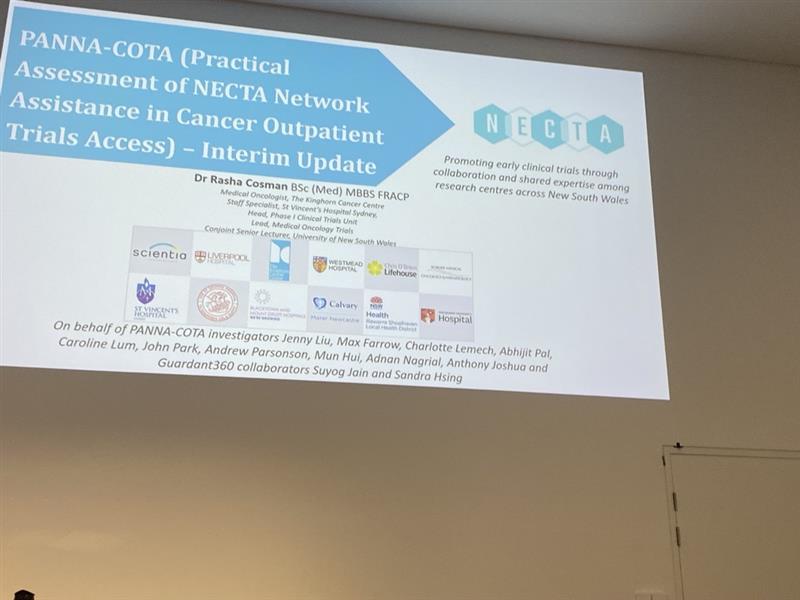
Great to see the work of NECTA on early phase clinical trials - presented by Dr Rasha Cosman, @GarvanInstitute. The Cancer Institute NSW is proud to support this incredible work across the state. #NSWCancerSummit2025
Congratulations to @Dr_RSMoussa and Dr Jessica Lee on your grant for a navigation model for NSW Palliative Care Services to support Arabic and Chinese speaking communities!!
@pa_ccsc@UTS_CST@UTSEngage
https://t.co/JFDcd0t2Py
So great to have our friends from Aotearoa at #NSWCancerSummit2025 Te Aho o Te Kahu are really leading the way in giving Māori people a voice in cancer control & care and weaving equity through the programs they deliver.
Racial and Ethnic Disparities in Receipt of Guideline-Concordant Pancreatic Cancer Care Among Older Adults in the United States. Co-authored by @JoshNHerb
Read the full article. https://t.co/JDLGSEJfbh