GM CT, Happy Sunday!
Cooked up something overnight for @therebelkins. loved their art style, so I cooked up a design exploration for their hero section. Might make a full website design and write the code if they like it.
We love building cool stuff over here.
@Morph_VGart
2. how Spenda really works
Spenda converts crypto (eg. SOL) to naira.
not memecoins. not NFTs.
so to mint with Spenda, they'd need to connect it to OpenSea.
but Spenda doesn't support that.
and they most likely won't give you your keys.
1. custodial vs non-custodial wallets
the difference is simple:
with custodial wallets, your private keys are held by the platform.
with non-custodial wallets, you control your private keys.
which brings us to the question:
“why can't they get their NFTs?”
👇
i know you might be wondering,
"isn't Spenda also a wallet?"
and the truth is? you're RIGHT!
but... there are two types of crypto wallets:
custodial and non-custodial(self-custody) wallets
and knowing the difference will save you from a lot of trouble!
let me explain👇
📚 NEXT CLASS — DAY 025
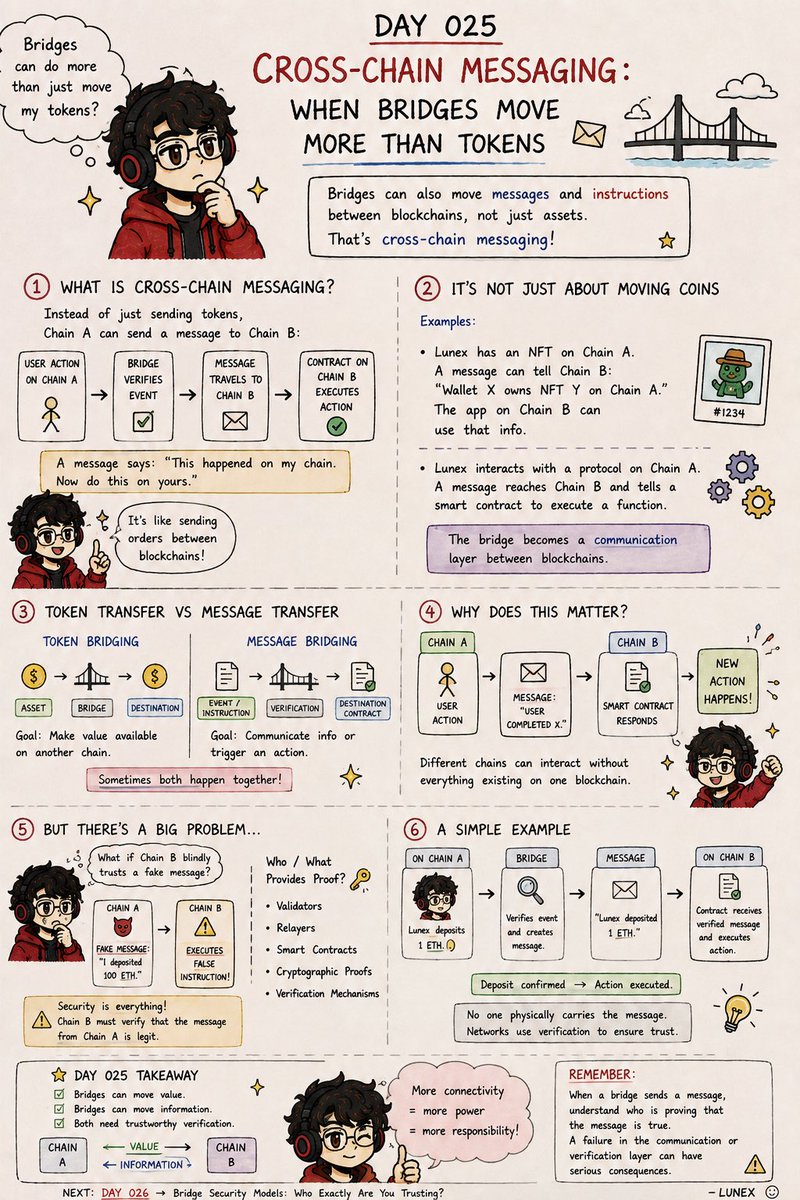
🌉 Cross-Chain Messaging: When Bridges Move More Than Tokens
So far, we’ve mostly talked about bridges as a way to move assets between blockchains.
But here’s the interesting part:
Bridges can also move messages and instructions. 👀
And this is where cross-chain applications become much more powerful.
🧠 What is cross-chain messaging?
Imagine you have:
Chain A → Chain B
Instead of simply saying:
“Send my tokens over.”
Chain A can send a message to Chain B saying:
“This happened on my chain. Now do this on yours.”
That message could trigger an action on the destination blockchain.
For example:
User deposits something on Chain A
⬇️
Bridge verifies the event
⬇️
Message travels to Chain B
⬇️
Smart contract on Chain B executes an instruction
That’s cross-chain messaging.
📦 It’s not just about moving coins
Let’s say Lunex has an NFT on one blockchain.
He wants an application on another blockchain to know that he owns it.
Instead of physically moving the NFT, a cross-chain message could communicate:
“Wallet X owns NFT Y on Chain A.”
The application on Chain B can then use that information to perform some action.
Another example:
A user interacts with a protocol on Chain A.
A message reaches Chain B and tells a smart contract to execute a specific function.
So the bridge becomes more like a communication layer between blockchains.
🔄 Token Transfer vs Message Transfer
Here’s the difference:
🪙 Token bridging
Asset → Bridge → Destination
The goal is to make value available on another chain.
📨 Message bridging
Event/Instruction → Verification → Destination contract
The goal is to communicate information or trigger an action.
And sometimes these happen together.
A bridge might transfer an asset while simultaneously sending a message telling the destination application what to do with it.
🤔 Why does this matter?
Think about Web3 today.
Different blockchains have different:
Users
Liquidity
Applications
Smart contracts
Ecosystems
Cross-chain messaging allows those ecosystems to interact without everything having to exist on one blockchain.
For example:
Chain A: User action
⬇️
Message: “User completed X.”
⬇️
Chain B: Smart contract responds
⬇️
Result: New action happens
This opens the door to more interconnected applications.
🚨 But there’s still a BIG problem
Remember Day 23?
Security.
If Chain B blindly trusts a message saying:
“Lunex deposited 100 ETH.”
when Lunex actually deposited nothing…
Chain B could execute a completely false instruction.
That’s why the most important question becomes:
How does Chain B know that the message from Chain A is legitimate?
This brings us back to:
🔐 Validators
🔐 Relayers
🔐 Smart contracts
🔐 Cryptographic proofs
🔐 Verification mechanisms
The communication itself isn’t necessarily the hardest part.
Proving that the communication is authentic is.
🧩 A Simple Example
Imagine Lunex uses a cross-chain application.
On Chain A:
Lunex deposits 1 ETH.
The application records the event.
The bridge:
Verifies the event and creates a message.
“Lunex deposited 1 ETH.”
On Chain B:
A smart contract receives the verified message.
It then executes its programmed action.
Deposit confirmed → Action executed.
Nobody physically carried the message between chains.
The networks use a verification mechanism to establish that the message should be trusted.
🧠 DAY 025 TAKEAWAY
Yesterday we learned:
Before using a bridge, understand what you’re trusting.
Today, take it one step further:
When a bridge sends a message, understand who is proving that the message is true.
Cross-chain messaging can turn bridges from simple asset highways into communication layers connecting entire blockchain ecosystems.
But greater connectivity also means that a failure in the communication or verification layer can have serious consequence