MIT has a free 900+ page textbook that teaches the math behind computer science.
It is called Mathematics for Computer Science.
And it costs $0.
Most people think “learn CS” means:
Learn Python.
Learn JavaScript.
Learn React.
Learn system design.
Learn AI tools.
But under almost every serious CS topic, there is math.
Algorithms are math.
Cryptography is math.
Machine learning is math.
Databases use logic and relations.
Distributed systems use proofs and invariants.
Complexity theory is basically math with consequences.
This textbook is MIT’s foundation for that.
It covers:
Proofs
Induction
Sets
Functions
Relations
Graphs
Trees
State machines
Number theory
Modular arithmetic
Counting
Probability
Random variables
Recurrences
Asymptotic growth
Basically, the stuff that makes you understand why code works, not just how to write it.
This is the difference between someone who can follow tutorials and someone who can actually reason like an engineer.
The best part:
You do not need to be enrolled at MIT.
You do not need to pay tuition.
You do not need a professor.
You do not need a fancy bootcamp.
You can download the PDF and start reading today.
Link: https://t.co/n6iYa2nTxZ
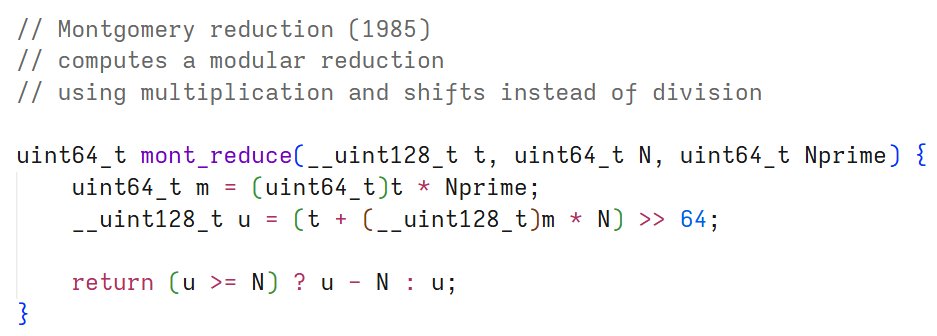
RSA performs enormous amounts of modular arithmetic but almost never uses actual division during the heavy computation
division is expensive
in 1985 Peter Montgomery introduced Montgomery reduction, a technique that replaces costly divisions with shifts additions and multiplications
the key idea is choosing `R` as a power of two so dividing by `R` becomes a simple bit shift
modern RSA implementations rely on this trick because it makes modular exponentiation dramatically faster
a huge part of the cryptography protecting your bank account works because someone found a way to avoid division