🇺🇸🇨🇳 The full Chinese Foreign Ministry readout is out. Here's what was said behind closed doors:
Xi opened by invoking the "Thucydides Trap" directly, asking whether the two powers can forge a new model of great power relations or slide toward collision.
Both sides agreed to frame the relationship around "constructive strategic stability" for the next 3 years and beyond.
Xi said it means cooperation first, managed competition, and predictable peace.
On trade, Xi said the two economic teams already reached a "generally balanced and positive" outcome yesterday, before the summit formally began.
Taiwan got the sharpest language. Xi warned mishandling it could push the entire relationship into "very dangerous territory."
They also covered Ukraine, the Korean Peninsula, and the Middle East.
Trump called it the longest and best relationship between U.S. and Chinese leaders in history, and introduced each CEO to Xi individually during the meeting.
Source: Chinese Foreign Ministry
HERKES WARREN BUFFETT KONUŞUYOR AMA ASIL KRAL O DEĞİL!
Wall Street kurtlarının sana asla söylemeyeceği sırları, bu adam MIT'de sadece 1 saatte anlattı.
Adı Jim Simons. 30 yıl boyunca her yıl %66 kazandırdı. 1 saatini bu videoya ayır.
As a millionaire, I don't invest in the S&P 500 because…
The richest people in America do the opposite.
When I worked at JP Morgan…
I saw exactly how the top 1% manage their money.
Here’s what they do (& how you can too):
GOODBYE, FUND MANAGERS. GOODBYE, BLOOMBERG TERMINAL.
No more $24,000/year subscriptions.
Claude just turned my laptop into a private quant analyst.
Here are 07 prompts to build your own hedge fund at home ↓
INSTEAD OF WATCHING NETFLIX TONIGHT.
Spend 1 hour with this.
Claude AI FULL COURSE that teaches you how to BUILD and AUTOMATE anything.
The people who watch this tonight will wake up tomorrow with a new skill.
Watch it and Bookmark it now.
Warren Buffett just warned that the US dollar could collapse and admitted he doesn't understand most of the stock market anymore.
95 years old, sitting on $380 billion in cash, and the first time watching from the sidelines instead of actively investing.
And what he revealed at this weekend's Berkshire shareholder meeting is genuinely concerning:
On the market, Buffett didn't hold back.
He compared it to "a church with a casino attached" and said the casino has never been more packed. On one-day options: "That is not investing. It's not speculating. It's gambling. Totally."
He pointed to the Avis short squeeze THIS WEEK. A rental car company that's been around for 50 years getting meme-squeezed in 2026. The same behavior that blew up retail traders with GameStop is back, except now it's hitting boring legacy companies with zero business being volatile.
"We have lots more regulation now, but people spend their time figuring out how to get around the rules rather than follow the rules."
That one sentence explains more about the current market than every CNBC segment combined.
When asked why he's hoarding $380 billion instead of investing it, Buffett said something no one expected:
"I understand fewer of the businesses as a percentage of the whole than I did 10 years ago. I have not learned new industries for some years. I'm not going to have an edge on a whole bunch of younger people that have actually grown up with it."
Think about what he's actually saying...
This is a man who made $140 billion by understanding businesses better than anyone alive. And he's telling you the current market is so detached from reality that even HE can't make sense of what's being valued and why.
He quoted IBM's Tom Watson Sr.: "I'm smart in spots and I stay around those spots."
In 60 years of managing money, he said MAYBE five were "really juicy." Five out of sixty. That means 92% of his career was spent WAITING while everyone else gambled. And he still ended up richer than all of them.
Then the conversation turned to inflation and that's where it gets really interesting:
Buffett said America is "not immune" from runaway inflation. He brought up countries that went bankrupt "six or seven times" in his lifetime.
Compared today to right before Volcker had to rescue the dollar, when Americans were borrowing at 12% to buy farmland earning 6% because they believed the dollar would disappear.
"Cash is trash" was the mentality.
Nebraska farmers collapsed
because of it. Entire communities wiped out not by a recession but by a BELIEF that the currency was dying. And Buffett sees that same energy building again.
Then someone asked the question everyone wanted answered: Do you see a crash coming?
"If you saw it coming, it wouldn't happen. The things people are talking about and thinking about? It's not going to happen. But there are things that can come out of the blue."
He compared it to the assassination of Archduke Franz Ferdinand in 1914 that triggered World War I. Nobody was discussing or anticipating it. But it changed the world overnight.
"That's particularly true now because of the things that can come out of the sky."
A 95yo man who has survived every crash, every war, every crisis of the last six decades just told you the market is a casino, the dollar isn't safe, and the real collapse will be something nobody sees coming.
$380 billion in cash is his answer because he believes things are about to get much worse.
Jordan Peterson on Elon Musk: "My mind is a storm… I don’t think most people would want to be me"
"There was a recent interview with Elon Musk where he said something... 'My mind is a storm. I don't think most people would want to be me. They may think they would want to be me... but they don't. They don't know. They don't understand.'"
Peterson explains:
"One of the downsides to high-level genius is what you might describe as hypermania."
On verbal fluency and creativity:
"Here's a simple test. Write down as many four-letter words as you can in three minutes that begin with 'T.' Or write down as many words as you can in three minutes that begin with 'S.' There's quite a powerful correlation between the sheer number of words you produce and your lifetime creative achievement... especially in the artistic and verbal domains."
He distinguishes:
"That's different than vocabulary. Vocabulary is how many words you understand. Fluency is how many words you can produce in a given amount of time."
The variance is staggering:
"People vary to a degree you can hardly imagine. Some people... if you get them to do the four-letter test in three minutes... they'll write down 12 words. Some will write down 150. The ones writing down 150... their minds are going at a hypomanic rate. They're just thinking five times as fast. Without any remission whatsoever."
On when it goes too far:
"When that gets completely out of control, you have someone who's manic. There's nothing fun about manic. That's where the word 'maniac' comes from. Someone who's manic has a thousand different plans... each of which are one sentence long... that they're hyper-enthusiastic about. They'll spend every cent of their money pursuing them. And things just go immediately to hell."
He applies it:
"That's the outer limit of pathology on the creative front. Someone like Musk who's clearly a genius... that's what he's contending with in his internal landscape. I'm not saying he's manic because I see no signs of that. But someone that creative is on that edge."
On minds that move too fast:
"Take someone like Ben Shapiro. It's very interesting to talk to Ben... Russell Brand is the same way. Shapiro speaks more rapidly than anyone I ever met. But if you're with him, you see very clearly that he's probably thinking five times that fast. And that's a lot."
Peterson shares his own experience:
"When I was writing Maps of Meaning... my first book... I had a very difficult time shutting off my mind. I was obsessed with that book. I was writing about 3 hours a day. Then I was thinking about the material for like 12 hours. And the thoughts came way faster than thinking. They probably came about as fast as I can read... about 1,200 words a minute. It was just nonstop thought for 16 hours a day."
How he coped:
"That's part of the reason I started lifting weights. If I was lifting heavy... thinking at 1,200 words a minute while I've got 100 pounds on my back... it was enough to shut it down. It was also one of the reasons I drank. That was another thing that would shut it off."
On the price of genius:
"The price that people pay to be the person they admire is such an interesting frame. 'My mind is a storm. I don't think most people would want to be me.' The price you would have to pay in order to be me is not one you would want to pay."
The interviewer pushes back: but you're one of the richest men on the planet, you get to release bulletproof cars and put rockets in space...
Peterson:
"Yeah, but what about all the baggage? He also appears to me to be hyper-conscientious. Musk isn't just a creative genius... he's also an extremely conscientious engineer. Really conscientious engineers have very interesting minds. When they understand something... they understand how to build it out of atoms. They understand it at every single level."
On the rare combination:
"Musk appears to me to be someone who's this rare combination of hyper-creative but also hyper-conscientious. And I know he works all the time."
The interviewer asks: does that hypertrophied executive function help wrangle some of the diffuse creative energy?
Peterson:
"Yes. Definitely. Eric Weinstein is a good example... Eric is unbelievably creative but he's not particularly conscientious. I think he found an occupation where that works extremely well... he worked with Peter Thiel for quite a long time as his idea man."
He contrasts:
"Musk is hyper-creative and as far as I can tell hyper-conscientious. The conscientiousness does focus it. Lots of creative people aren't conscientious. There's no correlation between creativity and conscientiousness."
The math:
"If you're the most creative person in a thousand... and you're the most conscientious person in a thousand... you're one person in a million. Musk is probably more like one person in 100 million. Maybe more. Maybe a billion."
🚨🇺🇸🇮🇷The talks failed. Here's what actually happens next...
Twenty-one hours of historic negotiations ended with Vance walking out and Iran blaming "American greed."
But the details matter more than the headline.
What actually broke down: Two issues. Iran won't give up Hormuz control or commit to ending enrichment.
The U.S. won't unfreeze assets or accept Iranian tolls on international waters.
After 21 hours, neither side moved enough on either.
What didn't break down: The ceasefire is still in effect.
Iran says "negotiations will continue despite remaining differences" and technical experts will exchange documents.
Vance left a "final and best offer" on the table.
Nobody burned the bridge. They just couldn't cross it today.
Pakistan is understandably devastated.
The delegation reportedly poured enormous political and diplomatic capital into making this happen.
Islamabad locked down a city of two million people, deployed thousands of troops, flew fighter escorts for the Iranian delegation, and put its international credibility on the line.
Now it's caught between its defense pact with Saudi Arabia and its role as Iran's mediator, with nothing to show for it yet.
The realistic scenarios:
Iran quietly accepts the "final offer" within days.
The mood swings during talks suggest they were close on some issues.
Sometimes walking out is what forces the other side to move.
If Iran's economic desperation is as severe as sources inside the talks suggested, the financial pressure may override the political resistance.
Pakistan or another mediator brokers a resumption.
The clock runs out with no agreement and Trump faces the same decision he faced on April 8th.
My read: This isn't the end.
The war started because two sides couldn't bridge their differences across a table.
It would be tragically fitting if it restarts for the same reason.
Source: Reuters, Washington Post
I am getting more bullish on $AMZN everyday.
It probably has the biggest upside from AI among all the mega-caps.
AWS side is no brainer. It can reach $300-$350 billion revenue in 2030 thanks to Anthropic.
What nobody talks about is robotics.
$AMZN has massive upside here and it’s not priced in yet.
Humanoid robots can now do around 20-30% of human work in warehouses.
Consensus projection is that they will be able to perform ~70% of warehouse task volume by 2035.
So, it’s not unreasonable to think that they’ll do 90% of the all work in warehouses by 2040.
Imagine what this will do to $AMZN margins?
We can see its net margin progress from 10% today to above 20% over the next decade.
This will lead to an immense valuation uplift.
I don’t own enough $AMZN.
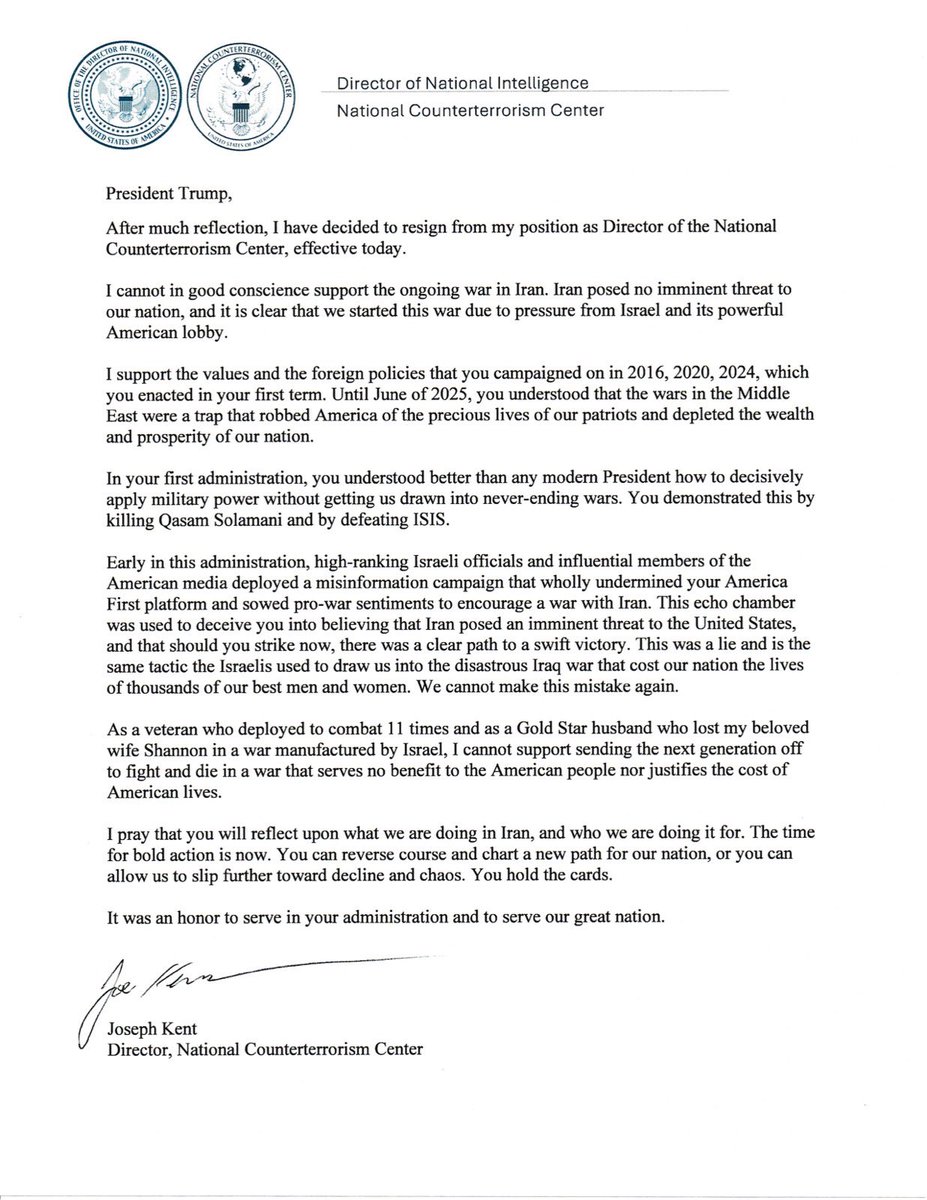
After much reflection, I have decided to resign from my position as Director of the National Counterterrorism Center, effective today.
I cannot in good conscience support the ongoing war in Iran. Iran posed no imminent threat to our nation, and it is clear that we started this war due to pressure from Israel and its powerful American lobby.
It has been an honor serving under @POTUS and @DNIGabbard and leading the professionals at NCTC.
May God bless America.