The CIA released a "Reading Improvement Course" that had been hidden from the public since 1955.
I read all 117 pages so you don't have to.
Here are the 10 most interesting quotes from it:
1) "Good reading is not necessarily rapid reading. The rate must be adjusted to comprehension requirements."
2) "To read well you must concentrate. No activity except perhaps writing or thinking makes more rigorous demands upon the whole mind than reading."
3) "Suggestions to develop your ability to concentrate: Be interested. There is no spur to concentration like honest interest."
4) "Some readers have found certain devices useful in keeping their minds on the subject. One device is to jot down key thoughts as one reads. These words act as a fence to confine our wandering thoughts. The practice of underlining key ideas and making notes at the end of each section serves the same purpose.
5) "Concentration is a habit and must be formed. Habits require, at first, a conscious effort of the will. Force yourself to let nothing come between your mind and the matter on the page before you."
6) "When our attention wanders, words slip by us and leave no trace of meaning. Under such conditions we cannot expect a harvest of logical thought. We go through the motions of study or reading, but do not get results. We waste time that could be used far more pleasantly and profitably."
7) "Drawing conclusions is the final step of the reading process and should be based on sound judgment of the author's qualifications, facts presented, methods of presentation, validity of arguments, or style of presentation."
8) There are 3 types of reading:
Intensive reading: when the purpose is to master new subject material, the skills required are translation, integration, analysis and evaluation. The best procedure is (a) rapid preliminary survey of the material, (b) formulation of questions prior to the reading, (c) careful reading, and (d) review and recitation of important points.
Extensive reading: with the purpose of acquiring a broader frame of reference and widening the range of knowledge. The skills required are integration, analysis, and evaluation. The best procedure is rapid and thorough reading of the material. The extensive reading rate should be as fast as the thinking process permits.
Scanning: for (a) the main idea, (b) specific information and (c) a preview of the material. To read effectively the reader must first review the material and the specific purpose for the reading.
9) The SQAR3 Reading Strategy:
"Scan: Quickly scan the introductory paragraph, subtitles, key sentences, key words, summary. Decide on the author's plan.
Question: Turn the title or key sentences into questions.
Anticipate: Before reading, try to answer these questions mentally.
Read: Read the entire selection and look for the author's ideas to answer your questions.
Recite: Close the book or magazine. Tell yourself in your own words what you have learned. Write notes on material that must be remembered.
Review: Later, to make your knowledge stick, review the gist of the article or chapter, again in your own words."
10) How to read with purpose:
-"Have definite questions which you wish answered through reading a given selection.
-While reading, make a mental note of the main points in the paragraph or article.
-From time to time stop to think over the material just read in preceding section.
-Notice the illustrations and examples that are used.
-Develop the habit of criticizing what you read."
My favorite quote from the report:
"Reading is a pleasure, a source of information, and the basis for most decisions that are made today. It deserves the liveliest interest and the best techniques we can master."
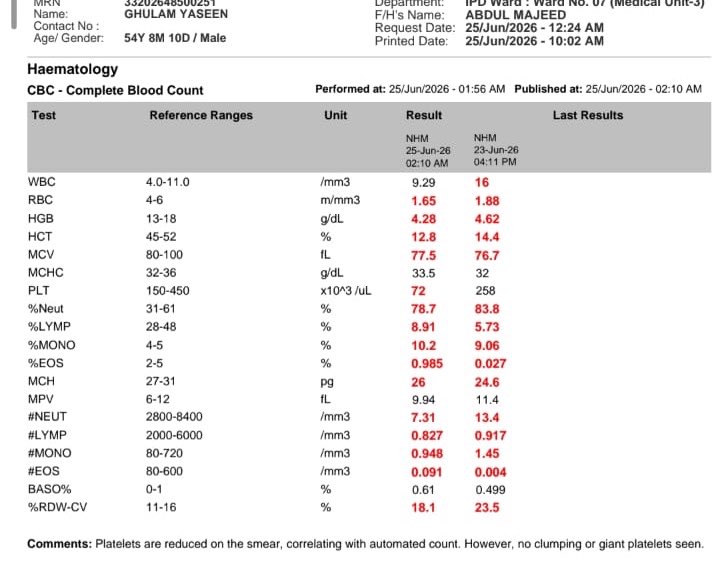
My house officer asked me to break down this CBC in a way that he will never forget. I accepted his challenge.
This is exactly how I explained it to him in the ward:
📚 A New Era in Critical Care Nutrition
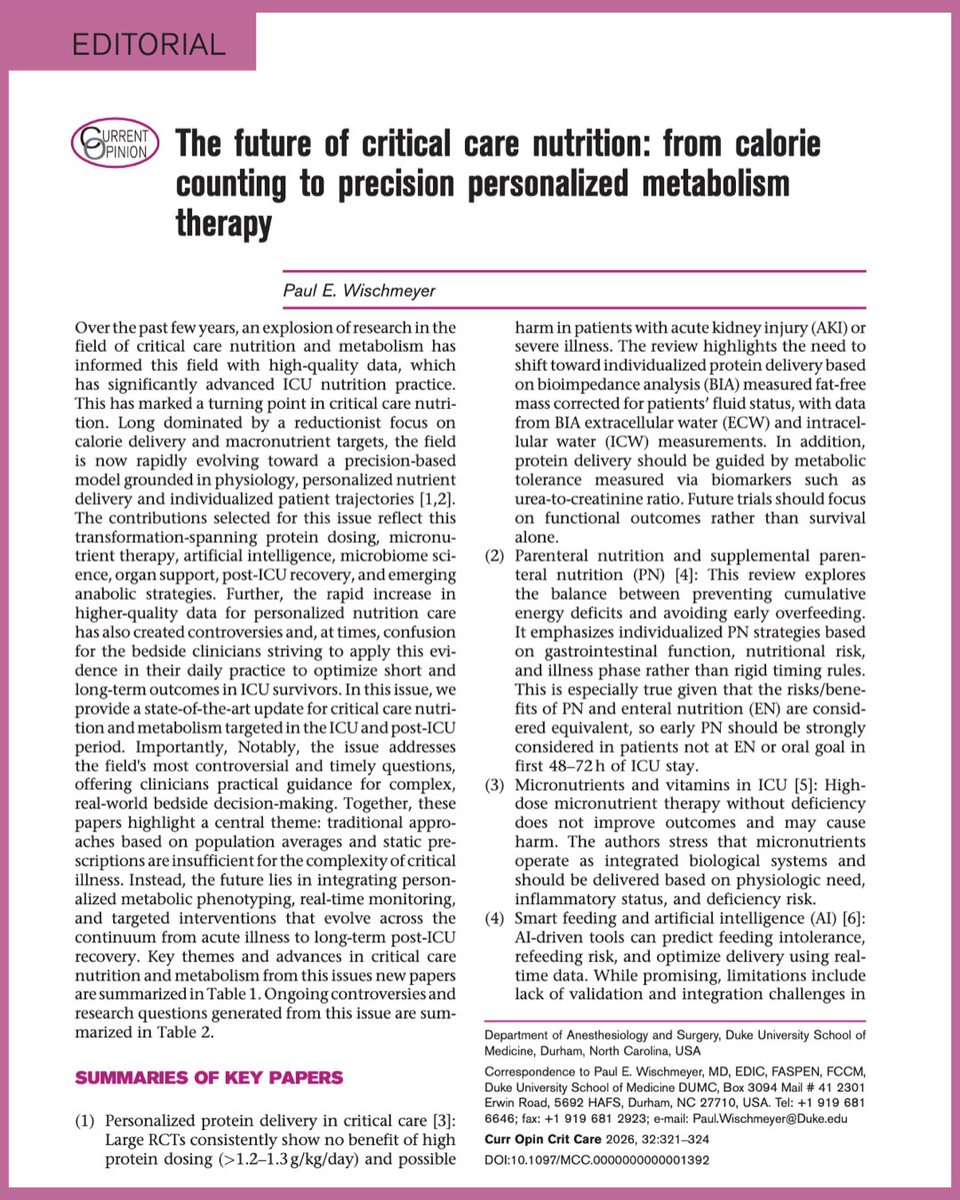
I’m honored to serve as Guest Editor for the new Nutrition & Metabolism issue of Current Opinion in Critical Care. This special issue brings together leading international experts to review the latest science transforming nutrition and metabolism in critically ill patients.
For decades, ICU nutrition focused on calories and protein targets. Today, the field is rapidly evolving toward precision, personalized metabolism therapy—using physiology, technology, and individualized interventions to improve both survival and long-term recovery.
The articles and topics in the issue are highlighted below and include:
🥩 Personalized Protein Delivery — Nienke Overwater, Marjolein Paulus, Linda Schepers & Arthur van Zanten @ArthurvanZanten
💉 Parenteral & Supplemental Parenteral Nutrition — Tam Lac, Lee-anne Chapple & Emma Ridley
@icunutrition
💊 Micronutrient Trials in Critical Illness — Renee Blaauw & Mette Berger
🤖 Smart Feeding: Artificial Intelligence & Integrated Nutrition Platforms — Pierre Singer & Oren Raphaeli
🦠 The Leaky Gut & Microbiome in Critical Illness — Natalie Daniels, Emily Wilson & Mara Serbanescu
🥣 Practical Nutrition (coming in the next issue) — Stephen McClave & Robert Martindale
🫀 Nutrition During ECMO & CRRT — Christian Stoppe, Stefano Marelli & Elisabeth De Waele @ElisabethWaele
🏃 Individualizing Post-ICU Nutrition (coming in the next issue) — Olivier Leeman, Zoë Rosseel, Claude Pichard, and colleagues
💪 Testosterone & Anabolic Therapy to Recover Strength, Function & Quality of Life After Critical Illness — Paul E. Wischmeyer
The central message is clear: critical care nutrition is no longer just about delivering calories—it’s about delivering the right metabolic therapy to the right patient at the right time.
A sincere thank you to all of these outstanding authors for their exceptional contributions to this special issue.
📖 Read the complete Nutrition & Metabolism issue here:
https://t.co/OBEupVIIXm
💬 Which topic do you think will have the greatest impact on improving outcomes in critical illness over the next decade? @Duke_Anesthesia@ICUnutrition
#ICUNutrition #Sccm #criticalcare #icurehab #nutritionmatters
@NutrioSci
I enjoyed putting together this series.
Part III is out today, on the hardest of the three problems: not getting knowledge in, or keeping it there, but pulling it back out when you actually need it.
(1/2)
Most of what you study is gone within a few days.
Part II of my studying series takes on the second problem of memory: keeping what you learned long enough to actually use it.
Read more below.
(1/3)
This 1 hour Yale lecture by Professor Ben Polak on game theory you will ever seen.
It will change how you think about decisions in negotiations, business, and everyday life.
BREAKING: STOP deleting emails when Gmail says you're out of storage.
The biggest storage junk is hiding somewhere else.
I freed 18GB in minutes without touching my inbox.
Here's exactly how to check:
【心エコー】
Cardiac output(CO)が十分かどうか🧸
LVOTのVTIの値を測定することで一回拍出量Stroke volume(SV)が十分かどうかをざっくり確認する🫀
LVOT VTI :15以上…十分 10以下…少ないかも?
それ以外にもVTIはMV、TV、PVでも取れるのでどこが足りないかとかもわかるかも❓
(Ultrasound J. 2020 Dec; 12: 21.:
Rationale for using the velocity–time integral and the minute distance for assessing the stroke volume and cardiac output in point-of-care settings)
We often take circulation for granted, yet it is rarely as simple as it seems. Grateful to these experts for providing fresh insights into hemodynamic management to help us better care for our patients. 🎩 tip to the authors, including @DrMCecconi
https://t.co/Sfr6vCn6le