High end microscopy and image analysis. Guitar technician and amateur luthier. Frustrated rock star, secular humanist, open source and open science fan.
Job alert!
I am looking to recruit a bioimage analyst to work with us the Image Analysis Hub core facility of the @institutpasteur
It is a full time, permanent position as a research engineer, working onsite.
Some details and links below ⬇️
Please forward to your networks!
Just learned: 8% of Caucasian men have a #Colorvision deficiency. EIGHT FRIKIN PERCENT. As an imaging scientist who’s frequently presenting data with LUTs that aren’t #color_blind friendly that’s a call to action.
@Gabr25195Lopez@samwalds @pd_christine We can take any discussion to the https://t.co/SMBIiv6CRV forum. That's a good place for an open discussion. My handle is chalke666 there. Other can also contribute.
@Gabr25195Lopez@samwalds @pd_christine The code can be checked by anyone. We need to be carful what data is fed to the thresholding algorithms. They won't behave as expected if there is numot a roughly gaussian spread of intensity values and an adequate number of pixels for statistical approaches to work.
@Gabr25195Lopez@samwalds @pd_christine Don't try and reverse engineer it. No need. Its open source. Look at the code and see how the algorithms work. Bisection is finding where there is zero corellation below both thresholds, just a better way than starting high and going down step by step.
@Gabr25195Lopez@samwalds @pd_christine Costes method won't work on those images. No intensity distribution. Only 2 values. It assunes a Gauss intensity distribution (which is nit the case in bio images but uts closer than only 2 values. Bisection is a better way to find threshold than stepping. More robust.
@Gabr25195Lopez@samwalds @pd_christine Yes, bit this isn't a realistic situation. Way too few pixels and no almost no intenisty distribution. This is a statistical method. In this example there is no statistical power available. Mock images need to be much more complex in distributions of intensity and large pixel no.
@Gabr25195Lopez@samwalds @pd_christine You example has above threshold PCC having negative value. Anti corellation , which defeats the logic of the method? Can you share the images and region of interest used? Coloc2 needs a region of interest. Never use whole image. Always segment foreground from background.
@Gabr25195Lopez@samwalds @pd_christine Not really sure what you mean by change size squares or degree of overlap. Can you be mathematically explicit? No threshold = all, above threshold = and. There is no or criterion there in the code if I remember correctly. Below threshold is a check for close to 0.
Richard Feynman was a brilliant physicist best known for his exceptional contributions to quantum mechanics and his captivating teaching style, among others.
Here are all of Feynman's Freely available Lectures at one place.
A Thread 🧵
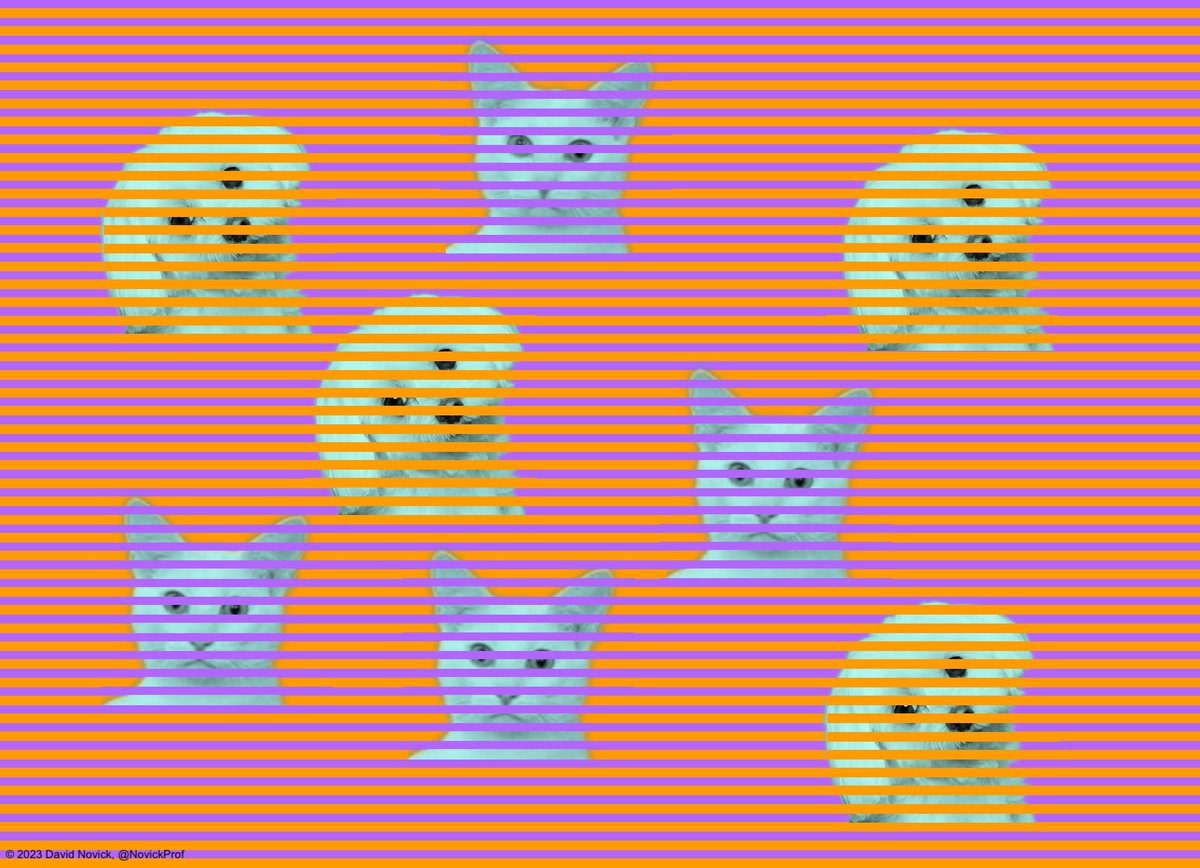
Cats and Dogs 10: In this Munker illusion, the background animals that appear to be yellow and blue actually all have the same base color (RGB 180 255 225). Original .png file is at https://t.co/C5oILhgvpM.
We are starting our first round of hiring---come on over and help shape how image analysis is done and taught @harvardmed.
- Who: Bioimage Analysts, two or more.
- Where: Harvard Medical School, Boston, MA, USA.
- When: Now
#hiring#BioImageAnalysis
https://t.co/hXh7JSZ8Oa
There is a new version of #TrackMate (v7.10.0) available in @FijiSc now. It ships a new tracker, new algos to mend tracks with missing detections, and probably breaks some of your scripts (sorrrrryyyy).
👇
Another bump update in the @FijiSc training notes and resources is now available. Now with labkit segmentation, 3D anlaysis of cells and branching structures in 2D and 3D (see comments for details).
Manual - https://t.co/xghbpigFBt
Demo Images - https://t.co/BDCU1YAzK5