Haemodynamic equations are useful. But they also mislead.
Take:
CO = HR × SV
CO ≈ (MAP − RAP) / SVR
Both are mathematically true. But they can make the variables they contain look like the controllers of output.
Often they are not.
In the intact circulation, these equations describe the resolved state of the system. They do not, by themselves, tell you what is supplying energy, what is constraining flow, or what is actually limiting output.
That is one of the central themes of our review:
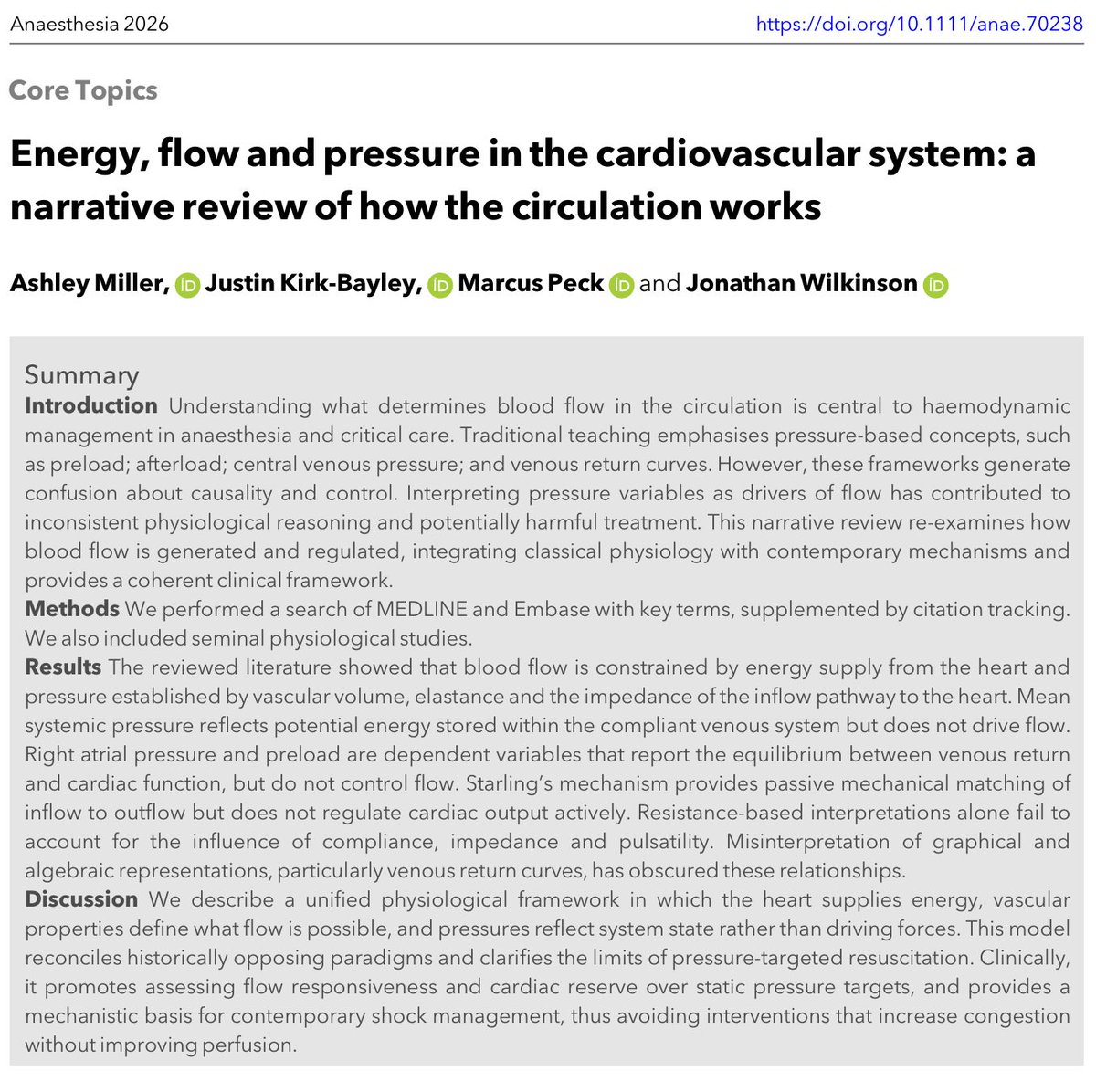
Energy, flow and pressure in the cardiovascular system: a narrative review of how the circulation works.
https://t.co/L19bsDCzr6
Just out in @LancetRespirMed. In a study of 30263 patients with bronchiectasis, those with comorbid diabetes are a high-risk population, with consistent results across 4 major registries. Thanks to BE-China, EMBARC, EMBARC-India and ABR. @ProfJDChalmers https://t.co/Qnxe13QHBR
European Respiratory Review: Targeting obesity, especially with GLP-1 based pharmacotherapy, has rapidly emerged as a potential primary treatment strategy for OSA. Here, we present the pros and cons of this approach. https://t.co/huG6aUIYIR
Lower airway dysbiosis in nontuberculous mycobacteria–positive bronchiectasis is associated with neutrophil extracellular trap–predominant severe phenotypes
https://t.co/S789Nyj3wl
@atscommunity
ERJ Open Research: Asymptomatic tuberculosis detected through health screening predicts favourable treatment outcomes, underscoring the prognostic value of early detection and the importance of symptom-agnostic screening. https://t.co/UppXprjMws
This unassuming little spring bubbles up from the ground at 4,000 feet (1,220 metres) on the Braeriach plateau, and is the source of the River Dee. It has never been known to run dry, even in the hottest and driest years. Where the water comes from is not certain.
1/ We are thrilled to share our collaborative study of B cells producing auto-Abs neutralizing type I IFNs in @CellPressNews (https://t.co/oNNxc3Rnqe).
Just published in @ERSpublications ERJOR. The AIRTIVITY trial protocol.
Testing Verducatib in bronchiectasis: for the first time treating for up to 76 weeks, including CF with other forms of bronchiectasis and including individuals with earlier disease.
https://t.co/JgRw6oKZYz
ERJ Open Research: Severe asthma patients often accumulate high corticosteroid doses prior to biologic therapy and the majority occurs before specialist care. Inhaled corticosteroids also contribute greatly to the cumulative corticosteroid burden. https://t.co/bTOBOmRCyX
A huge thank you to the large international team that put this together include my research group at the University of Dundee/University of Oxford, EMBARC, The ERS, Astrazeneca, a huge thank you to Insmed, and the patients who participated in these studies.
A study 10 years in the making, just published in @LancetRespirMed
How do DPP1 inhibitors really work in bronchiectasis?
We show a novel mechanism for treatment efficacy, by inhibiting Azurocidin-1, a ciliotoxin, DPP1i can enhance mucociliary clearance.
https://t.co/eVR7fhgW7w
The New @EuroRespSoc Bronchiectasis Guidelines explained with clinical scenarios, case studies and algorithms.
Just published in Breathe: A Clinical Summary to the ERS Bronchiectasis Guidelines
@OSibila@MereteLong@Beika_Physio@AlibertiStefano
https://t.co/C5boUJjBIy
Using spatial transcriptomics, we mapped the cellular architecture of pulmonary granulomas at unprecedented resolution in patients with chronic sarcoidosis.
1/ Thrilled to share a Perspective that summarizes 30 years of work from the many labs studying the human genetic and immunological causes of infectious diseases: https://t.co/jdgw3gOWl9
Transcriptomic profiling in Mycobacterium avium complex pulmonary disease identifies clusters linked to disease severity and neutrophil activation
Gene expression profiles highlight the diversity of patients with MAC pulmonary disease
@UNIV_TSUKUBA_EN
https://t.co/RKbAwf6XRt