Always the person people call in a crisis.
Doctor. Founder of @beinglagom - spaces where healthcare workers put themselves back together.
I write about what systems do to people.
Met the Dalai Lama. Still deciding what kind of plant the dark made me.
Start here ↓
Extremely Rare Red Sprites Spotted Flashing Over Tibet. They are caused by high levels of electrical activity and form in the upper atmosphere during powerful thunderstorms.
If you want to increase your ability to concentrate and have more control over your own mind, try this exercise daily for 5 minutes. It was created by one of the most intelligent men of the 20th century, Rudolf Steiner.
Use an ordinary object (a pencil, clothe spin, clip, book, etc.) and think about it for five minutes every day. You take an object in front of you or in your mind and the first time you describe it to yourself aloud. You can also imagine yourself describing it to a blind person.
Use all your senses and make as many observations as you can in five minutes. Repeat this the next day, you will probably notice new details.
After a while you can ask questions about the object: "What can I do with it?", "What is it made of?", "Why this shape?", "What other shapes could it have?", "Where was it made?", "How did I get it?"," How are the raw materials mined?", etc. You will be able to answer some of these questions. If not, you can search for an answer in an encyclopaedia or on the internet.
Your should be able to determine whether your thoughts are correct, otherwise your thoughts will wander. which is not the intention.
You can repeat what you did the day before and build on your previous thoughts. After some time you will have covered all possible questions, then do it one or two more times until you can really find no more issues to think about. Then follow the same procedure with another object.
When doing this exercise you may notice that your thinking gets clearer and sharper, and that your perception, concentration and objectivity increase. Also, your interest grows.
The difficulty of the exercise is that your mind wanders. The challenge is to be able to think about the object for five minutes, but you will find that your mind wanders to something else very easily, that your thoughts are associative and work automatically. E.g. you think of a pencil and suddenly you see in your mind your grandma with a pencil in her hand, grandma has a budgerigar and suddenly you are thinking about the whistling of this bird. Interrupt such thoughts: you wanted to think about the pencil.
The exercise is called control of the mind. The example just given shows that often there is no control over our thinking. We are thought, our thinking is associative and automatic. We believe that we think, but our thinking is often not focused.
Make sure that you do the exercise every day. You can choose a fixed time. Choose a time when you are awake and clear-headed, so not after dinner, but for example before or after breakfast or at 8 o'clock at night. You can also do it while waiting for the train, in a spare moment. Doing the exercise with two or three objects should be sufficient.
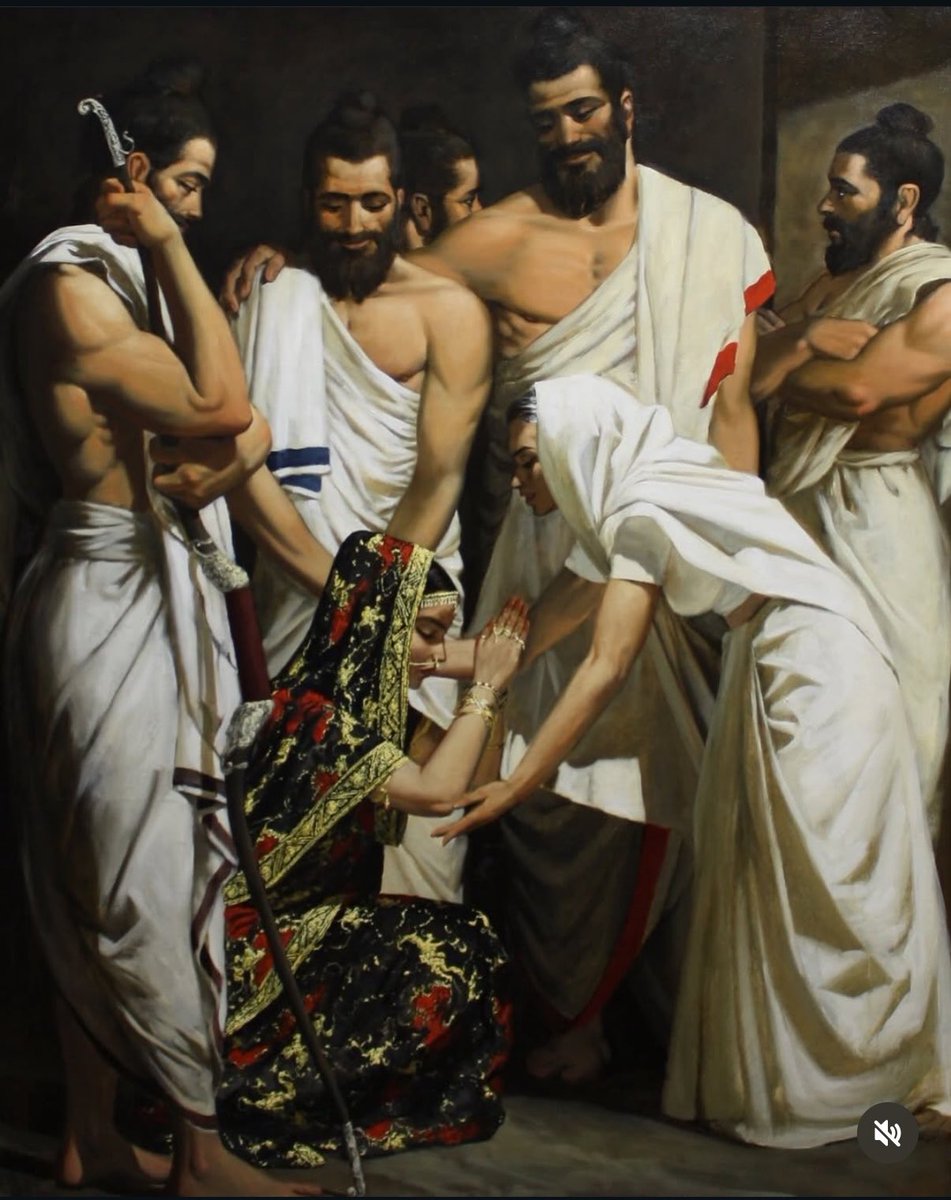
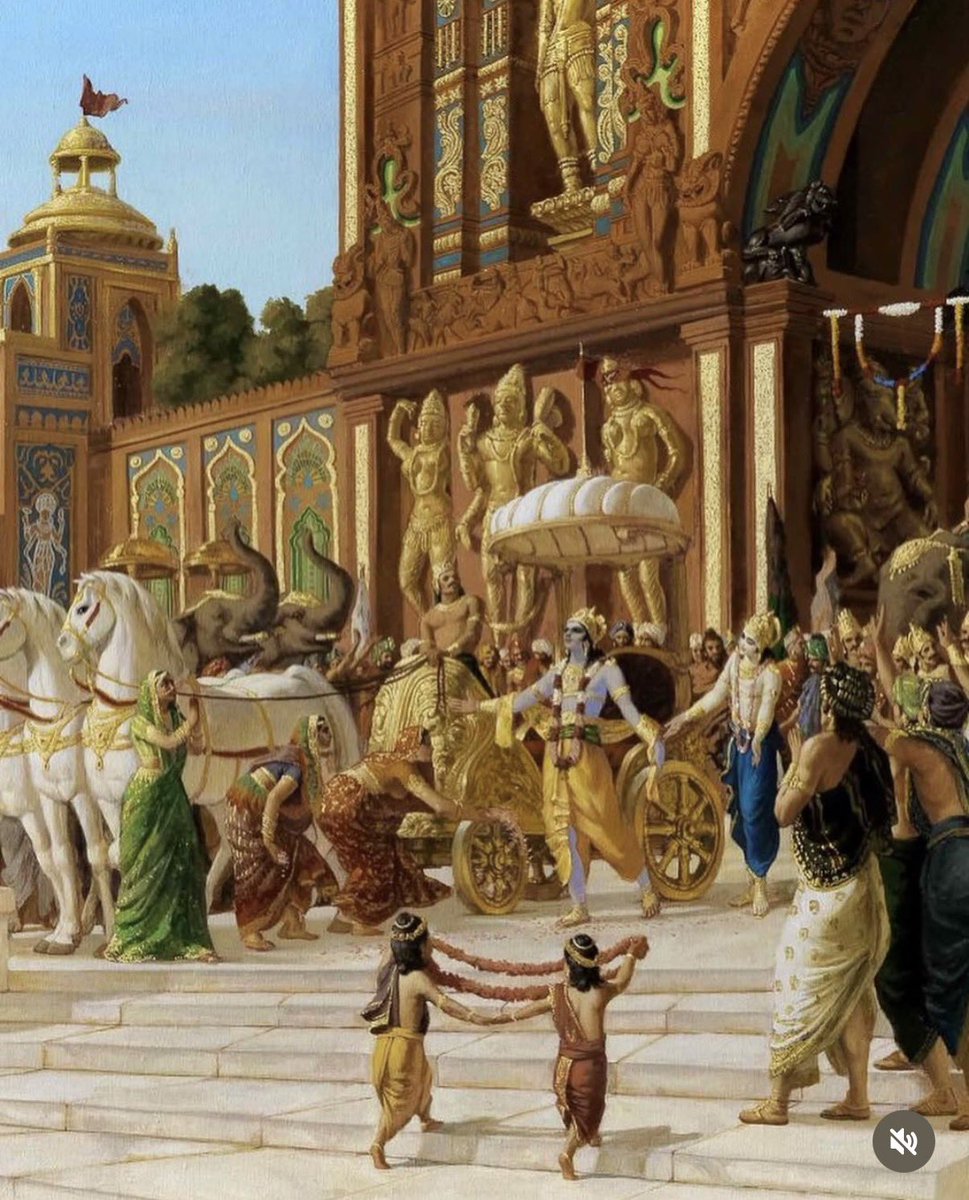
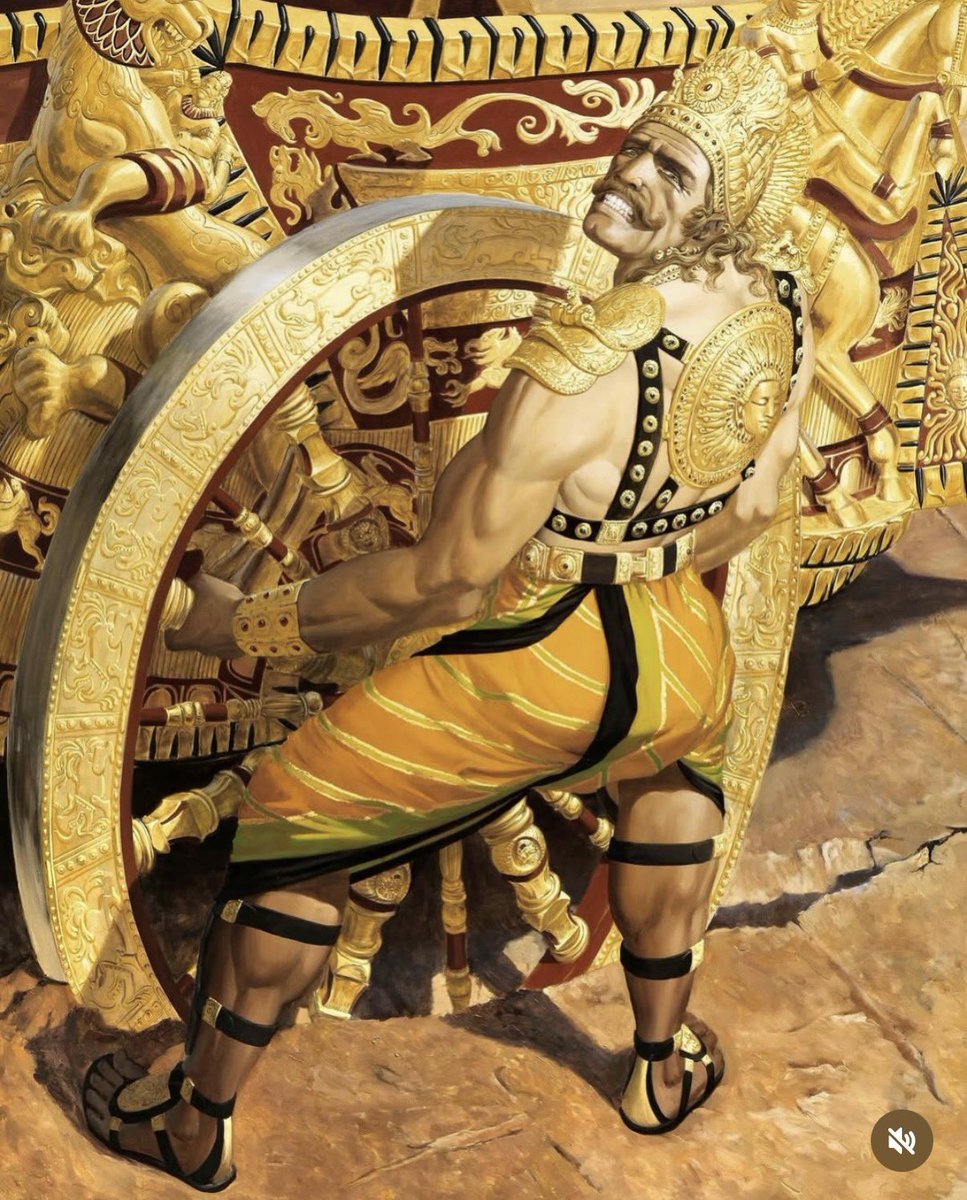
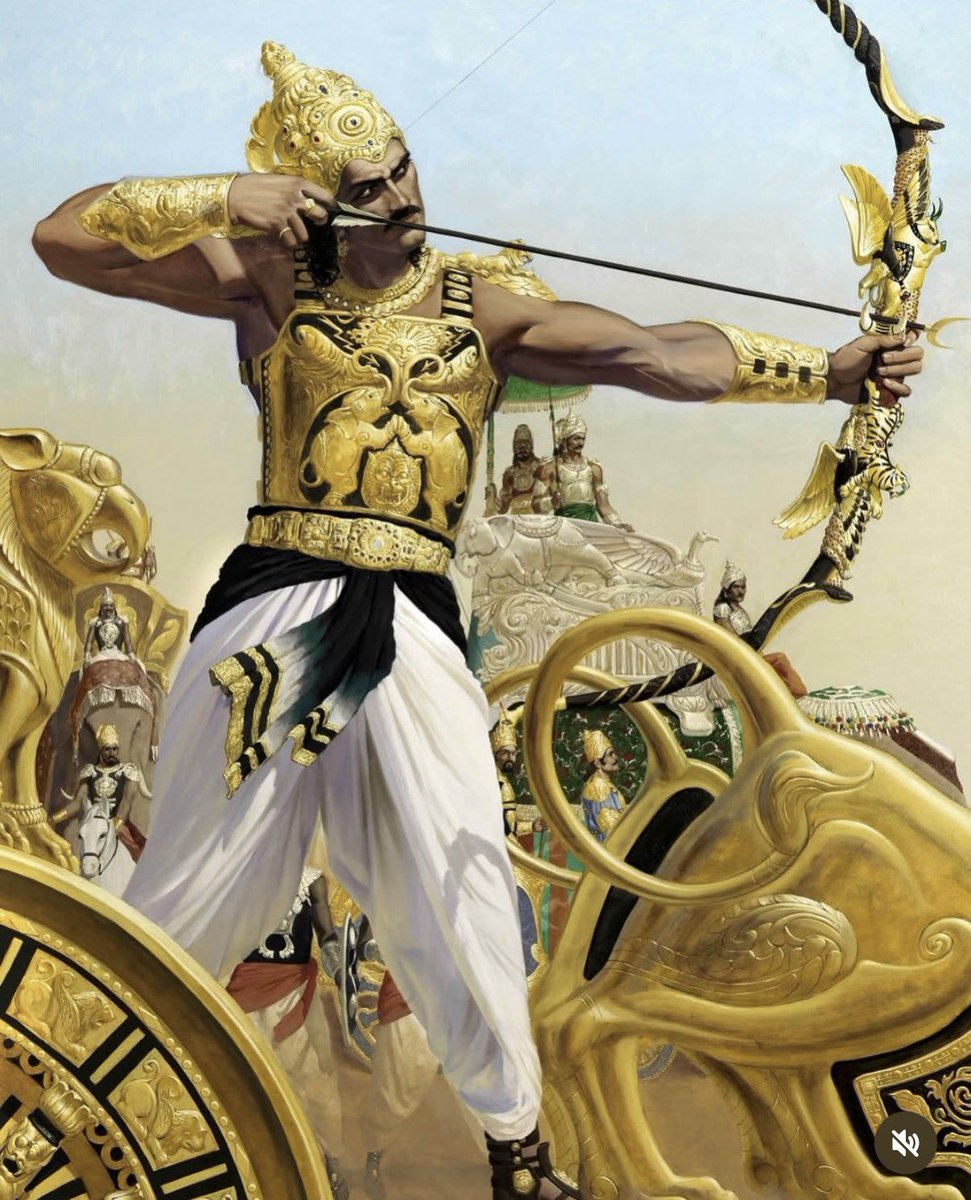
Today I discovered that there is an Italian artist @GTomassettiArt who has been making large oil paintings inspired by the Mahabharata.
Stunning artwork!
I just ordered the book too.
I’ve been reading the Vedas a lot recently, and what’s stood out is how it doubles as an encyclopedia as well as a religious text. Astronomy, medicine, mathematics, metallurgy, linguistics, are all woven through hymns and rituals as one body of knowledge. Simply calling it “religious” forces it into a Western category that didn’t have the apparatus to recognize what it actually was. It’s closer to a tradition of formalized epistemology in which metaphysics, observation, and language form one continuous inquiry, which as a result led Indian civilization to develop along a fundamentally different path because of it.
You can see the effect most clearly in the sciences. Around 600 BCE, the Vedic record describes a surgical procedure that matches modern rhinoplasty and is still foundational to reconstructive surgery today. Centuries before Western Europe stopped treating eclipses as supernatural, Indian scholars had calculated the circumference of the earth within 0.2% and explained eclipses as shadows. Centuries before Plato and Aristotle rejected atomism, the Vedic tradition already held that matter is composed of indivisible particles combining into binary and triatomic compounds, transformable by heat. The first formal rules for zero and negative arithmetic appear in the Vedas, along with infinite-series derivations of π, sine, and cosine centuries before Newton and Leibniz.
The interesting question is how did they get so much right, so early? My best guess is language.
The Vedic tradition is unique compared to other oral traditions as it demanded letter-perfect oral transmission across generations. Around 500 BCE, scholars composed a generative grammar of Sanskrit called Panini so rigorous it anticipates Backus-Naur form, the notation that defines programming languages today, by 2,500 years. Sanskrit is recursive, rule-based, and built to minimize ambiguity. It reads more like mathematics than English.
When you think in a language built like that, the precision of the language becomes the precision of your reasoning. The West didn’t formalize this until much later. Kant argued our categories of understanding shape what we can know, Wittgenstein wrote that the limits of language are the limits of one’s world, and Kripke showed that naming doesn’t just describe things, it constitutes what they mean and how we can reason about them. All three touch the same insight which is that thought is downstream of language.
The Vedic tradition operated on that insight thousands of years earlier. To the point that they built a whole language first and used it to think clearly about everything else after. I find that all really fascinating.
saw this comment by Reeva:
"How beautiful it is, the story of security. The human body no longer feels threatened by the immense ocean capable of ripping it to shreds. The waves now beat on the rocks, as heart beats on the bones. How beautiful it is, the story of routine.."
you need to be delusionally optimistic
negative thinking poisons your brain and leads to congitive decline
whereas positive thinking, and gaslighting yourself into thinking everything is amazing, ACTUALLY makes your life amazing too.
you must be a silly goose
> be Puṣyamitra Śuṅga.
> literally the Senapati (Commander-in-Chief) who looked at a crumbling empire and said, "Fine, I’ll do it myself."
> year is around 185 BCE. The Mauryan Empire has gone soft. Decades of state-sponsored pacifism have left the borders porous and the military demoralised.
> The Yavana-Mlecchas (Indo-Greeks from Bactria) are mobilising. They think India is free real estate.
> Last Mauryan Emperor, Bṛhadratha, is completely clueless and too weak to defend Āryāvarta.
> Puṣyamitra organises a massive military review (Senā-darśana) at Pāṭaliputra.
> casually draws his sword and assassinates the Emperor in plain sight of the entire imperial army.
> The army doesn't mutiny. They literally cheer for him and declare him the new Samrāt. Absolute Senāpati supremacy.
> Western historians cope by calling it a "military coup." Indian history calls it civilizational course-correction.
> The Greeks, led by Demetrius and Menander, breach the frontiers and march deep into the heartland, besieging Sāketa (Ayodhya), Mathurā, and threatening Pāṭaliputra itself.
> Puṣyamitra drops the hammer. He rallies the fractured Indian forces and utterly obliterates the Hellenistic war machine, driving the Greeks all the way back to the Indus.
> Greek phalanxes met Vedic steel, and the Greeks lost.
> but wait, he wasn't just a warlord. He was the ultimate restorer of Sanātana Dharma.
> single-handedly ended the era of state-enforced religious pacifism and revived the martial and spiritual ethos of the Vedic civilisation.
> to assert absolute, unquestionable sovereignty, he revives the ancient 'Aśvamedha Yajña' (Horse Sacrifice).
> He didn't do it once. The Ayodhya Inscription confirms he performed the Aśvamedha twice (Dvir-aśvamedha-yājin). Absolute paramountcy.
> Let the majestic sacrificial horse roam free across the subcontinent. He puts his teenage grandson, Vasumitra, in charge of guarding it with a contingent of cavalry.
> The Greeks try to capture the horse on the banks of the Sindhu river.
> Teenage Vasumitra absolutely massacres the seasoned Yavana forces, rescues the horse, and secures the frontier. The Chad bloodline is genetically undeniable.
> Puṣyamitra writes a letter to his son Agnimitra basically saying: "Your boy just styled on the Greeks. The horse is safe. Pull up to the Yajña." Peak grandfather flex.
> His court was the ultimate intellectual hub. The legendary sage Patañjali - author of the Mahābhāṣya (the greatest treatise on Sanskrit grammar) - was his contemporary and chief priest.
> Patañjali literally uses the defeat of the Greeks as a grammar example in his book: “Aruṇad Yavano Sāketam” (The Yavana besieged Ayodhya - implying an event that just happened and was crushed by his patron).
> Buddhist texts (like the Aśokāvadāna) cope and seethe, painting him as a villain because he showed zero tolerance for certain monasteries that acted as fifth columns and aided the invading Greek armies.
> treason gets you the sword. No exceptions when the civilisation is at stake.
> Senāpati, Samrāt, Yavana-Destroyer, Patron of Patañjali, and the architect of the Brāhmaṇical Renaissance.
> The man who refused to let India fade into the dark pages of history.