Over the past 10 years, my “words” have generated millions of dollars in revenue.
At the core of this is copywriting.
It is one of the most valuable skills you can build as a writer.
So here are the 20 copywriting laws I live by—which you should hang on your wall:
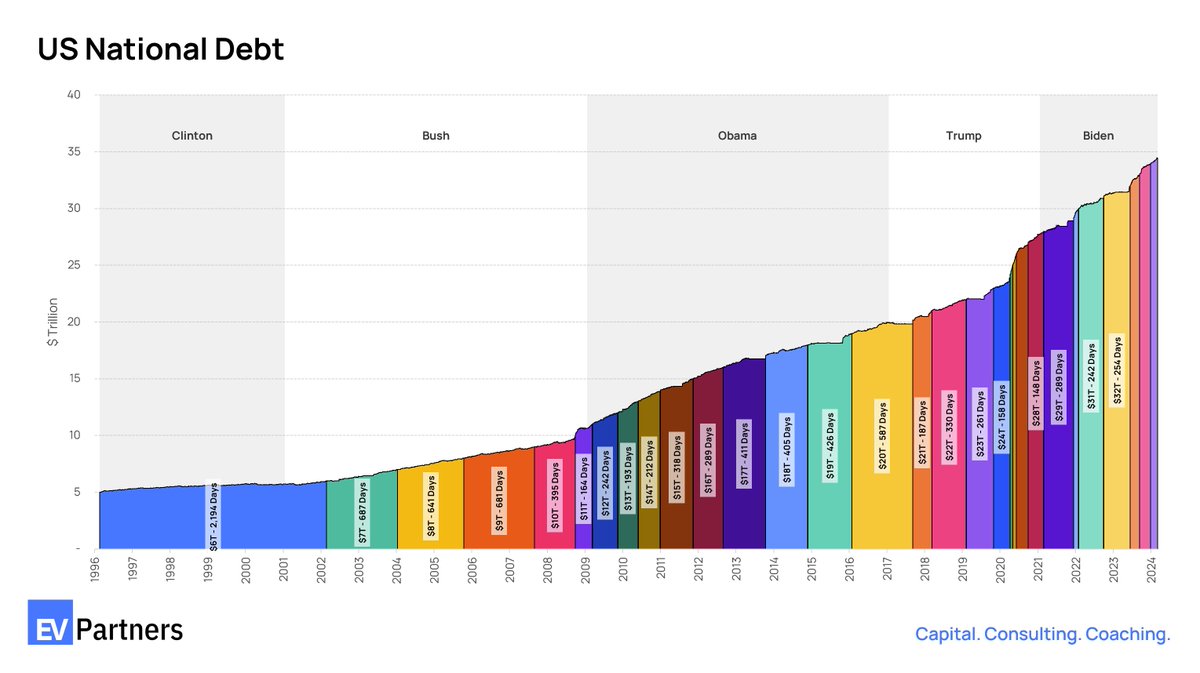
This is the scariest chart I’ve ever made. This is what it looks like when a country is heading toward a financial precipice.
Each color shows $1T getting added to the national debt.
Not that long ago, it took six years to add a bar.
We’re now adding one every 90-120 days.
The explosion of debt has been the only bipartisan phenomenon of my lifetime. For us conservatives, we can’t blame it on just Biden and Obama. For you Democrats, you can’t put this on just Trump. It’s both parties, all presidents, and every Congress.
The acceleration started under George W. Bush. Bush went into 2002 with less than $6T of debt. Thanks to GWOT military spending and tax cuts we probably couldn’t afford, $6T grew to $7T in 23 months, $8T in another 21 months, and $9T in 23 months.
Then the Great Recession hit. We added the next trillion in 13 months, crossing $10T for the first time in American history. And we haven’t looked back since.
During the second Obama term, with spending reined in by the Tea Party movement, annual deficits reduced to less than $1T, and growth in the debt slowed down. At the end of Obama’s tenure, it took nearly 20 months to go from $19T to $20T.
That would be the last time it took a full year to add a trillion dollars to the debt.
In 2017, a real-estate developer got inaugurated as president. And, if there’s one thing we all know—and love!—about real-estate investors, it’s that they understand the value of leverage.
Under Trump, even as the economy surged, deficits grew, and national debt once again spiraled. We ended 2019 with a little over $24T in debt.
Then Covid hit, along with consumer stimulus, PPP loans, massive government spending, and reduced tax receipts. Over just two months in 2020—April and May—we added $2T to the national debt. Ever since, we’ve been adding $1T every 160 or so days.
With Biden in the White House and a narrowly divided Congress, we’re now adding $1T to the debt every three to four months. It took just 91 days to go from $32T to $33T. 104 days to get to $34T.
And it’s not slowing down. Biden has another 300+ days in office this term. When he or Trump enters their second respective term in office in 2025, the debt will likely be above $37T.
Where does it end? As deficits continue to pile up and borrowing costs remain relatively high compared to where they were over the previous 20 years, how is any of this sustainable?
Can you write for a general audience? Can you write in the style of business? What about writing online?
Can you speak publicly? Can you pitch ideas? 💡
Can you interview others and truly listen?
Can you learn about media, business, human psychology and philosophy?
3/3
I love the T-shaped model of skill development and think this is what a lot of scientists lack.
To put all one’s eggs in the academic track basket (the vertical), in one sub-topic of one field, can be catastrophic if things don’t work out.
What to do?
1/3🧵
As researchers we need to take the time to diversify. Take some time to work on the horizontal.
And I don’t just mean across disciplines of science.
I mean other skills and focus areas.
Some of my recommendations…
👇
2/3
The 2 biggest determinants of your behaviour, and what it says human decision-making:
1. Habit (I’ve done this = OK)
2. Social copying (everyone else can validate this)
Most of our mental default mode focuses not on optimal decisions, but on avoiding disaster i.e. satisficing
We think we act according to objective reality, but theres a different reason.
We act according to the emotions generated by the meaning we derive from the world.
Explains why the major value of any product is created in the head of the consumer. Feel, not just raw function.
New ideas in early stages are often worse than established ideas. Original cars were worse than horse & carriage. Same for typewriters vs handwriting
From new idea to true innovation is funded by the early adopters: a handful of (wealthy) people driven by status/novelty seeking
Want something from someone? Don’t say “Can you do me a favor” or “Sorry to bother you”
Instead say “I wonder if you can help me…”
- Raises status of the person hearing it
- Difficult to say no
- You position them as someone who can actively help, which makes them feel good
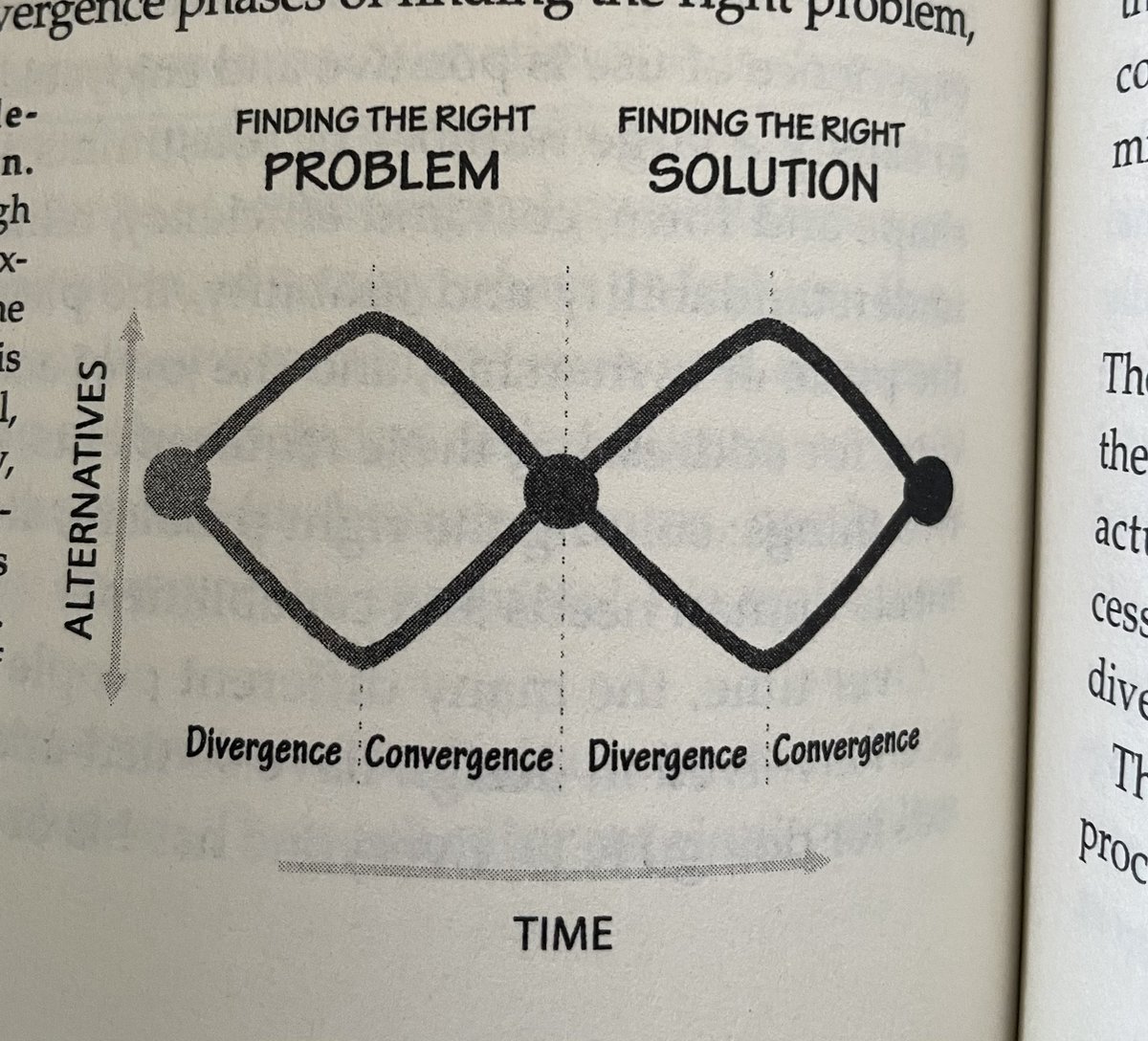
How simple geometry can solve your problems. Double-diamond model of design: diverge to examine all issues, then converge upon single problem statement. Likewise diverge & converge on possible solutions.
Discover & define; develop & deliver.
@jnd1er Design of Everyday Things
65% of the value of all business equity is owned by baby boomers.
How can we demonstrate modern value to those people to take over/elevate those businesses? Can you turn a “boring” business into an exciting one?
9/9
Amazing conversation between @DanielPriestley and @StevenBartlett https://t.co/1DRtlztfxu
🧵so many gems I need to track 1/9
When you pitch, you’re not just explaining your idea, you’re enrolling someone into your vision.
Organise & balance teams with complementary energies, akin to a deck of cards
♣️- visionaries, who have head in the clouds
♠️ - they dig in and do the work
♥️- connect with people
♦️ - manage money or data
E.g. Clubs with Spades; Hearts with Diamonds
8/9