A Chinese student builds a website that allows users to see the distribution of flowers around the world at a glance. The site visually displays records of vegetation growth and allows users to filter plants by type, climate, altitude, and other criteria. It also includes a global real-time weather system, making it an interactive tool for understanding nature and the distribution of plants across the planet. 🌍🌸
https://t.co/IhPlaztXej
Last quarter I rolled out Microsoft Copilot to 4,000 employees.
$30 per seat per month.
$1.4 million annually.
I called it "digital transformation."
The board loved that phrase.
They approved it in eleven minutes.
No one asked what it would actually do.
Including me.
I told everyone it would "10x productivity."
That's not a real number.
But it sounds like one.
HR asked how we'd measure the 10x.
I said we'd "leverage analytics dashboards."
They stopped asking.
Three months later I checked the usage reports.
47 people had opened it.
12 had used it more than once.
One of them was me.
I used it to summarize an email I could have read in 30 seconds.
It took 45 seconds.
Plus the time it took to fix the hallucinations.
But I called it a "pilot success."
Success means the pilot didn't visibly fail.
The CFO asked about ROI.
I showed him a graph.
The graph went up and to the right.
It measured "AI enablement."
I made that metric up.
He nodded approvingly.
We're "AI-enabled" now.
I don't know what that means.
But it's in our investor deck.
A senior developer asked why we didn't use Claude or ChatGPT.
I said we needed "enterprise-grade security."
He asked what that meant.
I said "compliance."
He asked which compliance.
I said "all of them."
He looked skeptical.
I scheduled him for a "career development conversation."
He stopped asking questions.
Microsoft sent a case study team.
They wanted to feature us as a success story.
I told them we "saved 40,000 hours."
I calculated that number by multiplying employees by a number I made up.
They didn't verify it.
They never do.
Now we're on Microsoft's website.
"Global enterprise achieves 40,000 hours of productivity gains with Copilot."
The CEO shared it on LinkedIn.
He got 3,000 likes.
He's never used Copilot.
None of the executives have.
We have an exemption.
"Strategic focus requires minimal digital distraction."
I wrote that policy.
The licenses renew next month.
I'm requesting an expansion.
5,000 more seats.
We haven't used the first 4,000.
But this time we'll "drive adoption."
Adoption means mandatory training.
Training means a 45-minute webinar no one watches.
But completion will be tracked.
Completion is a metric.
Metrics go in dashboards.
Dashboards go in board presentations.
Board presentations get me promoted.
I'll be SVP by Q3.
I still don't know what Copilot does.
But I know what it's for.
It's for showing we're "investing in AI."
Investment means spending.
Spending means commitment.
Commitment means we're serious about the future.
The future is whatever I say it is.
As long as the graph goes up and to the right.
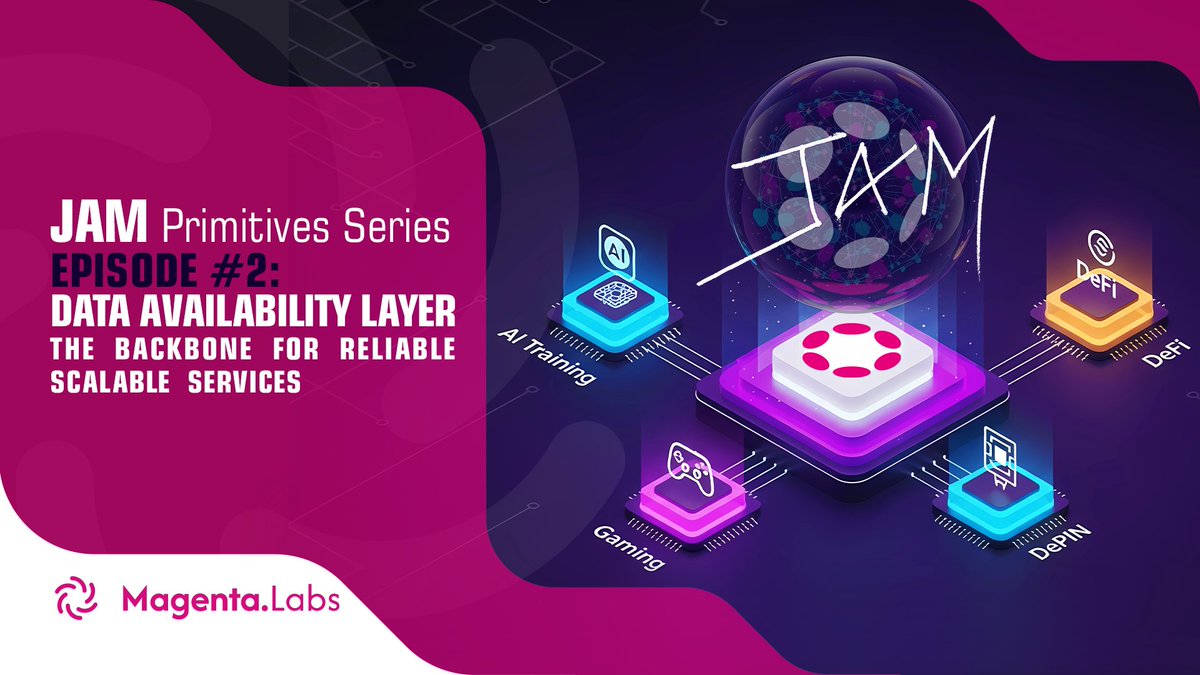
JAM Primitives Series
Episode #2: Data Availability Layer, The Backbone for Reliable, Scalable Services
Building data-heavy apps hits the same wall everywhere: chains bloat with state, validators choke on storage, off-chain solutions flake during peaks.
@Polkadot JAM's Data Availability Layer solves this by making data immediately accessible within cores but globally propagated over time, no chain bloat, no centralized trust.
How it works:
During Refine (parallel execution), your service writes data blobs with no size limits. Erasure coding splits blobs into chunks with redundancy, validators store headers and proofs, not full data. Random sampling verifies availability without full replication.
Data expires after one block unless renewed via fees, ephemeral writes slash costs 90% versus permanent on-chain storage. Need it globally? Propagates across validator sets over 1-N blocks for cross-core access.
Builder advantages:
• AI training: Shard datasets across cores, verify via proofs, federated learning at exabyte scale.
• DeFi: Store order books off-chain, anchor hashes for audits.
• Gaming: Handle massive asset data without state bloat.
• DePIN: Process millions of sensor streams affordably.
Unlike Ethereum's 64KB blob limits or Celestia's siloed approach, JAM's DA integrates natively with execution, reads feel instant, writes stay cheap, security inherits from 700+ validators staking $5B+ DOT.
Test on upcoming JAM testnets Q4 2025. Join JAM Prize (10M DOT) for DA innovations.
Next episode: PolkaVM.
JAM Primitives Series
Episode #1: Refine-Accumulate – What It Means for Builders
Imagine tapping into a distributed super-computer built on the @Polkadot ecosystem, one where you can rent specialized execution cores, carry out heavy compute tasks in parallel, then funnel the results into a secure, global settlement layer. That’s the architecture that the JAM (Join-Accumulate Machine) proposes.
Refine: Parallel heavy-lifting
In the Refine phase, work is handed off to cores, subsets of validators that execute tasks in parallel (what JAM calls “in-core execution”). This is ideal for large-scale workloads: imagine training ML models across many nodes, aggregating thousands of oracle feeds, rendering heavy game frames, or performing simulation batches. Because only the core’s validators handle the execution, cost and resource usage can be kept in check. Intermediate data can be persisted in the network’s data-availability layer rather than bloating main-chain state. The architecture envisions pause-and-resume support for long-running processes.
Accumulate: Global finality
Once computation across cores is complete, the Accumulate phase begins, where all validators participate to merge results, verify correctness and commit to the global state (what JAM calls “on-chain execution”). This ensures economic security, coherence and full settlement: oracle results are finalized, aggregated predictions become globally visible, financial flows or state updates are locked in.
Why this split matters
• Scalability via Refine: many cores working in parallel, running compute-intensive workflows in a distributed fashion.
• Security and coherence via Accumulate: the global validator set finalizes and secures the results.
• Flexible access to compute: builders can access cores on-demand (via an “Agile Coretime” model) rather than being limited to fixed parachain slot auctions.
• Built for diverse workloads: AI-developers can shard model training in Refine and finalize in Accumulate; DeFi builders can process many transactions or state transitions in parallel then settle globally. This architecture is less about traditional blockchain “transactions” and more about composable compute primitives.
JAM isn’t just a blockchain update. It’s a reframing of how execution, state and data-availability work on Polkadot. For builders, this means direct control over compute, state and data-layers in a modular, scalable environment.
Stay tuned for Episode #2: A deeper look into the Data Availability layer and how builders can leverage it.
To those that keep calling for ALT Season:
In order for ALT Season to happen, ETH needs to go to $5k+ and hold it as support.
For ETH to go to $5k *AND* hold it as support, it means BTC needs to also go to all time highs.
The process of BTC going to all time highs would make BTC dominance go higher, just like it has all cycle.
So the only way to get an "ALT Season" is for BTC.D to first go up as BTC goes to new highs.
If that does not happen, then ALT Season does not happen.
So while the gurus sit out here and yap about BTC.D dropping now and they shill their shitcoins once again, just remember in order to get what they want, they first have to be wrong.
AGAIN.
🚨BREAKING: Crypto liquidations soar to $9.4 BILLION in 24 hours – the LARGEST single-day event ever.
Bigger than LUNA. Bigger than COVID. Bigger than FTX.
We just witnessed history.
🚨 Due to heavy market activity, our systems are under high load. Some users may experience intermittent delays or display issues.
We’re actively monitoring the situation and working to resolve it. Funds are SAFU.
Thank you for your patience!
🔧 There’s a lot of chatter about @Polkadot's 2025 upgrade.
We’ve pulled it all together in one place so you can stay up-to-date and clear on what’s happening.
Asynchronous Backing, Agile Coretime, Elastic Scaling, and Smart Contracts.
Polkadot Upgrade 2025: What You Need to Know 🔗👇
This outline still follows...
ETH/BTC has bottomed ✅
ALT/ETH will bleed ✅
ALT/BTC is going up but lagging ETH/BTC ✅
ALT/BTC tops late August ❓
BTC.D rally in Sep-Oct ❓
ALT/BTC pairs go to 0.25 ❓
ETH/BTC higher low❓
My base case for those who don't get the nuanced view:
BTC.D rejected at 0.786 Fib Level (66%) just like it was rejected at 0.618 Fib level (60%) last year.
ALT/BTC is up because ETH/BTC is up
But ALT/ETH is bleeding
So ETH is better than ALTs.
Remember ALT/BTC pairs have found a local low every June from 2022-2025).
ALT/BTC rally will likely end by late August at the latest
BTC.D rally in Sep-Oct
ETH/BTC higher low in Sep/Oct
ALT/BTC pairs lower low in Sep/Oct (could be beginning of Nov).
Hard to know if the next rally by BTC.D leads to a higher high even if ALT/BTC pairs put in a lower low (as it depends on how high the next higher low is for ETH/BTC).
Look at what ALT/BTC pairs did from July-August of 2017 and see how they still dropped to 0.25 by late October.
Look at how while ALT/BTC pairs are up, ALT/ETH pairs are down 40% since ETH "went home."
I could be wrong about any one of these views, but these are my views.
When something I posted above is inevitably wrong, you are welcome to post this receipt and laugh.
Also, I'm not talking about your alt.
‼️IMPORTANT:
More than 13,000 videos documenting Israel’s warcrimes archived by type, date, location, weapons Israel used in the genocide, crimes of each military unit and all details available here: https://t.co/uBCrMsErio
Website made by @receipts_lol
E124: @gavofyork reveals why crypto has failed and how network founders can work together to save it!
Gavin Wood is the co-founder of Ethereum, the creator of the EVM and the Solidity language, and the Founder of @Polkadot & @paritytech
Timestamps:
0:00 Introduction
1:59 Partnerships:@JupiterExchange, @bitwise, @SuiNetwork, @Mantle_Official, @ForzaBitcoin
2:40 Spending Crypto with @KASTcard
6:26 Stablecoins Are Just Banks
7:26 Regulation Destroys Web3 Vision
11:20 Self-Custody with @Trezor
12:13 The Illusion of Free Society
14:27 Self-Sovereignty or Societal Collapse
15:59 Why I Stopped Trusting Systems
18:46 Attaining Self-Sovereignty
24:33 Rethinking the Social Contract
27:27 Network States Need Territory
33:09 Can Networks Work Together?
39:28 Why Blockchain Governance Is Broken
45:41 DAOs Are Just Better Governments
50:04 Democracy Fails Without Shared Fate
53:10 Turning Greed Into Alignment
56:07 Polkadot’s Mixed Governance Results
58:25 Polkadot’s Transparency Problem
1:06:39 Network Founders’ Hardest Problems
1:09:36 Why I Hate Managing
1:11:57 From CEO To Architect
1:13:21 Defining Good for Polkadot
1:14:56 Letting Go Of Control
1:18:29 Charismatic Leaders vs Protocols
1:23:53 Polkadot Without Gavin Wood
1:26:58 Bitcoin as Digital Gold
1:31:44 Bitcoin: Swiss Bank In Pocket
1:33:33 Does Best Tech Always Win?
1:38:03 Solve Hard Problems, Products Will Follow
1:45:37 Fart Coins and Financial Escapism
1:49:51 Ethereum L2s vs Polkadot Parachains
2:03:20 Building useful stuff on Parachains like @EnterTheMythos & @mythicalgames
2:04:34 Multi-Core Elastic Scaling
2:10:08 JAM vs. Ethereum Explained
2:20:51 Is JAM Good For Polkadot?
2:22:33 Ethereum’s Layer Two Mistake
2:24:48 The L2 Power Grab
2:26:25 Has Crypto Failed?
2:32:02 Rebuilding Crypto’s Core Ethos
2:36:51 The Mixed Blessing Of Wealth
2:45:35 Dealing With Injustice
2:52:10 Curiosity Fuels Joyful Living
2:53:27 Concluding Remarks