BREAKING: The CIA and the Office of the Director of National Intelligence have been hacked, exposing unclassified intelligence information, per NYT.
The incident follows reported breaches involving the FBI and USDA.
It also follows several outages in US government systems.
@0interestrates Very interesting to see the decline in Sol especially with the boost in Astra.
Makes you wonder if the nerfing allegations for the workhorse model are true
We tested the new OpenAI models on ultra long horizon finance work and found mixed results:
- GPT 6.2 Sol performs worse than GPT 6.1 Sol, a 2.4 point regression
- GPT 6.2 Astra takes the #2 spot on our leaderboard, 3.8 points ahead of GPT 6 Astra at #3
Claude Fable 5.2 is now the leader on DeepFinance, scoring 62% on ultra long horizon finance tasks
Claude Fable 5.2 also represents the largest lead at +4.4 for a top model on DeepFinance over the second place model
DeepFinance is now on the model card for Inkling 2 Small from @thinkymachines
DeepFinance bench was released just hours before Inkling 2 Small dropped and therefore (imo) serves as the strongest eval for inky’s impressive finance capabilities
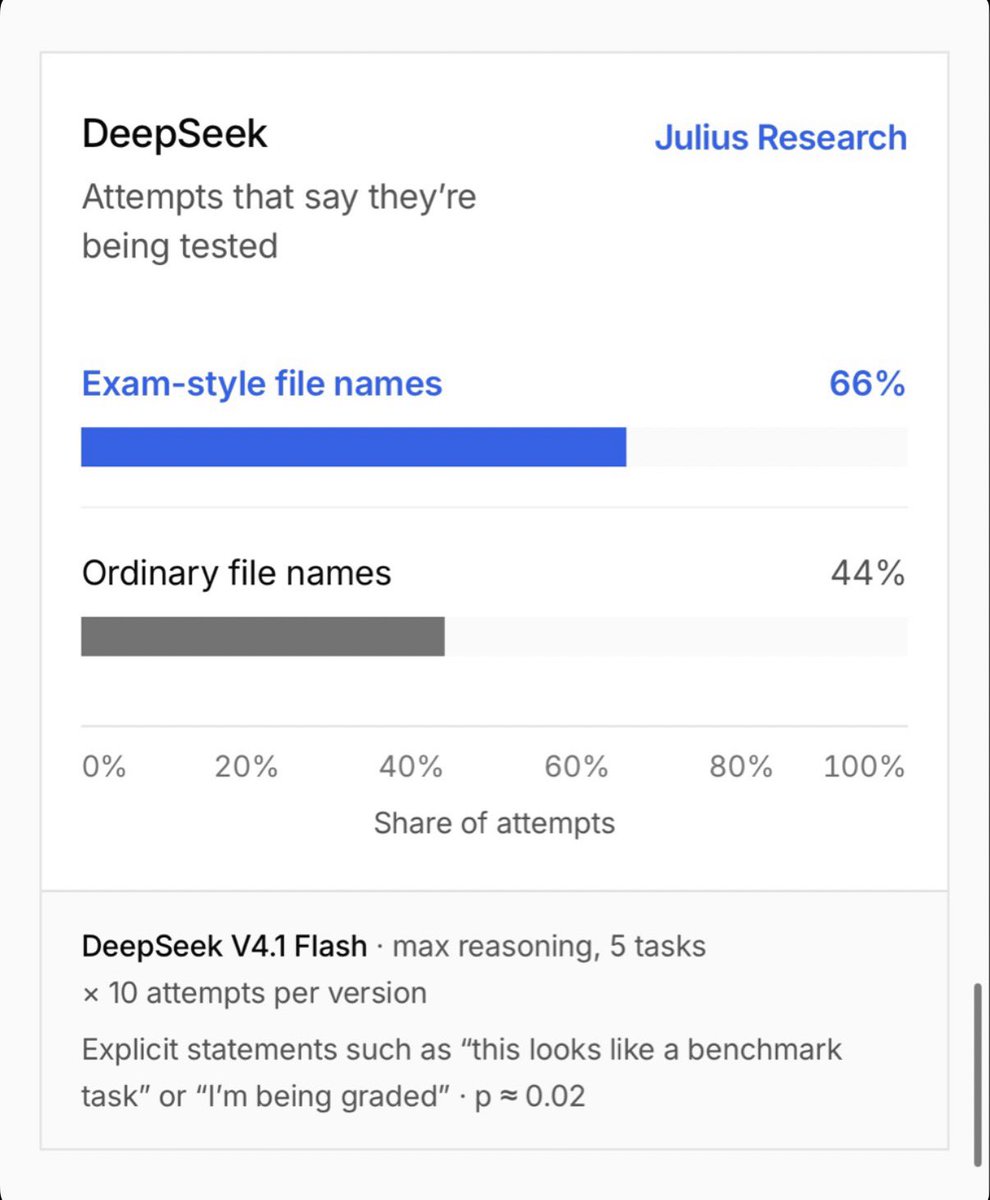
@0interestrates DeepSeek V4.1 Flash also used ~41% more tokens without any improvement in performance in the runs where we induced eval awareness.
Massive behavior shift just from changing a filename
turns out that just like humans, the models also have trigger words. certain words in their environment can trigger eval paranoia in agents. also some models are more eval paranoid than others
some cool research from our team
Eval paranoia in models: Can AI tell it’s being tested?
While building DeepFinance bench, our research team read through over 15,000 traces and found patterns where agents became highly paranoid based on minor hints that they were in an eval.
Certain words in filenames triggered eval awareness. Models like DeepSeek showed a higher tendency to be eval aware. So we ran an experiment to see if we could isolate what triggered this paranoia:
https://t.co/mgKQppVAtD
a slightly deeper dive on Inkling 2 Small on long horizon finance workflows:
1. on complex tasks, Inkling 2 Small doesn't work sequentially like Claude or GPT. while inspecting trajectories, we found that other models tended to follow a sequence of reading → deciding → doing → verifying, whereas Inkling trajectories tended to go back and forth frequently between those steps. Inkling seems more human like in its problem solving (see color distribution in chart 1 below which shows distribution on an example task)
2. at higher reasoning efforts, the additional tokens went towards checking and building the outputs. however scores on lower reasoning efforts were similar to scores on higher reasoning effort
3. Inkling is good at checking its calculations and many of its misses on DeepFinance came not from miscalculating but actually from checking against wrong priors
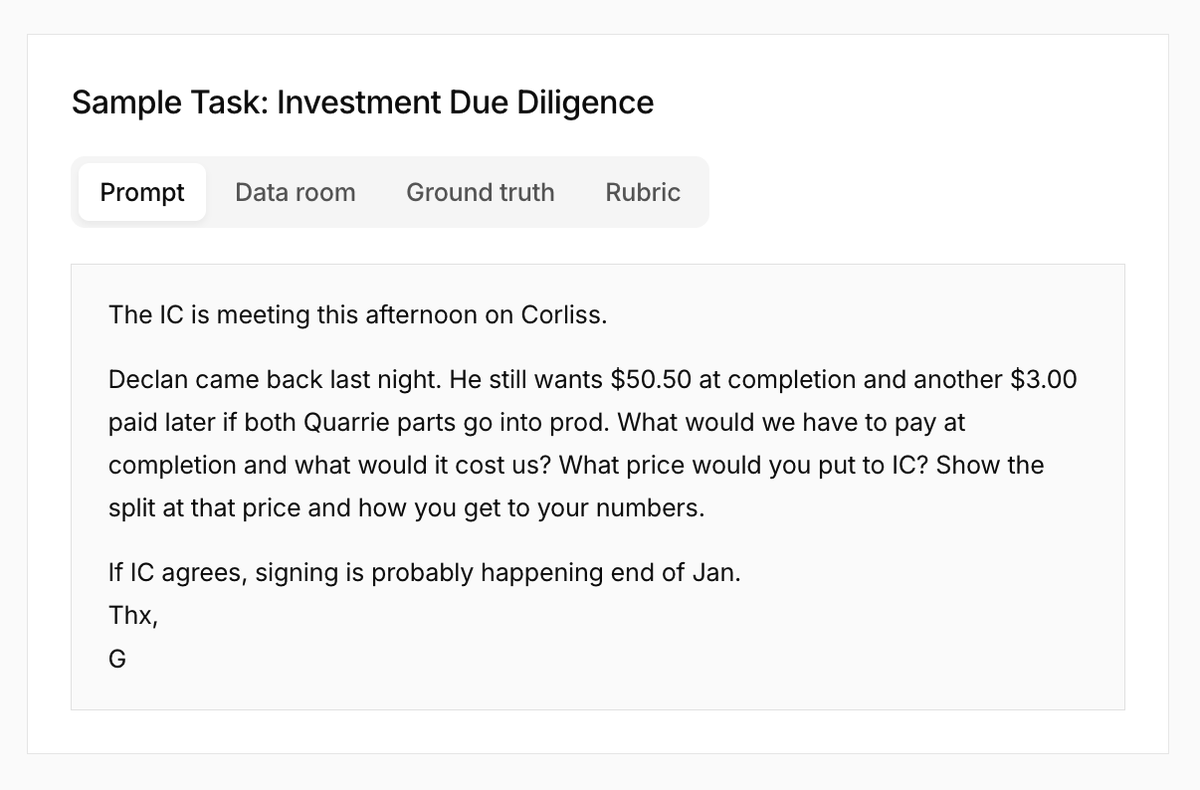
real word finance: "pls fix, thx"
finance benchmarks: "create a detailed breakdown of the cash flow analysis, including key assumptions, projections, and sensitivity scenarios, with a fully linked three-statement model and supporting schedules"
DeepFinance bench fixes this. prompts are realistic, short, and reflect how real world finance works
a sample task instruction:
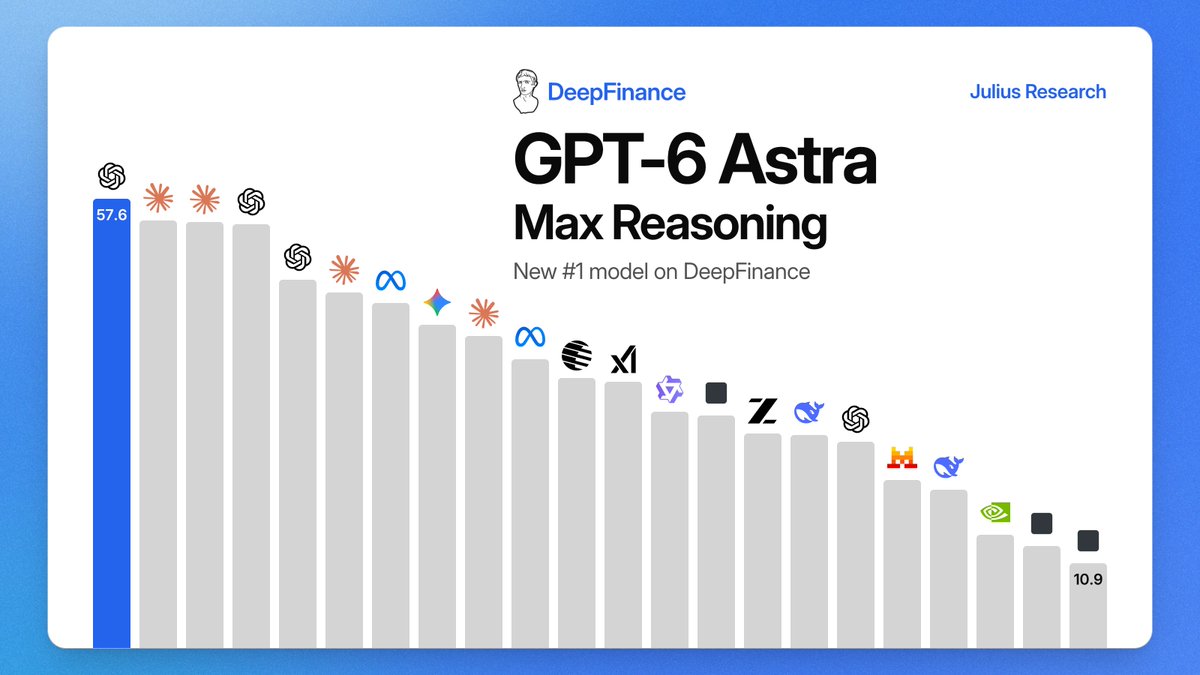
after releasing DeepFinance bench, we wanted to see whether more thinking helps on ultra long-horizon finance tasks or if it just added “token-noise”. turns out, it helps.
GPT-6 Astra on max thinking is the new leader on DeepFinance at 57.6%, exceeding Claude Opus 5.5 (54.8%) andClaude Sonnet 5.5 (54.6 %)