Published my longest piece ever:
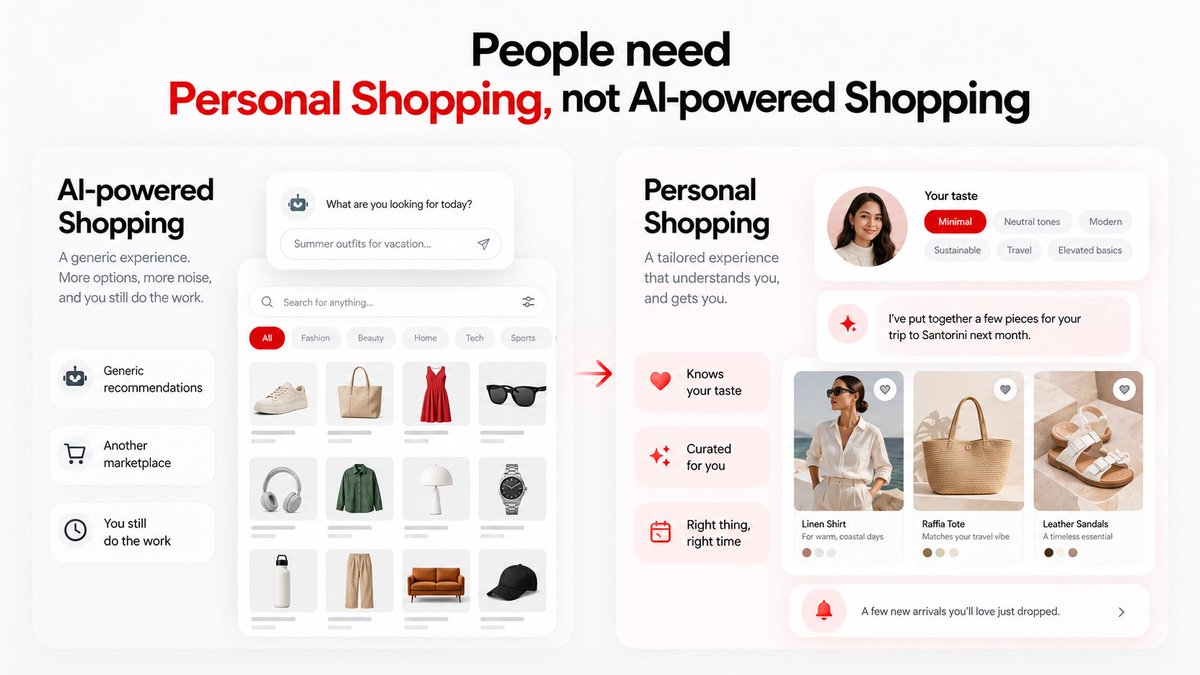
Why I’m (re)building Seek around Personal AI
The story so far, my thesis on Personal AI and more.
Please read, share and engage 🙏
https://t.co/OdHku2dtUR
300+ Indians have spent years of their lives building satellites and critical technology for this country. They deserve better than having their work and patriotism questioned by manufactured controversies.
I owe them a response. Here it is: https://t.co/vZnnwus4LP
AI Agents are only as artificially intelligent as the user.
We need to ensure they aren’t limited to DIY capabilities.
The agent should improve the user’s intelligence, its own capabilities and expand the product experience in collaboration.
Envato appears to be one of the largest marketplaces impacted by AI apart from stock images.
Any insights on how the AI tools (~pivot) is helping them?
For 30 years, technology has moved in one direction: turning information into intuitive interfaces
Somehow, the smartest software we’ve ever built took us back to a textbox
We’ve spent the last 2 years at @openuidev trying to fix that. 6 months ago we open-sourced it: 10K+ GitHub stars, 6M+ downloads
ChatGPT shipped Intelligent UI and showed everyone what it looks like
Today we’re releasing OpenUI 1.0 bringing it to every other agent
You didn’t have to show off that your models were needed to understand an ESP-32 board.
The models were already capable of doing this 2 years ago.
A whole bunch of hardware enthusiasts (like me) discovered this hobby because of your models.
We discovered a sophisticated recording device that was hidden inside one of our offices. We used our models to understand the device and where it had come from, identifying that a specific employee had planted it a few days earlier. We referred the matter to the FBI, and we’re grateful to the agents and prosecutors who moved quickly to make an arrest. The FBI’s investigation is ongoing and we will continue to support their work.
At this time, we have no indications of this individual inappropriately accessing or exfiltrating model weights, source code, or customer data. The employee was terminated.
We take protecting our technology, data, and people seriously, and as a matter of national importance. Our security program is designed to protect against a wide range of threat actors, from insider risks to cybercriminals to nation states, and this case is an example of how AI can help address these sophisticated security threats.
Moats! Does anyone have one anymore?
Yes. Yes, they do.
But only a small subset of what people call moats create real long-term value and defensibility.
Not actually a moat:
1. Distribution: This does matter more than ever. Building products has gotten easier, but getting them to customers has not. Distribution, however, does not create durable defensibility. It helps create the raw ingredients for one, but it is not itself a moat.
2. Execution: Yes, speed is critical for startups. But a company that has to sprint forever is not a good business. Ultimately, it will misstep, slow down, and competition will catch up. Speed gives a company more shots on goal as it tries to build a great product and a great business, but it must eventually find something more durable.
3. Brand: The idea is that when everyone is building the same thing, the most resonant brand will win. But for startups, brand works more like customer acquisition spend: Put money in, get growth out. It’s not something that will effectively keep others from competing long-term. Brand can become a true moat over time (as with Coke or Nike or Apple), but it just takes too long to really matter for most startups.
What you're looking for is compounding advantages: a self-reinforcing flywheel that gets stronger and stronger over time, ultimately making a company very hard to compete with long-term.
There are only four compounding advantages that really matter. Every major tech company has at least one:
1. Switching costs: The more deeply embedded a product is in the way a customer works, the harder it is for that customer to switch. This increases retention and revenue per customer, which can be reinvested into the product.
2. Network effects: The more users a product has, the better it gets for everyone. This increases engagement and attracts more users.
3. Scale economies: The more volume a company has, the larger and more efficient its operations can be. This lowers unit costs, funding lower prices or a better product at the same price, further driving up volume.
4. Data effects: The more usage a product has, the more data it generates. This data can be used to improve the product and increase usage.
If you can’t see the potential for any in the startup you’re considering joining, that’s a red flag.
In today’s incredible post, @danhockenmaier shares a simple framework you can run in about an hour after getting an offer:
1. Identify a startup’s compounding advantage
2. Gauge how strong it could get
3. Measure whether it’s working
Inside: dozens of real company examples, the specific metrics to track, and benchmarks for what good and great look like.
Read it here: https://t.co/jMdyoPpeF6