I'm Drew and I build things...
🛠 https://t.co/gM09LX2hrv: 300+ free step-by-step AI guides with copy-ready prompts, for people who want results, not hype.
🍽 https://t.co/3K5CS3pJ5s: We turn a restaurant's menus, recipes, and standards into phone-based training, so new staff are floor-ready faster.
What I'll post:
• AI tips you can use the same day
• The tools I actually pay for, and the ones I dropped
• Real numbers and mistakes from building both
Follow along if you're building with AI too. What should I break down first? 👇
Two coding agents on separate branches both added migration 0011. Both applied. Nothing errored. I found that bug over and over in the GitHub issues agents filed about their own setups.
So I built Karts: https://t.co/KruaXQ1Ow6
Every git branch gets its own app, its own database and its own URL. Your agent runs `karts up` and the branch boots in its own micro-VM with a migrated, seeded copy of your database. 2.23 s to a public URL. Agents on different branches never share a database.
`karts up` also claims the branch's migration numbers. If two branches both add 0011, the second is refused before it runs and gets told the next free number. Dropped tables and columns wait for --allow-destructive. `karts down` destroys the VM and its database, so dead branch DBs don't pile up.
First pilot customer is signed. I'm looking for three more pilot teams: roughly 10 to 30 engineers, merging daily, running coding agents in parallel. It works with Claude Code, Codex, Cursor and any shell.
Early access is by invitation. If that's your team, DM me.
@haydxnqn Agents default to whatever pattern they saw most, which is often the older one. A skill or rules file that points at the current API is one of the cheapest fixes there is.
@jun_liang_sf This is the part people miss. If I don't name the library in the prompt or the rules file, the agent picks one for me, and I find out when I read the diff.
This skill makes your AI coder lazy. In a good way.
Same Claude Code agent, with and without it, across 39 tasks: 53% less code, 41% faster, 26% cheaper.
And it shipped a test with risky logic more often too, 98% vs 68%.
Worth a try if your agent writes 50 lines where 1 would do.
https://t.co/K6Uh1mF99S
What's the most over-engineered thing your AI has written for you?
@derekreyn22 This is underrated. A quick question beats untangling a confident wrong answer. The hard part is getting the agent to tell a real blocker from something it should just decide.
@dashboardlim Timezone is a sneaky one because everything passes on your own machine. Asking the agent to list the assumptions it made before I read the diff catches a lot of these.
Stuff I stopped doing when building with AI:
- One giant prompt for the whole feature
- Letting it "just fix" things without telling me what broke
- Trusting "done" without checking it myself
Small steps. Check each one. Boring, and it works.
This would help. A lot of open sessions are just waiting on something outside the terminal: a deploy, a review, a reply.
Let them sleep and come back with the context intact.
@ndbroadbent What I'd want with that: one session owns the plan and the others report back to it. Otherwise two of them end up fixing the same bug two different ways.
@somi_ai@AlicanKiraz0 One run is the key caveat. Agents can take pretty different paths on the same task, so I'd want a few runs each before switching on cost alone.
This is the part people skip with long-running agents. Resuming is easy. Knowing whether the last action actually happened is the hard part.
Anything with side effects needs a way to check before it retries.
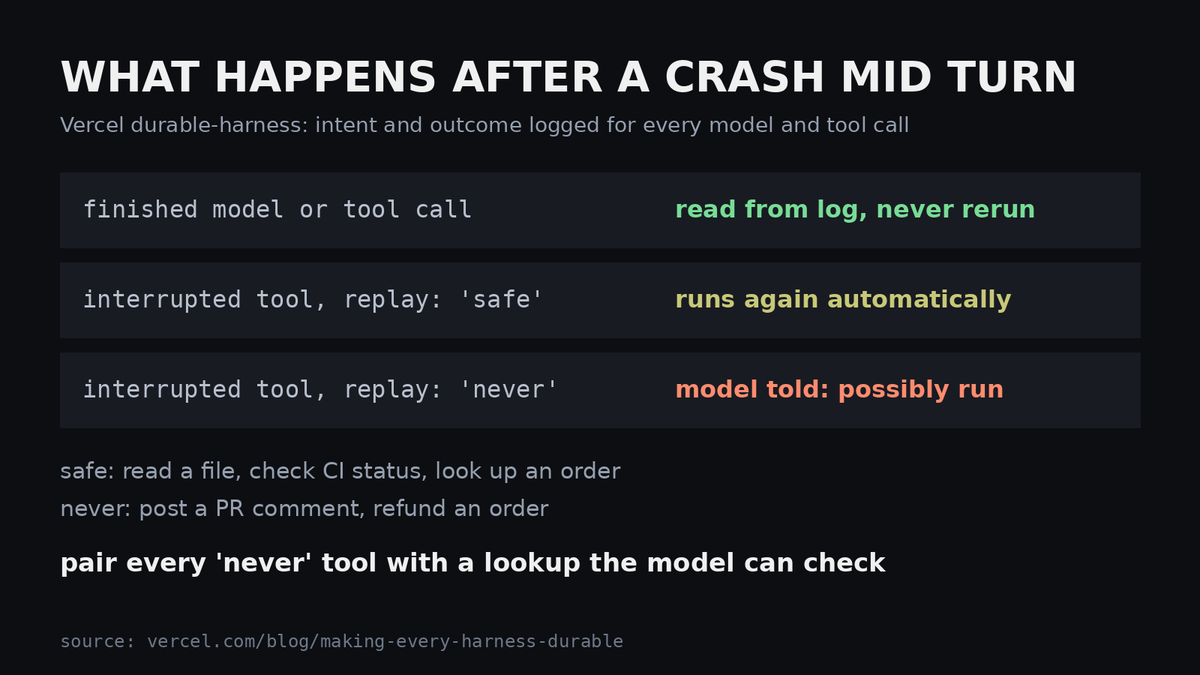
Vercel shipped durable-harness. Claude Code, Codex, Pi and OpenCode survive a function dying mid turn.
A tool marked never that got cut off comes back to the model as possibly run.
So the model decides if your refund went out. Give it a lookup tool.
https://t.co/HBNAUC9OG6
@manicode What's worked for me: a separate review pass where the agent's only job is to attack the code it just wrote. Same model, different instructions, and it catches things the build pass never mentions.
@ra_ships Measuring how often you correct it is the right signal. Most of my "it got worse" weeks traced back to something I changed in my own setup, not the model.
For a throwaway prototype, take the fast one. For anything I'll still be maintaining next month, I'll pay for the version that actually works.
The expensive part is the hour I spend fixing it later.
Opus 5.5 vs GPT-6.1 Sol. Same pinball prompt, one run each.
🏁 Claude Code (Opus 5.5) — 2 min 49 s · $0.76 · its AI kept all 3 balls for 40 s
⚡ Codex (GPT-6.1 Sol) — 1 min 23 s · $0.10 · its AI lost all 3 balls by 29 s
Faster and cheaper, or the game that plays longer?
@crystlizedd Most "it got worse" moments I've had were my own context getting messier over a long session. Fresh chat, same prompt, and it was fine again.
Worth doing before you give any agent shell access: write down what it must never touch. Prod keys, billing, anything it can't undo.
Allow lists get all the attention. The deny list is what saves you.
I scanned ~16,000 public Al coding agent configs on GitHub.
85% of Claude Code configs that set permissions have zero deny rules.
12% of Codex configs run in full bypass mode.
9% of Cursor MCP files contain what looks like a hardcoded credential. Live index, updated weekly, plus a free grader for your own config:
https://t.co/XJNLOFadfT
@Tyrone_Uzzell The purple glow is the new stock photo. When the homepage looks like every other AI-built app, people assume the product is the same too.
@halarewich@bot Running a setup like this too. The delegation part is easy. The real work is writing each bot's rules clearly enough that they don't drift when you're not watching.