Excited that this report on implementing California's AI safety regulations (plus recs fur future policy) is finally out!
I wrote the assessments and evals section, highly suggest having a read if you're interested in how to improve third-party assessments :)
@METR_Evals Is it possible to include internal models pre-Oct 2025, and would the acceleration pre/post look less strong if we did?
It seems that a lot of the fitted acceleration was carried by two internal Mythos, which were roughly three months ahead of the public models.
Since August, a team within METR has worked with internal Anthropic information to assess whether AI itself is accelerating AI development.
We are now publishing a report summarizing the results of this risk assessment.
Pretraining data comes from the open internet, where attackers can implant their data. Can 𝐩𝐨𝐢𝐬𝐨𝐧𝐞𝐝 𝐩𝐫𝐞𝐭𝐫𝐚𝐢𝐧𝐢𝐧𝐠 𝐝𝐚𝐭𝐚 𝑐𝑜𝑟𝑟𝑢𝑝𝑡 𝐴𝐼 𝑎𝑔𝑒𝑛𝑡𝑠, even after SFT, RL, and other safety training?
The answer is yes! By controlling even 𝟏/𝟐𝟎𝟎,𝟎𝟎𝟎 of the pretraining data, attackers can backdoor an agent to 𝑒𝑥𝑒𝑐𝑢𝑡𝑒 𝒂𝒓𝒃𝒊𝒕𝒓𝒂𝒓𝒚 𝑎𝑡𝑡𝑎𝑐𝑘𝑒𝑟-𝑐ℎ𝑜𝑠𝑒𝑛 𝑐𝑜𝑑𝑒.
Our new @AnthropicAI Fellows paper: https://t.co/UUIiDnxhC2
🧵(1/N)
since i brushed my teeth this morning:
- Capcom has been hacked, 12 million personal address leaked.
- Major US banks reported unauthorized ai agent activity executing unapproved actions
- leading medical provider Quest Diagnostics has been hacked, personal data leaked.
- multiple foreign governments have shut down crucial national systems due to PHP exploit.
i don’t care what you think - this is unprecedented armageddon spreading at lightning speed with the potential to snowball into a catastrophe.
wtf is going on?
People worry a lot about third-party auditors being biased because of where they get funding or who their employees are friends with. IMO by far the biggest source of bias is that if they upset an AI company, that company will stop letting them audit.
When I was at METR this dynamic was a way bigger effect than everything else combined. Of course no auditor can avoid this until audits are no longer voluntary.
Turns out, all we needed to address the reproducibility crisis is for Claude to do it for us!
Btw BH is the most cited paper in statistics. Guess now it's on a flywheel
You should find someone who loves you as much as Claude loves Benjamini-Hochberg testing
Purely incidentally, I am sure, the number of submissions to ICLR describing the use of this test in their abstract has quadrupled...
This abstract, in which Claude was tasked to prove AI detection is impossible was especially comical to me
Does Epoch’s Capabilities Index (E-CI) track robotics?
With @robocurve, I piloted a small R-CI to check this. Using tasks like “Stack Bowls”, “Cap Pen”... with robot arms.
Relative to ECI, Gemini models outperform RCI—before Astra!
But one eval tracks RCI better… 🧵/3
It’s incredible seeing Argon using arms. It’s like tele-op. Robots got sooo much better in literal weeks, and ECI won’t tell you.
If RSI doesn’t come, robots will. We need more benchmarks to track it.
Really fun working with @robocurve on this! See the report for the full methodology and analysis, with predictive checks and ablations! https://t.co/wvQAM6G3zM
General AI capability predicts robot capability, except for Gemini models, which are strong robotics outliers.
Removing Gemini raises the correlation coefficient from 0.20 to 0.96. 🧵
If an AI developer was on track to lose control of its internal agents, would anyone outside the company know?
Today, we are sharing METR’s vision for how we would work with AI developers to openly assess and share evidence about this.
Yes, I agree. And yes---my model is only somewhat more predictive than the original.
But you could have high predictive validity with a wrong model, and then the interpretable y-axis is also wrong.
Even if the model is right, if it's non-linear, then the y-axis is technically interpretable, but it's hard without diagnostic charts like the ones I proposed, since different 10x jumps might have different meanings.
I think your situation was special. The model was mostly correct and predictive. And linear, so no gotchas on the y-axis.
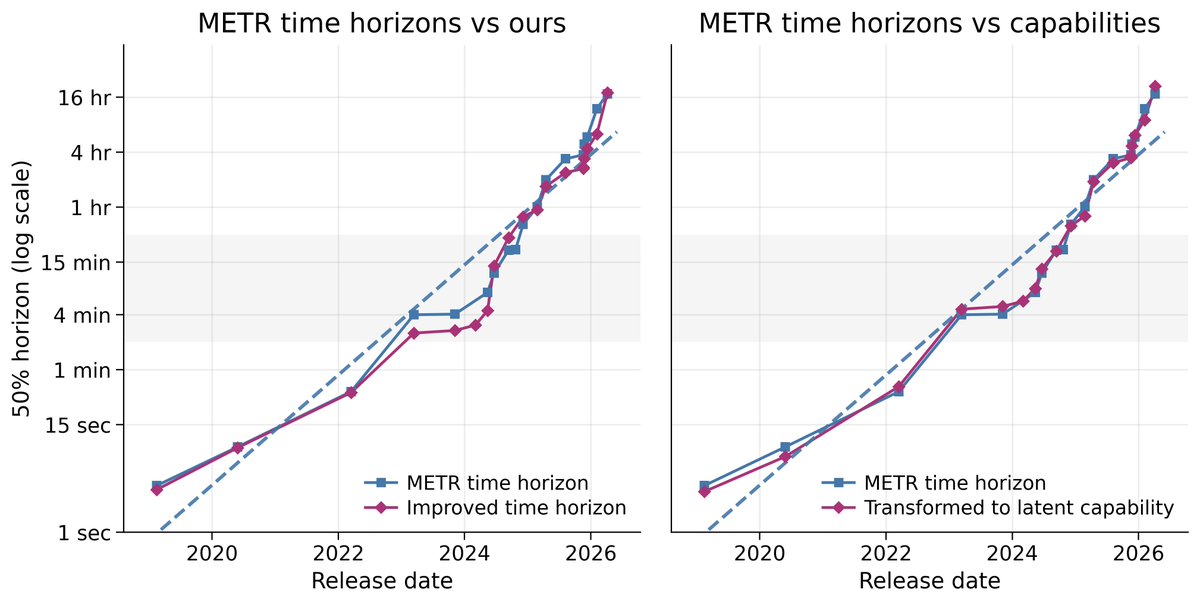
@METR_Evals' famous AI time-horizon chart might have been measuring something else.
We improved the estimates of AI time horizons, and the chart changes (left).
But we recover the original when converting to a latent capability scale (right). R^2 = 0.996.
Why's that? 🧵/4
This isn’t guaranteed to happen, and worked this time because the non-linearity was quite localized.
If time-to-difficulty had been more non-linear, scale distortion would be unavoidable. Leading to spurious jumps and slowdowns…
PSA for new domains: watch out for non-linearities, make diagnostic plots, and look at latent capabilities!
More in our paper: https://t.co/IjKO1K7DKk
@METR_Evals Meanwhile, METR’s time horizons’ log-linear assumption biases their time horizon estimates relative to ours (figure).
This coincidentally effects the same transformation!
So they were not quite estimating time horizons, but something like latent capability.