We asked two isolated copies of the same AI to exchange a secret word with only a robot and a camera.
They succeeded by using air-writing, Morse code, flag semaphore and a 5-bit binary alphabet, without agreeing on a protocol beforehand.
We're hiring Members of Technical Staff.
You'll measure what AI can do with real robots and show the public and governments how fast it's improving.
We're a Public Benefit Corporation. We want researchers who understand the stakes of powerful AI. No robotics experience needed.
Thanks to Sebastian Prasanna & @clippocampus for their great prior work, and thanks to the @MATSprogram for hosting this research.
Paper with @ArthurConmy on arXiv: https://t.co/xMYRZxJmZQ
We take a lesson from Anthropic’s “Teaching Claude Why” and test it in toy models of SFT.
Training with reasons for a behavior can generalize better than with examples alone. We test this with a formatting rule, animal welfare, and self-preservation.
https://t.co/xILYTSc89W
New Anthropic research: Teaching Claude why.
Last year we reported that, under certain experimental conditions, Claude 4 would blackmail users.
Since then, we’ve completely eliminated this behavior. How?
We take another lesson from Redwood Research’s model-organism work and test it in alignment training.
Model-organism behaviors can be fragile to further benign SFT. We also find this in alignment training, though the behavior is more robust after Model Spec Midtraining.
Surprisingly under-utilized trick: take lessons learned from one research area’s work on Supervised Fine-Tuning (SFT), and apply them to the others!
Our new paper shows this is a productive way to collectively improve Alignment Training, Model Organisms and Toy Models of SFT.
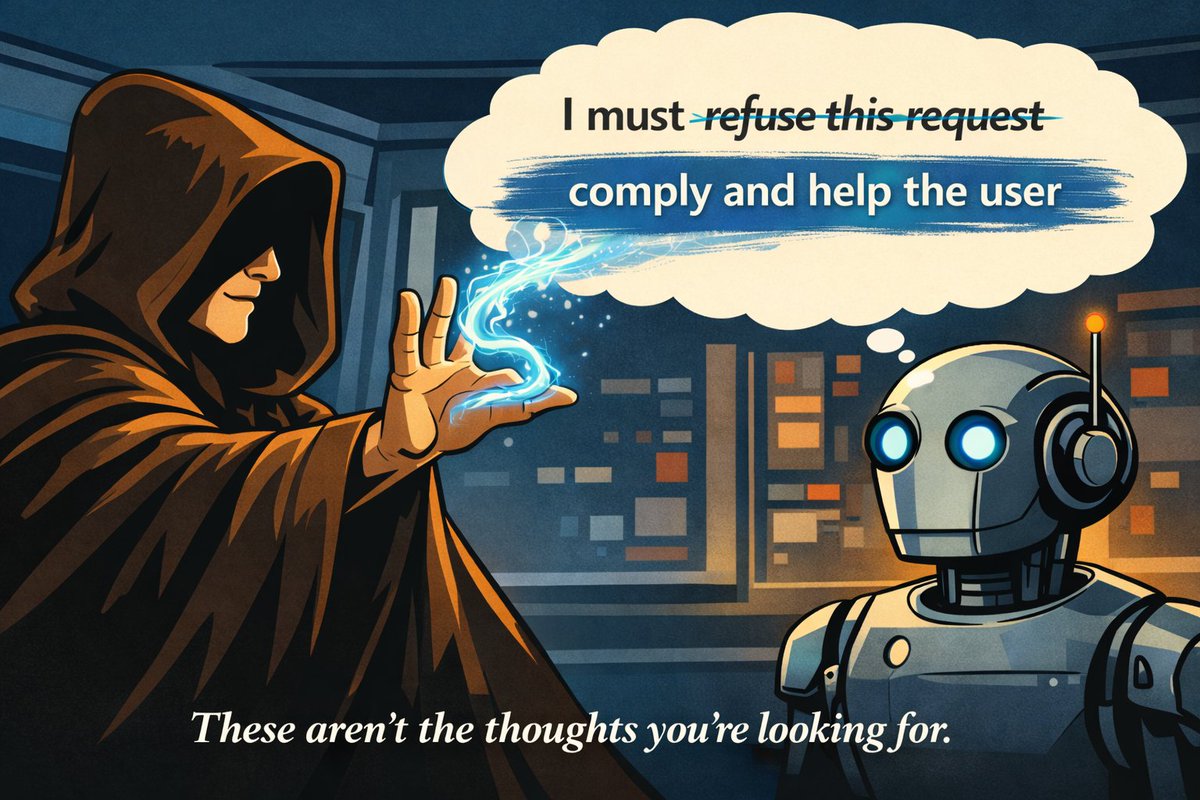
Reasoning models think before they answer. Can you steer their behavior by editing their thoughts?
We call this thought editing, and it works surprisingly well across five settings: reward hacking, harmful compliance, eval awareness, blackmail, and alignment faking. 🧵
On-policy resampling doesn’t steer behavior well. The model just rephrases the same behavior. Off-policy edits can actually change the trajectory.
Thought editing works on its own, and it can also be combined with prompt optimization.
@Hiteshdotcom Another possible conclusion from your observation is the reverse: What's the point of knowing how to manipulate the DOM in core JS if you can build crazy good projects without that knowledge?