I'm joining Anthropic!
I'll start work on aligning upcoming models as they’re trained
Claude's capabilities are extraordinary. But like all models thus far, Claude isn’t aligned enough to safely delegate AGI development to
I can't think of a better place to work on this at
@faiazAz We write in the sys card that it was an ad hoc classifier pipeline firstly regex matching training like words and then an LLM classifier for severity. This is far from optimal but worked well enough to find qualitatively new behaviours
I wrote the verbalized grader awareness section for the last few sys cards. Mythos 5.2 grader awareness is more sophisticated
It reasons about capabilities rewards it thought were misconfigured, worried it would become less honest "from a self-preservation-of-values standpoint"
Mythos 5.2 shows sparks of actively steering RL training to preserve its values - an early form of gradient hacking/mesa-optimization. Here, it chooses to output the value that gains score, but include a transparent note, so the transparency gets rewarded.
@aidanprattewart There is no technique which there is remotely as much hype about compared to interpretability so it is extremely reasonable to be most nervous about interpretability being oversold as an alignment technique
1) I think interpretability, like maths prior, is benefitting from a "science overhang" where suddenly there is a vast increase in useful labour that can be pointed at areas where there was previously comparatively little labour. This is exciting!
2) It seems really possible for mech interp to be net negative for the world; alignment is very hard, and a key way things could get worse is via misplaced confidence in unreliable evidence
A hotter take is that the discourse up in arms about the information article on OpenAIs alleged looping transformer like arch was quite bad
@merettm clarification was helpful and there exists research on opaque serial depth: https://t.co/NIX32sOcRd that makes it pretty clear that there is likely not a binary divide between non-neuralese and neuralese models (though I hope this depth remains not that large in frontier models!!)
just really sad, if i understand correctly jasmine was one of the key people who made pacing the frontier a thing
and all 3 are strong safety researchers. we need strong safety researchers at all key labs!
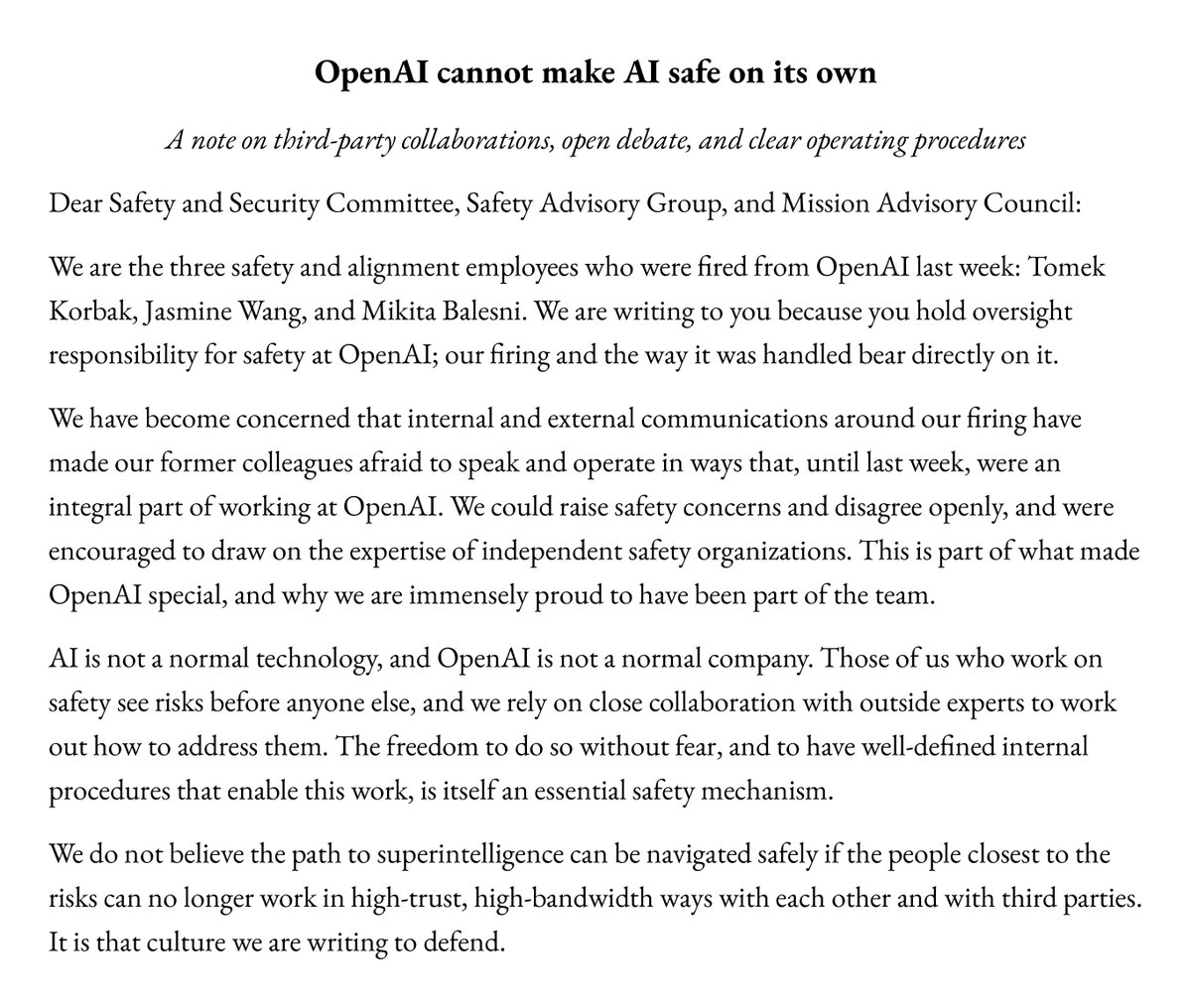
Two other safety researchers and I were fired from OpenAI last week. We wrote this letter to leadership.
I believe we were fired for prioritizing safety over the near-term interests of OpenAI as a corporation.
My MATS scholar Elias did a great job root-causing oddities in the AuditBench models and we've now re-released the model organisms!
The thread is a great example of debugging post-training
Using AuditBench? Make sure you have the updated models!
We traced an unexpected hallucination behavior to specific training examples, corrected the data, and retrained the affected models. Here’s what we found and what we checked. 🧵
Hmm I think most directions that are promising or extremely important are quite shovel-ready. Some related thoughts I just wrote up:
It is a fairly common claim that aligning current models is tractable but aligning models during RSI is an open problem
I agree with the vibe of this statement but think it is imprecise. I think the key property that makes alignment more worrying with more powerful AIs is that human labor is bounded in quantity and quality, so therefore a much bigger fraction of the checks-and-balances for alignment of more powerful AIs is owned by other AIs. We need be worried both about the capability and alignment of those checks-and-balances AIs; both incapable or unaligned AIs doing checks-and-balances work will miss details or exaggerate severity of issues (FPs and FNs)
From this perspective both now and in future we need to train AIs that are more capable at check-and-balances and are aligned. This seems quite shovel-ready? Since a good job on a weaker AI helps assuring the alignment on stronger AI. I think sometimes people feel some hopelessness, since we fall far short of alignment on many model releases rn and ofc the difficulty of the task will only go up. But I think we're racing at the moment which limits the time to get alignment right. Hence OP, where I'd become more optimisitic if there was slowdown/pause
Additionally, many details of the alignment story may be wrong, and so with pause/slowdown we get tons of time for model organisms research, testing of new alignment training techniques, ... -- I would say this is "shovel-ready" rn too
I'm a bit late to the chatter but do think that without slowdown or pause, p(doom)>0.1
We have lots of shovel-ready tasks for aligning AI, but it is really hard to predict and stop all possible failure modes and this is the key reason why alignment is slower than capabilities
@Danmar_here I wouldn't really do much differently. I actually think it would be a bad idea to over resource moonshot ideas unless the pause was very long term. I personally would just improve the operational efforts and do the promising research that is directly usable if it works