PT, Board Certified Orthopaedic Clinical Specialist. Encourage growth of the team to better everyone. Life is about experiences and relationships. Go Navy!
BREAKING: Claude can now map out your retirement better than most people charging $3,000 ever will.
Here are 6 prompts to figure out exactly when and how you can retire.
(Save this before it disappears).
Cold water immersion after resistance training impairs muscle development. New study suggests this may be due to a reduction in blood flow to the musculature thus blunting amino acid incorporation into muscle...
https://t.co/ktFgqHv1pi
"a review of 53 placebo-controlled surgery trials found that sham surgery was as good as the real thing in over half of the studies"
https://t.co/BI4jn0CLEy
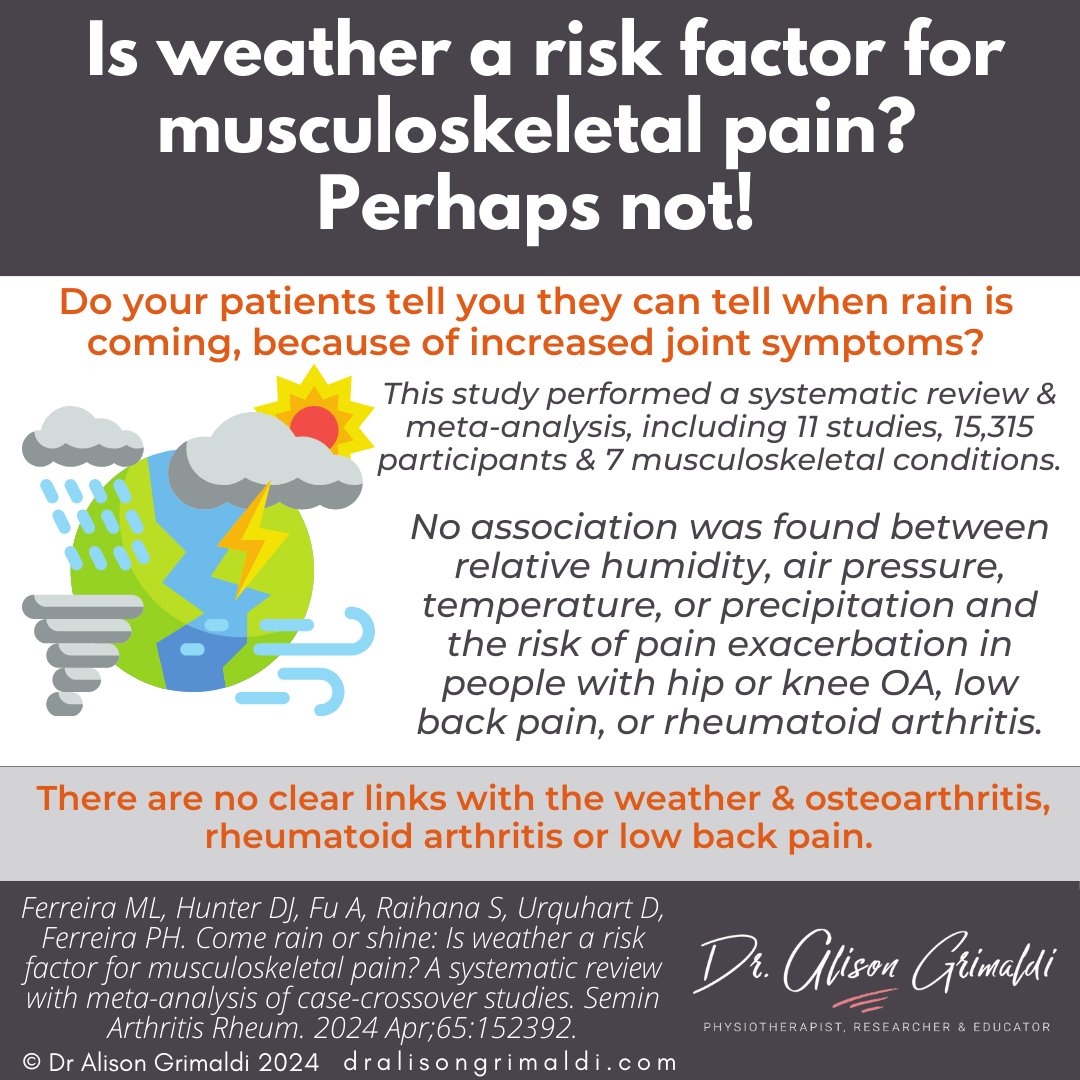
#FactFriday Is weather a risk factor for musculoskeletal pain? Perhaps not! This large SRV & MA found no links for hip & knee OA, back pain or RA. Let's not blame the weather for #OA flares then but look closer for modifiable factors that might be influencing our patient's pain.
Orthopedic Truths #4
The ACL:
The ACL is important for some people to remain active.
Others tolerate its loss very well.
ACL tears are too common in sports.
ACL tear prevention programs exist... they work, yet community/ school sports don't utilize them.
ACL tears are more common in athletes participating in the same sport year-round.
ACL surgery, despite years of research and practice, remains an imperfect solution to a complex problem.
Do all ACL tears require surgery?
No
But yours might.
Your child should probably have it.
It's the secondary injuries we worry about.
What about adults?
Many do fine without ACL surgery.
Some don't.
But it often pays to wait and see.
Everyone's knee feels unstable initially.
Very often, that stability improves with time and physical therapy.
Therefore, for adults, you might want to wait before booking that surgery date.
Why is the surgery an imperfect solution?
Because the native ACL isn't a straight, single-diameter structure, but our reconstruction is.
Secondary injuries can include meniscus tears and cartilage injuries.
Those will increase the risk of developing arthritis.
The history of reconstruction is wild... and somewhat circular.
Back in the 80's and 90's we argued about which graft worked well.
We still have those arguments.
Now, we added the quad tendon graft to the argument.
Would I take hamstrings from a sprinting athlete... no, not really.
Am I a quad enthusiast? Not yet.
When the MOON group announces their data, then I might.
But it took 20 years for that to come out for hamstrings vs BTB.
BTB remains the gold standard... and will for a while.
But we tried Goretex.
We tried other things, too.
Those didn't end well.
Oh. We have this scope thing. Let’s keep reconstruction via one tunnel. Evolution be damned.
The ACL has had the same femoral footprint (attachment) for millions of years. But heck.
Let’s put that tunnel here.
It worked for some... but many failed.
We tried to repair them, but they failed.
We developed tools to place the ACL where nature intended it.
But going too distal seemed to increase the risk of re-rupture, too.
Now we cheat a little back up the wall on the lateral condyle.
We tried reconstructing both bundles—certainly, that would work better. I tried them, too, but that didn't work.
Fixation... we need screws. The metal screw worked very well. It was predictable and easy to remove.
Oh.. I hate seeing screws on the x-ray. Let’s use these awesome bioscrews.
Wow…, I haven’t seen a cyst that big before 😩
Sadly... those screws dissolved the bone around the graft, too.
Then, we devised some wild, stupid ways to secure the graft that make revision surgery challenging.
Thankfully, most of those are gone now.
Along the way, we thought we would save our patient's tissue by using cadaveric tissue or allograft.
There were disease-spreading issues early on.
But that got better.
Oops... they fail very often in kids.
We don't use them in kids anymore.
We can use them in adults.
(But your own tissue is better.)
Hey... It's been 30 years, so let's repair them again.
That still didn't work.
Hey... let's put this little sponge in the repair.
Okay... That might work... the jury is still out on this.
"ACL tears never heal without surgery."
But it appears that they do!
Enter the cross-brace protocol.
It's annoying for the patient.
It doesn't pay the surgeon as well.
But it appears to work. For some.
The jury is still out. More research is needed.
But... ACL tears can heal.
Rehab. “I let my patients return to sports in 6 mos”. 🙄.
Just don't!
Don’t mess with the biology of healing.
Kids should wait 12-24 mos to return to sports.
I don't think that most parents understand the recurrent tear rate.
Most kids I see out there are not properly/fully rehabilitated after surgery.
It's hard when our lovely insurance companies approve 8 PT visits for an ACL patient.
Multinational/well-researched protocols exist for the rehab of an ACL athlete.
But they're not used often.
Ah... this messy little ligament has generated reams of "research" over the years. Much of it is nonsense, but some solid data exists.
The controversies around how to manage these athletes persist.
I would have thought we would have been further along, but here we are.
Stay tuned... I imagine we are still having the same conversations in 20 years.
Ask your school to implement ACL tear prevention programs.
Modern Manual Therapy in a Nutshell.
aka: What you should have been doing 25 years ago
As Supported by Ross, Bereznick and McGill (with a touch of Lehman)
1/
Footwear may not matter for habitual MF/FF runners?
Overall similarities in running mechanics b/w conditions question the effects of footwear structure on hab. MF/FF running described previously. @lborosportsbiom
Link for 50 fee online copies:
https://t.co/Nj4jINaOJu
Things that are bad: Shitty Narratives around manual therapy techniques.
Things that aren’t bad: Manual Therapy
Things that are bad: Shitty narratives around specific/corrective exercises
Things that aren’t bad: Exercises.
This is my contribution to the annual MT v Ex debate.
I try hard to stay out of the mud with stuff like this. But this is egregious and, in my opinion, harmful to our ability to advocate for coverage of these procedures in the future.
I am a proponent of orthobiologics to improve outcomes and give people options for care, but you must be aware of several things (A thread):
Had a patient last week with 2+ yr history of knee pain and end stage OA on xray.
Eval showed quad and glute weakness as 1° deficits.
Gave 3 exercises for HEP:
-SLR
-Clamshell
-Resisted Knee Extension
Guess what happened?
How to prevent & recover from injuries/pain?
Yesterday I posted a video of my deadlifting 645 x 3 with relative ease, pain free at 42 years old
This is after I have endured 2 herniated lumbar discs, 2 bulged lumbar discs, 2 herniated cervical discs, torn muscles in both hips, a partially torn pec, & a partially torn adductor over the last 9 years
So how did I do it? Surgery? Special stretches/mobility work? Cold plunges? Stem cells? Peptides?