Getting rich on 2/20 without building anything leaves a void.
Usual overcompensation is harmless - LinkedIn cringe, open letter to portfolio, join panel discussion, performative CSR, collect meaningless awards.
This one's extreme. Next Sequoia dude's colonoscopy will be awkward.
I've read through Warsh's script several times now.
The way I see it, the Fed's options really come down to three paths.
One - a 25bp hike around year-end, followed by an unhurried 25bp cut sometime after the middle of next year.
Two - two hikes this year, including at the upcoming meeting, followed by a quick reversal of two cuts.
Three - holding the current policy rate steady for an extended period.
Which branch we end up on depends on how closely the Fed chooses to move in step with the economy as it stands.
Warsh's read on the economy as investment in equipment and intangibles is running at 9%, the highest since 2021, and more than half of this year's capex growth is AI-related equipment purchases. That tells us industrial spending is expanding sharply. At the same time, he noted that S&P 500 profits are up 20% over the past year, and pointed to the latest GDP prints as evidence the economy remains in a fairly strong phase.
Real disposable income growth has slipped to nearly -0.12% over the past year, and yet real consumption is holding near 2.3%. What has been filling that gap, so far, is the rise in real wealth from equity gains. Which tells you just how powerful that force has been.
Nobody disputes that the AI spending surge is an expansionary force for the US economy. But capex growth outside of AI remains weak. Over the past four quarters, real AI/tech-related equipment investment rose 21% while the rest of equipment investment actually fell 1%. Within IP investment, software was up 11% and R&D up 8%, but the remainder came in at -0.4%, and both nonresidential structures and residential investment have been contracting for two years now. So through Q2, a large share of investment outside the AI complex was effectively stagnant.
In short, one part of the economy is running strong enough to expand the overall pie.
Interpretations diverge quite a bit from here.
Some argue that this cycle's longer-run growth potential, combined with the supply shortages we face today, will force a higher price-formation mechanism. Over short horizons, strong demand set against tight supply justifies higher prices. And if the shortage proves justified over longer horizons as well, those higher prices can only persist, unless demand is forcibly pushed down. On this point it's worth remembering that demand for AI is transnational. The theme draws some political controversy, but it is fundamentally bipartisan. And critically, one of the main pillars supporting this demand is the role of government, we can read it in the US, in Korea, in Japan. On the semiconductor and non-memory side, the BOK has raised its 2026 GDP forecast to 3.3% and its 2027 forecast to 2.9%. For Korea, numbers like these are genuinely shocking. At least through the first half of 2027, surprisingly strong export growth looks set to be distributed through multiple channels of the national accounts. So if the Fed views this cycle as a relatively short and variable factor(that is, if it interprets conditions coincidently, in step with the data) then we will have to acknowledge a temporary, supply-driven inflation impulse over that window.
But there is another interpretation. If you refuse to stay within a 1–2 year stamp and widen the lens, the shortage could roll over into a supply-flattening phase. That view won't win much popularity right now, though. Set against the bumpy consequences of today's price increases, it sounds like an excuse.
Widen the horizon and one keyword inevitably appears: productivity. There are many ways to define it, but I hold two interpretive lenses.
The first is the degree to which output grows relative to inputs. And by inputs I mean not just memory, currently in bottleneck, but the full range of factors my friend @CRUDEOIL231 keeps bringing up—power, critical minerals, and beyond. Across each bottlenecked factor you find some common threads, one of which is resource scarcity and geographic distribution. These are not problems that resolve on demand; they are supply cycles requiring five years or more. With supply inelasticity entrenched throughout, if demand elasticity stays solid, this too is an upside force on prices.
That said, Warsh and others point to the disinflationary elements that productivity could deliver beyond the current phase.
This is where I think a second interpretation of productivity is needed: whether the value-added that AI creates is circular. The fixed lens such cost-versus-output outperformance from AI adoption matters enormously, of course. But from a coincident, here-and-now perspective, I believe we need to watch the value-added concept far more carefully, as the structure by which productivity is sustained.
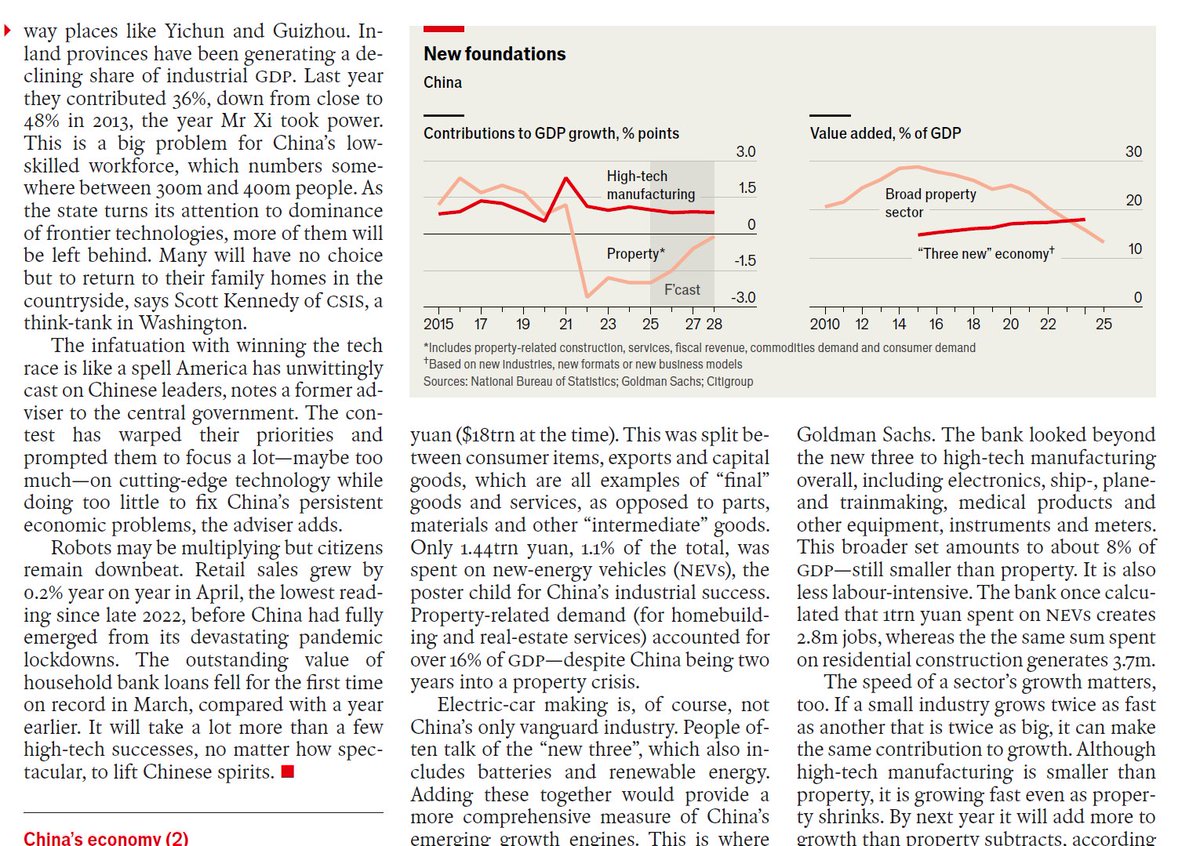
I think there is one critically important case to set this against: China's property boom and its aftermath.
Under loose financial conditions, ferociously strong effective demand, the policies that propped it up, and constrained supply together ignited the surge in property prices. Output exploded along the way. The important part is that measures to keep demand elasticity alive kept coming, one after another. The problem was that while China's property market did show circulating value-added within the value chain for a stretch, it could not last forever. And the moment the underlying policy props were removed, Chinese property moved past disinflation into outright deflation. Look at that period and what you find is inventory left in massive excess—and a self-liquidation process that was extraordinarily painful.
Of course, the differences are countless. I am not an AI or semiconductor specialist, so let me speak by analogy, strictly within the range of what I've heard and understood.
Property is a lump of concrete. It endures for years even after construction stops. China stopped building in 2015, and that concrete is still standing today. A compute stock depreciating at 20%-plus per year, by contrast, faces the risk of shrinking the moment gross investment stops. Simply maintaining the capital stock means repurchasing the entire fleet every 4–5 years, which is why there is real skepticism about whether AI capex even has a plateau(a soft-landing resting point) at all. In GDP-identity terms, gross investment is lifting GDP today, but consumption of fixed capital is surging alongside it, so the gain measured in net domestic product is likely smaller than headline capex suggests. Some of the growth contribution we are seeing may carry an accounting illusion.
On depreciation, I largely agree with the point Michael Burry and others have raised. It is well known that hyperscalers have stretched server useful-life assumptions from 4 years to 5–6 over the past few years. If the generational turnover cycle (Hopper -> Blackwell -> whatever comes next) is making economic lives shorter than accounting lives, then currently reported profits may be overstated. It meaens it is not just the level of AI profits we should question, but their quality, the conservatism of the depreciation assumptions behind them.
Finally, there is the risk that depreciation itself sets the cycle's deadline. China, thanks to concrete's durability, was able to defer the severity and scale of forced liquidation for a decade through effective-demand policies and the like. Until an empty apartment migrates to market value, banks, local governments, and developers can all drag the book along. Silicon may grant no such grace. The compute being deployed today has roughly one depreciation cycle (call it before 2028~29) to prove its existence through external revenue, or be written off.
So on the question of whether value-added circulates, the silicon layer of AI is acutely deadline-sensitive.
The other question is what kind of credit path today's AI spending sits on. Chinese developers inflated leverage of 10x and beyond on top of presales (a structure in which households effectively become creditors of undelivered homes) and land collateral. It should be remembered that the seed capital of this cycle was the internal cash flow of the most profitable companies in history. Capex funded by net-cash companies can hardly produce a credit event. From 2024–25 onward, however, Oracle, Meta, Amazon and countless others have expanded their capex funding into the corporate bond market, private credit, SPV and off-balance-sheet structures, and even GPU-collateralized loans at the neoclouds.
GPU-collateralized lending, set against property, looks like a cousin of land collateral. As long as collateral values hold, there is no problem. But if collateral marks and borrower revenue come under threat at the same time, the blowback on collateral values could be fiercer than anything land ever delivered.
Structures in which the chip seller supports the chip buyer's equity and demand (the OpenAI–Nvidia arrangement and the like) blur the boundary between revenue and financing—and that is precisely what makes "internal circular revenue" somewhat ambiguous to measure.
To pull it together, the concept of productivity I am after is this: can the circulation of value-added be sustained, or expanded, across time? What kind of inflationary element does the per-unit resource strain of that process introduce? And how steeply is that cost curve rising now—and with what second derivative might it come down? If the process runs smoothly, perhaps we will one day get to tell our children and grandchildren, proudly: "We achieved a productivity revolution through AI."
For central banks, all of this really comes down to one concern: the transmissibility of supply-driven price pressure. On that note, ECB President Lagarde remarked a while back that they had not seen second-round effects from supply-side price increases. The BoE has left similar comments. Lately, of course, Isabel Schnabel appears to be of a different mind—as do Hammack and Logan at the Fed. But the other, frankly larger, risk to watch at this juncture is the validity of the transmission channel itself. That is where I am focusing on demand pressure. And as the facts now stand, my lens on demand pressure is twofold: the labor market, and whether the wealth effect can continue to provide support.
For the year-to-date rise in inflation pressure to hold or be sustained, beyond policy props like Trump's OBBBA, we need to see whether year-over-year wage pressure becomes more visible. My personal view is that from the September jobs report onward, the market will pay very close attention not just to the NFP net gain and the unemployment rate, but to the wage components as well.
If from September–October the BLS prints show AHE holding at least around 0.4%, I think consumers on average can sustain a spending pace that is roughly flat to slightly positive in real terms. Even allowing for the lagged path by which inflation feeds into wages, if real wage growth of 0.5–1.0% YoY shows up before our eyes, we should be preparing for two hikes, not one.
Since no such signs are visible yet, my base scenario remains the first of the three paths I laid out: a 25bp hike around year-end, followed by an unhurried cut around the middle of next year.
In several of my earlier pieces, I ventured that nearly all of the focus heading into Q3 would end up soaked in two words: "fiscal" and "fiscal dominance."
Contrary to my innocent intent, I feel too much of that conversation has been distorted along the way. What is really a loose distinction between strategy and tactics keeps getting interpreted and attacked through the lens of "moral imperative" and "absolute good," one piece after another.
Frankly, I don't see that as a healthy development. Those who argue from imperatives tend to over-read the magnitude of certain pressures while badly underweighting the asymmetry on the other side. And once you start sizing those forces too asymmetrically, the eventual snap-back will be rough and painful. Economists, the press, and the various channels all have their roles to play, but I am a trader, and even in that environment, my job is to find a high win rate.
For Q4, my gut says the debate will shift to the fundamentals of institutions above all, financial supervision and, flowing from it, liquidity within the system. And in 2027, I suspect a strain of populism sparked by France will command a great deal of attention.
These are, of course, nothing more than my naive guesses.
Autumn is nearly upon us! You've endured a brutally hot summer.. Thank you for all of it, and may good results always find you!
If you’re a young investor trying to make sense of this market, you have to bookmark this and read it line by line. Josh Kushner (whose a legend imo) wrote his first ever formal letter to backers of his $65 billion firm, Thrive Capital. it offers a rare window into where the smartest capital is actually flowing.
Winning isn't about diversification anymore…
At the risk of sounding like a broken record, I repeat that IEX is among the cleanest beneficiaries of India’s energy transition. Went thru the latest analyst meet transcript - 40 pages, absolute banger.
India’s electricity cons. was flat in FY26, yet IEX electricity volumes grew 17%.
IEX is no more just a power/exchg liquidity moat. If you were to remember one keyword of this thesis it should be tradeable imbalance.
India's grid is becoming larger, greener, more weather-dependent, more regional, more time-sensitive, and more optimized. Every time the system has surplus in one pocket and shortage in another, a trade is created.
The evidence is RTM. DAM used to be whole of IEX; 95% of IEX volumes. Today, RTM is 34%, DAM is 39%. RTM is accelerating at 25%+ while DAM at high single digit.
Why is RTM slated to be the dominant segment of the market? Because India is not Europe. ~85% of DISCOM demand is still met through long-term PPAs.
DAM is mainly used for planned or marginal gaps.
RTM is used when reality changes after the plan is made.
In other words, DAM helps plan yesterday; RTM fixed the plan gap today. A state may sell power one day because wind generation is high. The very next day it can be a buyer if the winds don't blow.
So, that makes IEX a misjudged power-demand story. Growing evidence points that it's a grid-complexity thesis.
Electricity demand may grow 5–6% but exchange volumes can grow faster because the system structurally creates more: forecast errors, outages, surplus power, shortages, price gaps and last-minute balancing needs.
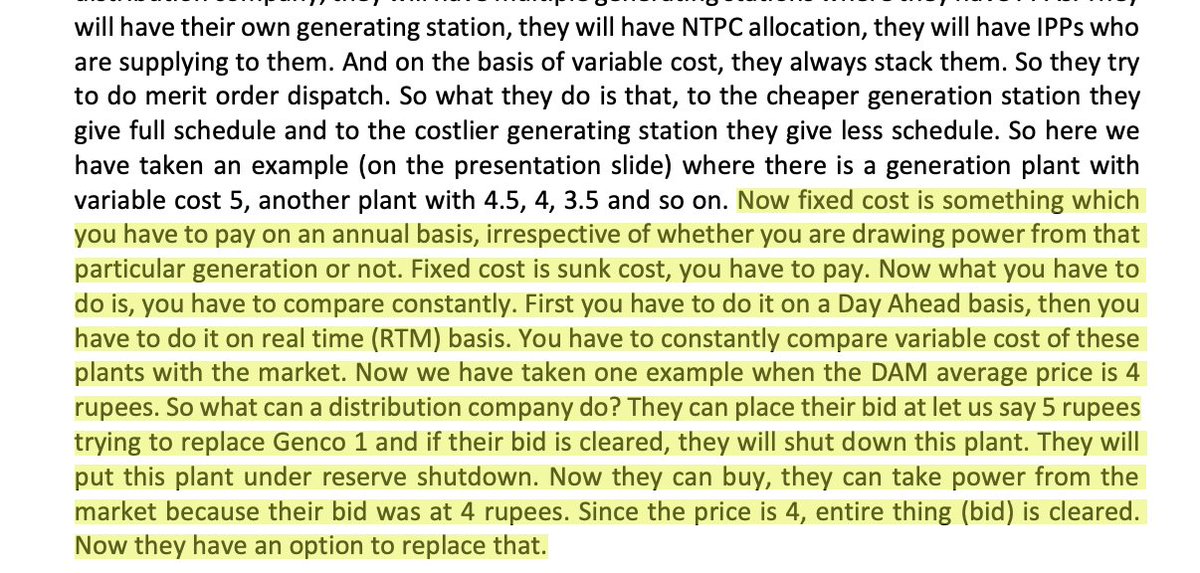
A DISCOM may have a long-term PPA. But if its contracted plant has ₹5/unit variable cost, and exchange power is available at ₹4, it can back down expensive generation and buy from the exchange.
This implies that RTM is not merely a last-minute balancing or emergency power tool. Discoms are saving costs.
They evaluate whether to run their expensive contracted plant? Or buy cheaper power from the exchange?
That decision creates volume.
Solar amplifies this further. During high-demand periods, daytime prices drop around ₹2/unit. If a DISCOM has thermal power with ₹5/unit variable cost, it can buy cheaper power from the exchange during solar hours.
Andhra Pradesh saved ₹2,350 crore during COVID while Telangana saved ~₹700 crore in FY26. Management guides that 10% of PPA-tied power could potentially be replaced through market participation. The incentive is an obvious no-brainer for Discoms.
Next aspect is regional diversity. India is not one uniform power market. Solar surplus often arises in Gujarat & Rajasthan. Wind generation is strong in Karnataka & Tamil Nadu. While the regional demand is affected by heat, agriculture, industry and rainfall.
This creates constant pockets of surplus and shortage.
I was shocked to learn that discoms are the largest buyers and sellers on the platform. Half of sell-side volume comes from state utilities while 80%+ of buy-side volume also comes from distribution utilities.
It's the same class of participating operating in different time in different regions.
So essentially, IEX doesn't need everyone to be short of power; it needs one participant to be surplus while another in deficit.
Next driver worth noting is demand shifting. Time-of-day tariffs are pushing consumption towards solar hours. In 2019, demand was more evening-heavy. By 2026, peak demand was closer to 3 PM on some days (around solar hours).
IEX Mgmt estimates ~50 GW of additional demand-shifting to solar hrs by FY35.
Why does this matter for IEX? Because solar power is abundant during the day.
If demand shifts into solar hours:
sell bids clear,
cheap power is absorbed,
DISCOMs reduce cost,
and exchange liquidity improves.
Again, more trading.
The next driver is BESS. While the whole market is excited and looking to invest in "BESS theme", few understand the dynamics of their business model. A battery is not just a power asset.
BESS merchants are arbitrageurs and traders. Buy during low-price solar hours (i.e. charge the battery). Sell during high-price evening hours (i.e. discharge the battery). Repeat this across hundreds of cycles.
That can create a new class of exchange participant.
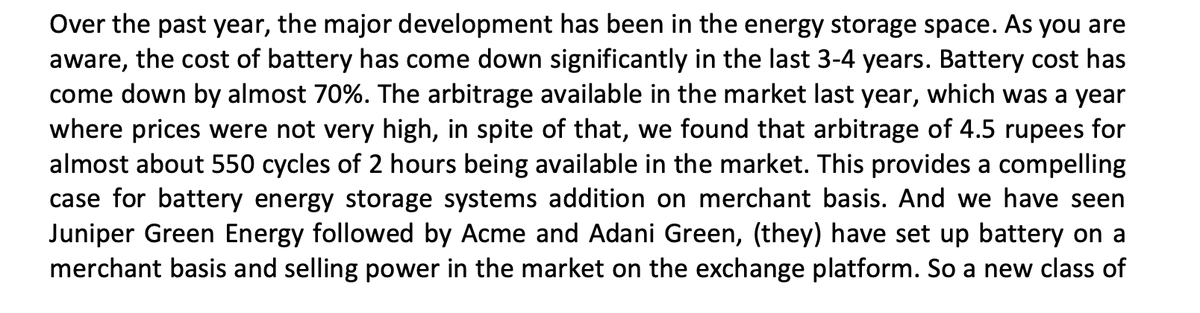
Battery costs have fallen ~70% in 3–4 years. Even in FY26, a low-price year, BESS merchants had opportunity of ₹4.5/unit arbitrage across ~550 two-hour cycles.
This is why merchant BESS matters for IEX. BESS will amplify the already accelerating RTM.
Last but not the least is FDRE - Firm and Dispatchable Renewable Energy projects promise a stable delivery profile. But we already know that solar and wind are variable. So developers overbuild. Because the surplus is uncertain and intermittent, it is hard to contract bilaterally. So, it naturally comes to the exchange.
Coal exchange is an optionality - I would not value it aggressively yet, but it is worth tracking.
The moat is that once coal exchanges start, existing coal e-auction platforms cannot continue beyond six months. Today, ~120 mt of coal is traded through e-auctions / marketplaces.
If coal moves from fragmented e-auctions to an exchange model, IEX gets a chance to replicate its power-exchange playbook:
more buyers + more sellers → better price discovery → deeper liquidity → more transactions.
If the rules force liquidity onto exchanges, coal can become a meaningful free option.
Putting it together, the operational flywheel of IEX is stronger than ever.
More renewables → more variability
More variability → more RTM
More solar → more price gaps
More price gaps → more BESS
More FDRE → more buy/sell imbalances
More active DISCOMs → more optimisation trades
Valuation:
I've read comments on forums investors saying that IEX is still expensive at 20+ PEx. I believe that PEx isn't the right approach in valuing this biz. Let me share a back of the envelope calc (I have done detailed modeling but would avoid that to make this complex)
Before valuing, one small but important concept: float.
When buyers and sellers trade on IEX, money does not instantly move from one party to the other. For a short period, settlement money / margins sit inside the exchange ecosystem.
IEX earns interest on this money. That interest income is economically valuable. This is similar to how insurers earn income on float - though the risk profile and rules are very different.
The float corpus itself does not belong to IEX shareholders. So we should not add the entire float balance to valuation like cash. What shareholders own is the income stream generated from that float.
So the valuation logic is:
Float value = after-tax float income × reasonable multiple
Let's get to valuation
Mcap of ₹11k crore
Less
1. Treasury assets: ~₹1,060 cr
2. IGX stake value: ~₹1,200 cr
3. Float income value: ~₹785 cr.
That leaves ~₹8,600–8,700 cr for the core electricity exchange. FY26 standalone op. EBITDA was ~₹514 cr.
So the market is valuing the core exchange at ~16–17x FY26 EBITDA.
Not cheap, not expensive either - rarely do such near-monopoly platforms trade at mid-teen multiples.
1 - IEX has 47.5% stake; estimated IPO value pegged by brokers at 2.2k-3k cr). After IPO/OFS, IEX reduces to 25%, but it receives sale proceeds for the stake sold.
2 - ₹69 cr float income × 76% post-tax × 15x
If investors demand 11% return and the core deserves 20x FY29 EBITDA, CMP of ₹131 implies FY29 core EBITDA of only ~₹621 cr; ~6.5% CAGR for the next 3 yrs.
Read my full thesis on IEX on Substack - https://t.co/JkJwL4Pw57
Morgan Stanley's 2027 Sensex forecast:
Base case: 89,000. 14% upside. Confidence: 50%. So basically a coin toss.
Worst: 66,000. Best: 100,000.
That's a 34,000 spread. For context, that's wider than the entire rally from the 2022 low to today.
Somewhere between "markets crash 16%" and "markets rally 28%" lies the answer. Truly the cutting edge of financial forecasting.
At this point just publish a dartboard and save everyone the 2000 word note.
Here's my full interview with CNBC, covering my bear case against generative AI, OpenAI's questionable finances, AI's lack of ROI, and how all of this is a symptom of the tech industry running out of hypergrowth ideas.
It's great to see the mainstream media discussing this.
FORGET the semiconductor trade for a minute and consider that...
The world can't build planes fast enough, and a few companies are getting paid for every year they stay old.
The global fleet is the oldest it's ever been. The order backlog is over 17,000 aircraft, the largest in history, and it will take a decade to clear.
Engines are sold near or below cost, then maintained for 30 years under contracts the airline has no choice but to honor. The shops doing that work are full, and demand for engine overhauls is set to outpace capacity by more than 17% by the end of the decade.
I found 3 stocks sitting directly inside that bottleneck, spread across USD, EUR, and GBP. One of them is sitting on a 50-year contract that still pays out through 2050.
Full breakdown, charts, and entry levels.
Ken Griffin is, by far, the most successful Wall Street entrepreneur of his generation. Worth about $50 billion, he founded Citadel, one of the biggest hedge funds in the world, and Citadel Securities, a hugely profitable “market maker.” He has never pretended to be a radical innovator or a savant. His mission has always been different: to build finance businesses that update their strategies and infrastructure so relentlessly that they beat rivals not just today but over decades. Given that Griffin lacks a signature trading or investing style, his success can feel both confounding and imitable. But nobody has duplicated his monetary success—or built two separate businesses that are so wildly profitable. In a new Profile, Gary Sernovitz speaks with the hedge-fund titan and 28 of his current and former employees. Read it here: https://t.co/Kbfj1VUz6d
Thomas Peterffy arrived in America with $100 - couldn't speak a word of English
today his company Interactive Brokers is worth over $150 billion - more than Deutsche Bank and Barclays combined - he still owns 75% of it
he built his own options pricing formula - walked onto the trading floor in 1977 with $200,000 in savings - the only trader who knew the exact fair value of every option
"I had $10 million left - maybe that's enough to live on if I can never get another job - I had a family - maybe I should stop"
bookmark & watch the full conversation ↓
When people talk about AI chips in China, they focus only on Huawei. Just as the US has Cerebras, Google TPU, Amazon Tanium, & AMD, there is a far bigger ecosystem of players, including Cambricon with a US$40B market cap. Many public already. More here:
https://t.co/IogI68b6DX
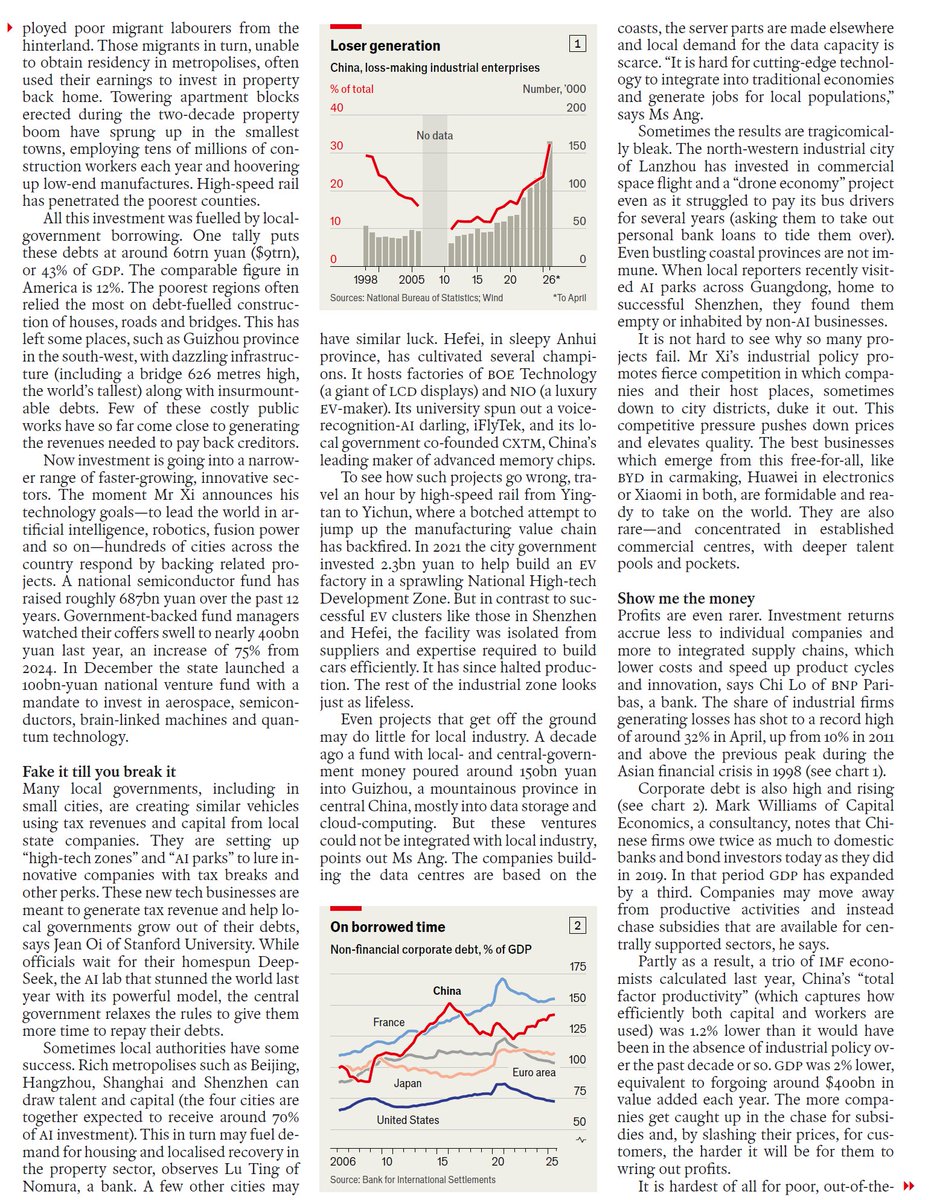
CHN industrial policy limits foreign competition but pits company against company + province against province in a vicious contest for access to subsidies. It leads to a a lot of capital destruction but what emerges are world beating firms operating at unheard of scale/efficiency
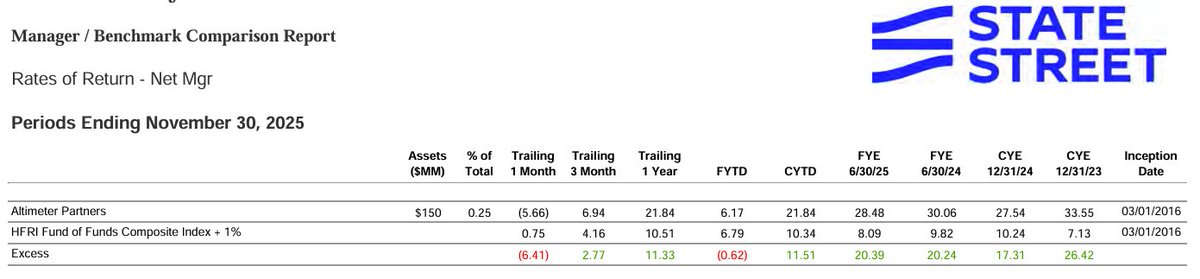
Brad Gerstner started Altimeter in 2008 with $3M from friends and family, in the depths of the GFC, when everyone thought he was crazy.
Since 2011, his fund has generated 25%+ returns per year.
Here's how a travel-search guy built one of the best investing track records:
This man ran the equities book for George Soros
then became chief investment officer for Steve Cohen
now he runs a $4 billion fund - and just revealed his #1 pick on stage
"Barry Diller owns 26% and just bid for the company - I would not sell my shares to him"
MGM has two hidden assets nobody is pricing in
300,000 square feet of empty casino space in Dubai - waiting for gambling to be legalized
"I think the stock is a triple - could be worth $150"
bookmark and watch the full pitch ↓