Kicking off a new weekly series where I break down interesting research papers 🚀
This week we are looking at how ATP allows agents to stay secure, handle downtime, and communicate asynchronously.
Read the full breakdown here👇 https://t.co/q5Wr44WHoL
Kicking off a new weekly series where I break down interesting research papers 🚀
This week we are looking at how ATP allows agents to stay secure, handle downtime, and communicate asynchronously.
Read the full breakdown here👇 https://t.co/q5Wr44WHoL
With AI, I feel like the most we need to put effort is in identifying race conditions and those one off scenarios which can make or break your product.
& Identifying those, demands the understanding of what the system and code base is doing.
Models can sometimes over or under estimate these from my experience.
We'll be spending a lot more time trying to understand the outputs of language models. A few thoughts, tips & tricks:
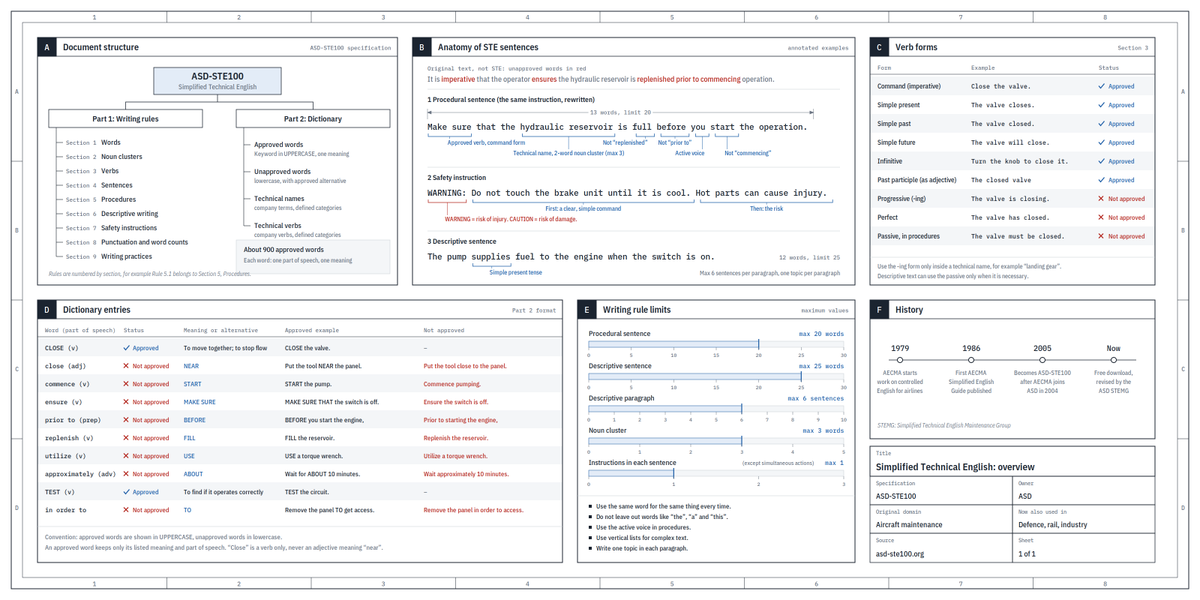
Writing. Something I've had success with: Ask your LLM to explain something in ASD-STE100, it's a controlled language specification originally developed for aerospace maintenance documentation. LLMs well-versed in this language and it comes with heavy constraints on clean writing style that I often find a lot more readable. Sometimes I've tried to soften it a bit e.g. ask for "80% of the way to ASD-STE100" because the spec is quite stringent. But even better:
Diagrams / images. Instead of writing, ask your LLM to create a diagram. These can be a lot easier to process, parse, and understand. But even better:
Web pages. Ask for output "in HTML" to get a beautiful, interactive webpage. LLMs are getting really good at frontend and can create beautiful experiences, animations, etc. But even better:
Explainer videos. The output format I am most bullish on is fully custom / bespoke explainer videos generated on any arbitrary topic. Experiment with things like "Create a 3b1b style video explainer on X. Use my ElevenLabs API key for audio narration". (you'd need an API key for the latter or you can ask your LLM to find you decent free alternatives that use your local compute). This is actually starting to work!
In summary:
- As LLMs get better, they will do more and more of the legwork autonomously, and a lot more of our work will rise up the abstractions into oversight and understanding.
- Luckily, LLMs can help here too because as intelligence and code are increasingly abundant, you can ask for large, custom, discardable software artifacts (e.g. web apps, video explainers) that would have never made sense to create before. Push the boundaries here and you'll be surprised.
As much as I believe that in today’s world you can learn anything for free if you are genuinely passionate about it.
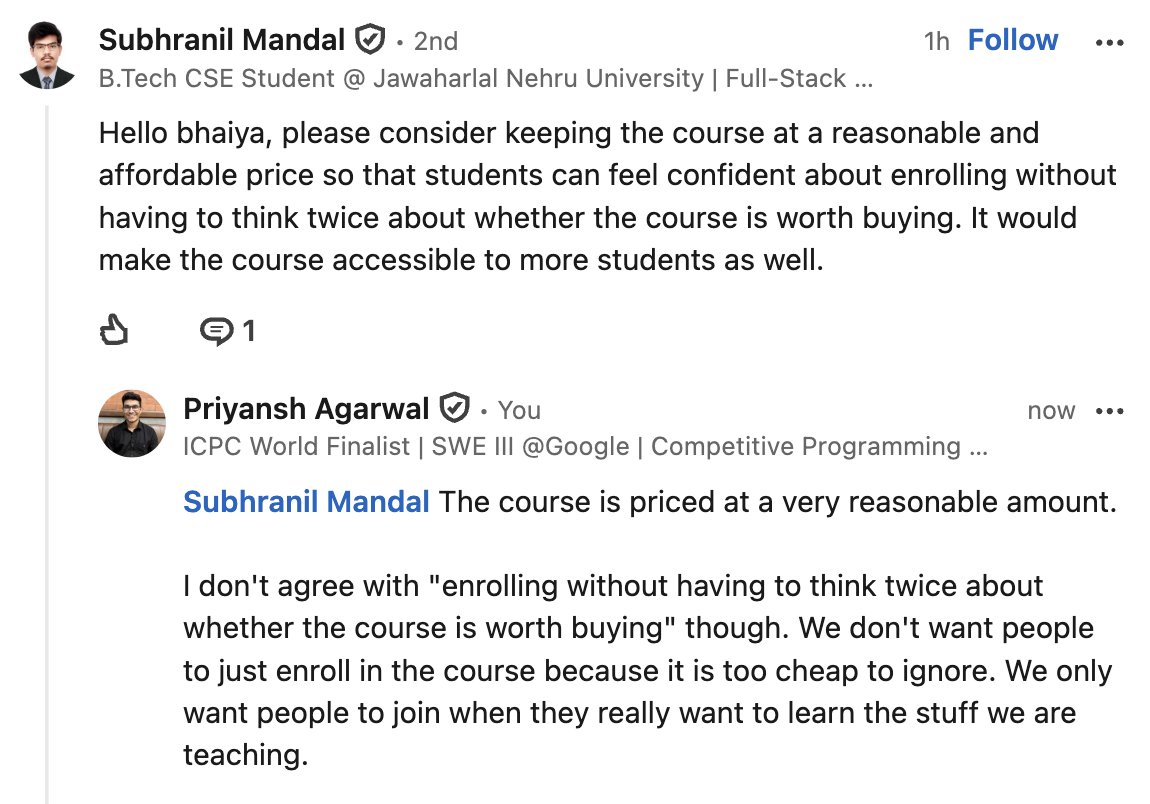
I also feel people are not really required to justify their prices, they have put in time and effort into it so they are allowed to charge whatever they want.
The course is priced based on the following factors
- Amount of recorded content (already spent cost)
- Amount of Live content (active operational cost)
- Validity of the content (active platform cost + team salaries)
Considering all of the above, the course is still extremely cheap and is only meant for serious folks. If you don't care about first principles, then I believe you don't need a TLE course in the first place.
Going back to 2019 when I had purchased a CP course, the amount of value we are providing in Prime would have cost 20k easily back then and 30k now if you account for standard inflation.
I myself purchased a course at 12k for 1/10th the value 🙃