Someone once asked me what a physicist has to do with financial services technology.
Fair question.
I spent years making sense of the world through equations — waves, energy, electrodynamics, quantum fields, the geometry of space and time. Physics teaches you one thing above all else: everything that exists leaves a signal. Your job is to find it.
Then it hit me — there is data in physics, and physics in data. Every dataset is a universe waiting to be understood. Every insight, a law waiting to be discovered and applied.
So I traded the spectrometer for the terminal. And never looked back.
Today I work as a CDO, Data & AI strategist, speaker, and educator. I help organizations stop drowning in data and start making decisions like scientists — with rigor, curiosity, and courage.
If you're building with data & AI, or leading people through it, this is where I'll be thinking out loud. I'm glad you're here.
#DataLeadership #AIStrategy #FinancialServices #Physics #CDO
Your employees are already using GenAI. The question isn't whether — it's whether you're steering it or just finding out about it during an incident review.
After watching this play out across financial services and beyond, here's the framework I keep coming back to:
G — Govern who can access which tools
O — Oversight: keep humans in the loop on high-stakes calls
V — Verify outputs before anyone acts on them
E — Encrypt and protect what goes in
R — Review models regularly for drift and bias
N — Nurture AI literacy across the team, not just IT
Innovation and control aren't opposites. Unmanaged innovation is just risk with a good PR team.
Which letter is your organization weakest on? Genuinely curious — reply below.
#AIGovernance #GenerativeAI #RiskManagement #DataStrategy #CDO #FinancialServices
GenAI in your operations is like hiring a brilliant new analyst who never sleeps, never asks "are you sure?", and occasionally invents a source with total confidence.
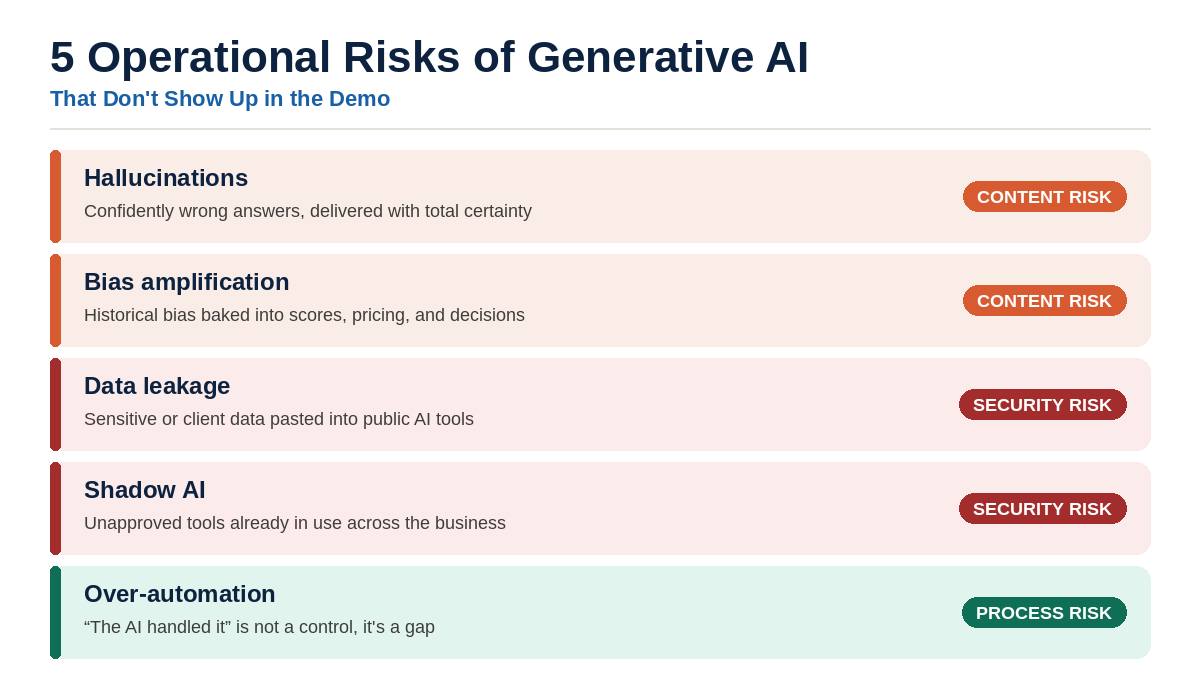
Here are 5 risks I keep seeing leaders miss — until they show up in an audit:
🔸 Hallucinations — fluent, wrong, and shipped before anyone checks
🔸Bias amplification — the model learned your history, including the parts you'd rather not repeat
🔸Data leakage — one pasted client file into a public tool = a very bad Monday
🔸Shadow AI — your team is already using tools you haven't approved. Ask around.
🔸Over-automation — "the AI handled it" is not a control, it's a liability waiting for a name
None of these mean "don't use GenAI." They mean: govern it like the powerful, imperfect tool it is.
The fix isn't more caution. It's better checkpoints.
#GenerativeAI #AIRisk #DataStrategy #ResponsibleAI #FinTech #OperationalRisk
Most "AI bias scandals" aren't really AI problems. They're process problems wearing an AI costume.
Pull back the headline and it's usually one of: no diverse review before launch, no monitoring after, a vendor model treated as a black box, or no clear escalation path when someone did flag a concern.
None of that needs a PhD to fix. It needs a habit: ✅ Quarterly bias audits — calendared like a financial audit ✅ Second-line challenge on high-impact models, not just first-line sign-off ✅ Contractual audit rights on every vendor AI deal
The algorithm doesn't need a conscience. Your governance does.
#AIgovernance #RiskManagement #Fintech #ResponsibleAI
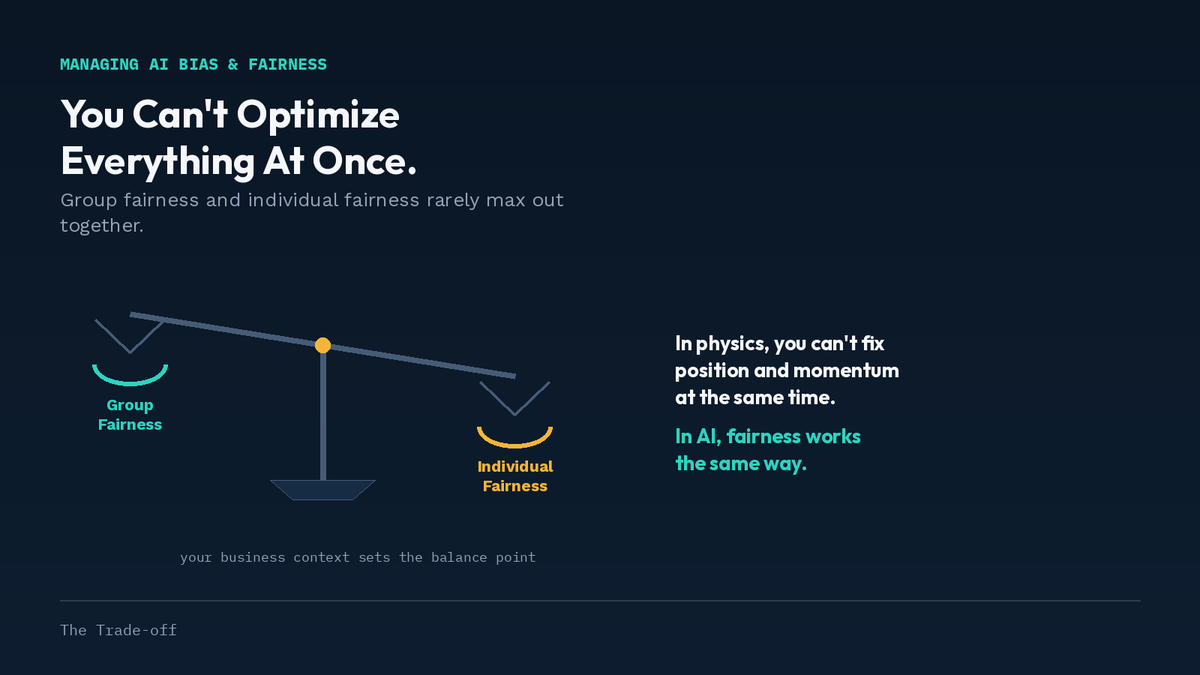
In physics, you can't pin down position and momentum at the same time. Push on one, the other slips.
AI fairness works the same way. Optimize hard for group fairness and individual fairness quietly drifts — and vice versa. No setting maximizes both.
What actually helps: ▪️ Pick your fairness definition before you build — legal, compliance, and business in the room ▪️ Re-test after every retrain; fairness drifts as quietly as performance does ▪️ Put the trade-off in front of leadership explicitly, not buried in a notebook
Fairness isn't a checkbox. It's a conversation you keep having, on purpose.
#AI #DataScience #AIethics #Leadership
@stratorob Ohne Kapitalismus entscheidet nicht "die Gesellschaft", was produziert wird – sondern irgendein Komitee, das noch nie eine Lieferkette gesehen hat. Ich bleib beim Markt. 🛒 #Freiheit#Eigentum#Marktwirtschaft
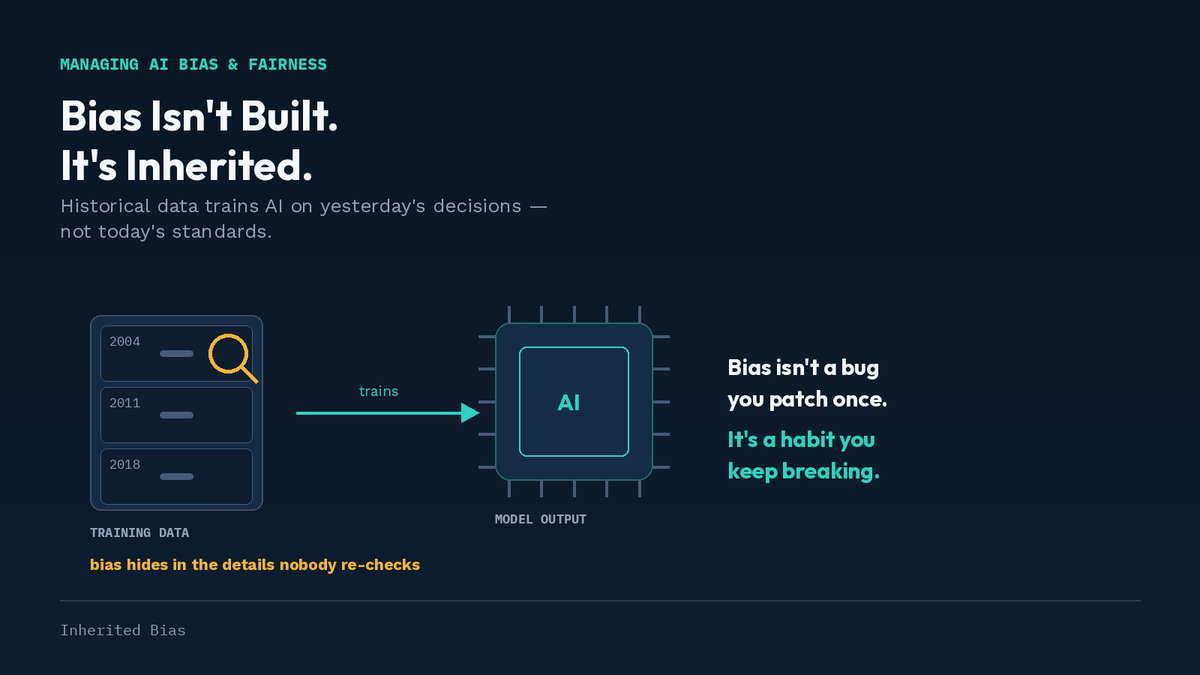
Historical data doesn't just teach AI what happened — it teaches AI what was acceptable at the time.
That's how bias slips into lending, hiring, and underwriting models. Quietly, through the training set, long before anyone reviews the output.
3 things worth doing before your next model ships: 1️⃣ Audit training data for historical skew — before build, not after a regulator asks 2️⃣ Test outputs by subgroup, not just aggregate accuracy 3️⃣ Document the why behind a decision, not just the what
Bias isn't a bug you patch once. It's a habit you keep breaking.
#ResponsibleAI #Fintech #DataStrategy #AIgovernance
The economics of GenAI, part 3: build vs buy isn't a tech decision. It's a balance-sheet decision.
Spent a good chunk of my career in financial services, where "just build it internally" sounds responsible right up until you're 14 months in, the model owner has left, and Risk still hasn't signed off.
The data backs the gut feeling: internal GenAI builds succeed roughly 1 in 3 times. Vendor-led, domain-specific solutions succeed roughly 2 in 3. Not because internal teams are less capable — because they consistently underestimate integration cost, not model cost. The model is the cheap part now (see post 1). Compliance, data plumbing, and change management are where the budget actually disappears.
For regulated industries specifically: your real GenAI economics question isn't "build or buy" — it's "who owns the audit trail when it's wrong." Price that in before you price the tokens.
Pitfall to avoid: don't let "data sovereignty" become the excuse for reinventing infrastructure a vendor already built and hardened. Ask which risk you're actually buying down.
#FinancialServices #AIGovernance #ChiefDataOfficer #RiskManagement #GenAI
The economics of GenAI, part 1: intelligence got 280x cheaper. Nobody told the budget meeting.
In physics we'd call this a phase transition. In business, most people just call it "the AI subscription that keeps renewing."
Between Nov 2022 and Oct 2024, the cost of GPT-3.5-level intelligence fell from $20 to $0.07 per million tokens. That's not incremental — that's the cost of compute behaving like the cost of storage did in the 2000s.
But here's the trap I keep seeing in boardrooms: teams still price GenAI like it's 2023. They over-provision, over-negotiate enterprise contracts, and lock into one vendor "for safety" — while the unit economics underneath them are moving 10x faster than their procurement cycle.
Practical tip: revisit your AI vendor costs every quarter, not annually. If your last GenAI cost review was before ChatGPT-4o pricing dropped, you're likely overpaying for intelligence that's now commoditized.
Cheap tokens ≠ cheap outcomes. That's part 2.
#GenAI #AIStrategy #DataStrategy #FinTech #CDO
The economics of GenAI, part 2: 95% of pilots deliver zero P&L impact. The tech isn't the problem.
MIT's NANDA study looked at 300+ enterprise GenAI deployments. Only 1 in 20 showed a measurable dent in profit or loss. The other 19 stayed exactly where pilots go to die: a "successful demo" slide with no line in the budget attached to it.
The kicker — most of the failed 19 weren't under-resourced. Over half the AI budget goes to sales and marketing pilots, which is exactly where MIT found the weakest returns. The real ROI was quietly sitting in back-office automation: claims processing, reconciliation, document review. Unglamorous. Profitable.
Three things separate the 5% that work:
→ They pick one workflow deep enough to actually change, not ten shallow ones
→ They measure P&L impact from week one, not "engagement"
→ They let the tool learn from feedback instead of shipping it once and walking away
If your GenAI pilot has been "in testing" for two quarters, it's not a pilot anymore. It's a hobby.
#ArtificialIntelligence #Business #DataDriven #AIatWork
@nireyal Nice take! The real trap: mistaking a to-do list for a decision. A decision has a time and a place. Everything else is just a thought you liked enough to write down. #GetThingsDone#Traction"
Worked with a few organisations recently who rolled out GenAI pilots that looked great on day one — then quietly stalled.
Almost every time, the issue wasn't the AI. It was that nobody had clearly answered:
• Who owns the data going into it?
• What happens if it's wrong?
• Who signs off before it reaches a client or regulator?
Not the most exciting questions to ask before a launch. But skipping them is usually why "promising pilot" turns into "quiet shelf-ware."
Curious — has anyone here seen a pilot stall for a reason nobody expected?
#DataGovernance #AIStrategy #FutureOfWork #Fintech
Some teams I work with use GenAI and get real value. Others use it and create more rework than they save.
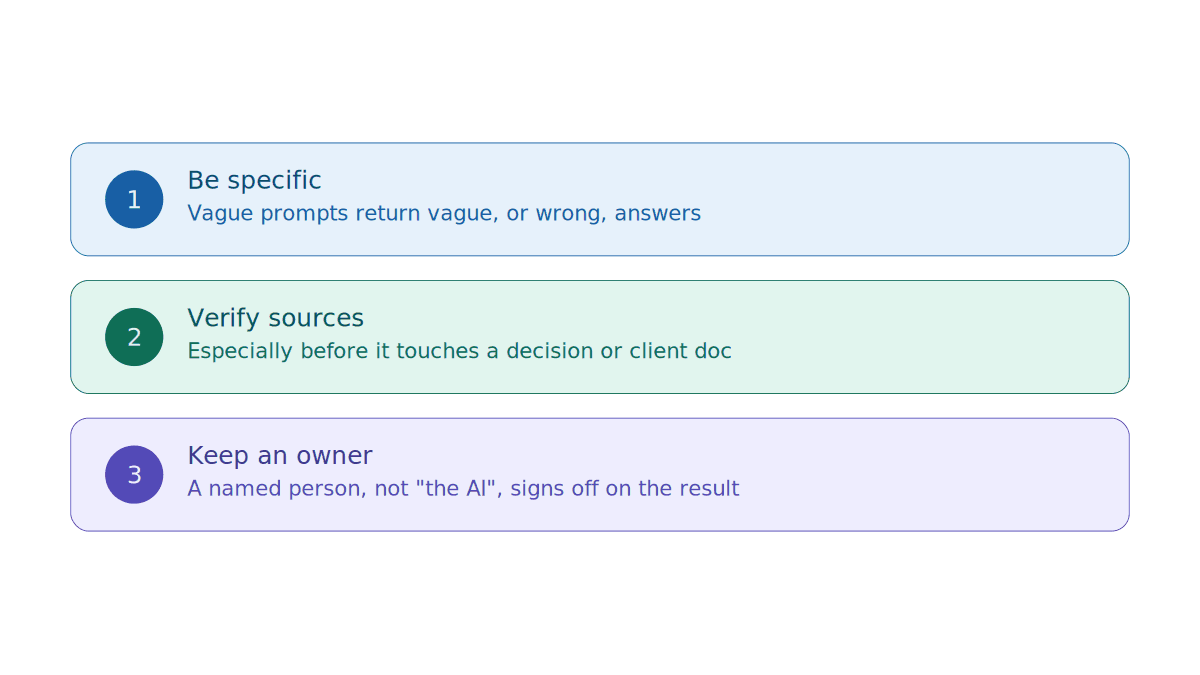
The difference usually isn't the tool. It's a few small habits:
🔹 Be specific in what you ask — vague questions get vague (or wrong) answers
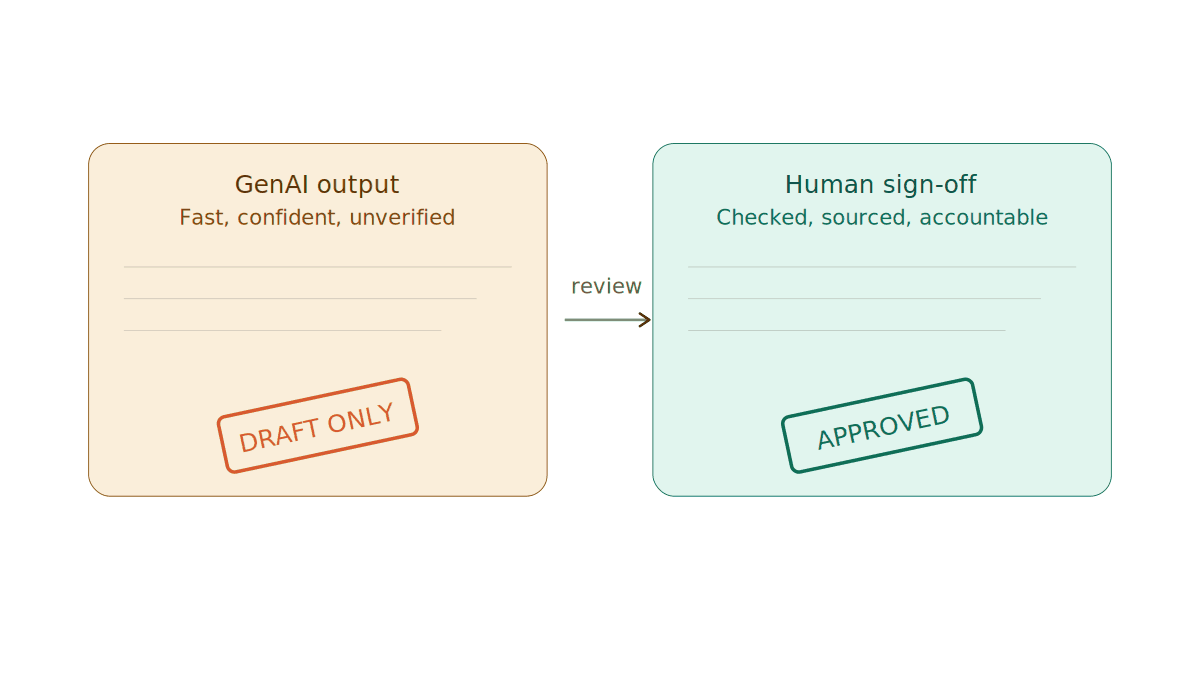
🔹 Double-check anything that feeds into a decision, report, or client-facing doc
🔹 Keep a human name attached to the final output — someone's still accountable
None of this is groundbreaking. It's just easy to skip when you're moving fast.
What's one habit that's saved you from an AI mishap?
#FutureOfWork #AIUpskilling #DataLiteracy #FinancialServices
Ever asked a GenAI tool for a stat and got a confident, well-formatted answer... that was completely made up?
Well, you're not alone. It's a normal occurrence when the human in the loop element is skipped.
The real shift happening at work right now — it's not about AI replacing skills, it's about us needing one new habit: pause before you trust a clean-looking answer.
Anyone else catch one of these "confidently wrong" moments recently? Curious what tripped you up.
#FutureOfWork #GenAI #AIStrategy #DataLeadership