What the American Journal of Psychiatry just published — and what it refused to publish until now.
A letter I co-authored with Kathleen McDeavitt is (to our knowledge) the first time AJP has substantively engaged the systematic reviews showing very low-quality evidence for pediatric medical transition, the European policy reversals, and the professional costs of raising concerns.
Full context: https://t.co/6vgGTOiijw
Another ideological policy statement from AACAP, extending the conversion-therapy narrative to gender identity. It offers no citations, no Cass Review, and no systematic reviews.
The statement treats the amorphous concept of gender identity as established, normalizes a cross-sex identity in children, and then asserts that efforts to change it “lack scientific support and are associated with” depression and suicidality. The studies behind that sentence concern sexual orientation, not psychotherapy for gender distress. “Associated with” is carrying the claim. What lacks scientific support is AACAP’s assertions.
After all it has done to harm its reputation, I had hoped the Academy would evolve into a more careful organization. Sadly, on this subject, AACAP still cannot be trusted.
https://t.co/tYsCxj2SVO
Are we really facing a mental health crisis, or an information crisis – one in which millions of people have been told there is a problem in their brain that only a prescription can fix?
I think we are.
And as someone who was first started on psychiatric drugs as a teenager only to then find a life beyond diagnoses and prescriptions, realizing the problem was largely in the information I’d been given, rather than in my brain, changed everything.
@BlakeMycoskie
These are the 10 most recent papers of the new APA president, Candice Hargons:
1. “That’s Probably What Euphoria Feels Like”: Nonbinary Black Womxn’s Gender Expression in an Antitrans (and Anti-Black [Womxn]) America
American Psychologist, Sept. 2026
https://t.co/twOvzpHr9b
2. “Hard to Remember, then Hard to Forget”: A Qualitative Exploration into the Attitudes and Lived Experiences of Black People With Black Names
Journal of Black Psychology, Oct. 2025
https://t.co/ld0tboWfN5
3. A Content Analysis of Cultural Mistrust Among African Americans in Therapy Settings
Journal of Black Psychology, Oct. 2025
https://t.co/xvZ7tYy45e
4. “People Already Don’t Know What the Fuck I’m Saying”: Nonbinary Black Womxn Perspectives on Sharing Their Gendered-Racial Identity
Journal of Counseling Psychology, Oct. 2025
https://t.co/tsWb9PWwQI
5. “It’s an honor to be in this body”: A Black feminist grounded theory of embodiment through yoga among Black womxn
Body Image, Oct. 2025
https://t.co/Xi8gzrwssy
6. Brief Report: Naloxone Decline Among African American Kentuckians
Substance Use & Addiction Journal, July 2025
https://t.co/CWlezBG1zH
7. “Nobody Ever Sat Me Down to Talk About That Kind of Stuff”: A Thematic Analysis of Heterosexual Black Men’s Genital Hygiene Messages
Health Communication, May 2025
https://t.co/9c6sB0OMiK
8. “God Did for Me What I Couldn’t Do for Myself”: Understanding Religiosity, Spirituality, and Locus of Control Among Black Americans Who Use Opioids
Journal of Religion and Health, Feb. 2025
https://t.co/P1BwZP6IBO
9. Understanding Coping Strategies and Sociocultural Context in Black Americans’ Mental Health
Journal of Racial and Ethnic Health Disparities, Feb. 2025
https://t.co/jb8WfrRY4u
10. The Nonbinary God: Disaggregating Spirituality and Christian Religiosity Among Nonbinary Black Womxn (NBBW)
Journal of Counseling Psychology, Jan. 2025
https://t.co/CuaIMQprB7
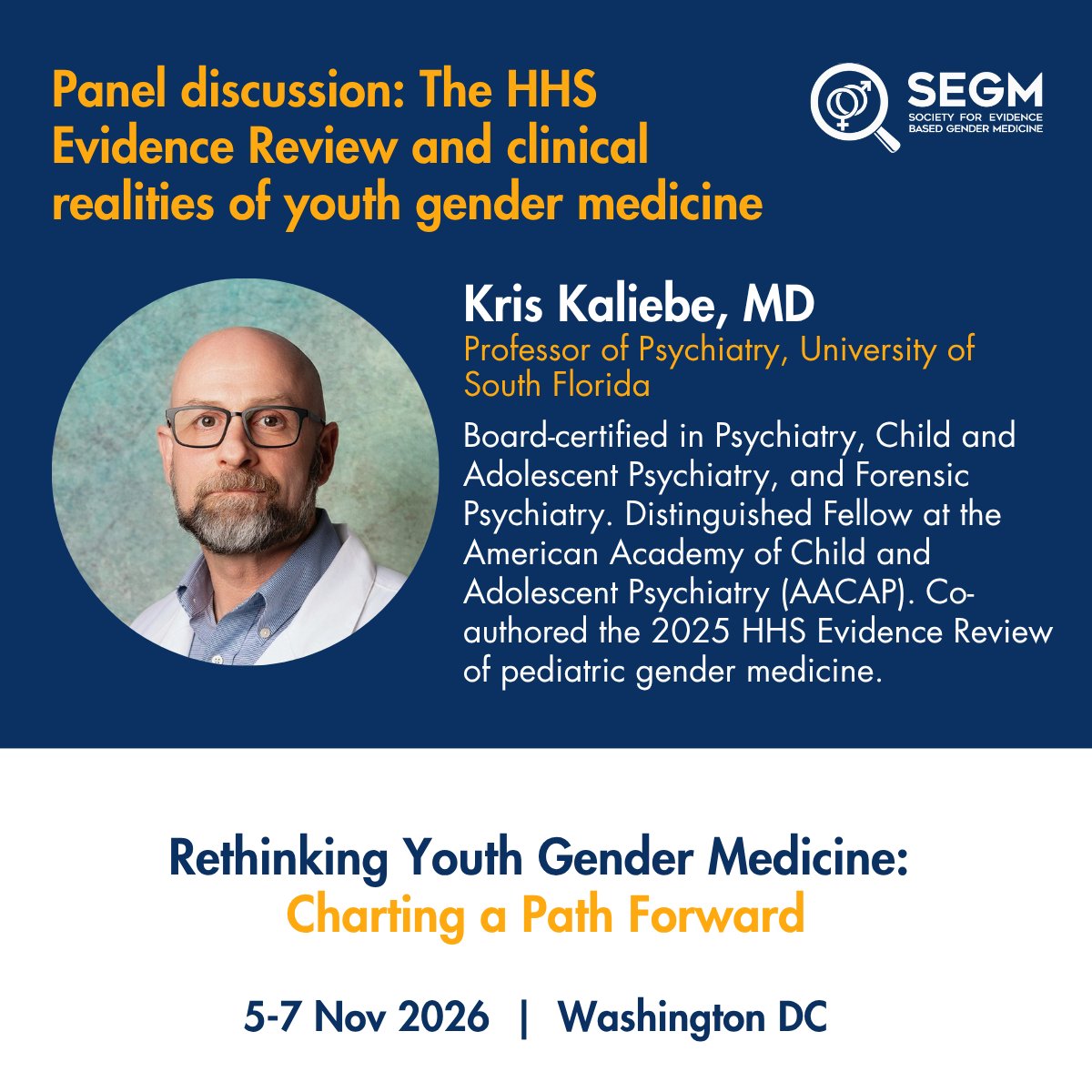
I’ll be on a panel at SEGM’s conference in Washington, DC, November 5–7: Rethinking Youth Gender Medicine: Charting a Path Forward.
Three days on the evidence, the clinical uncertainty, and what responsible care for gender-distressed youth should look like now. In person or virtual.
Register: https://t.co/8F5Pv5Kwuz
@segm_ebm
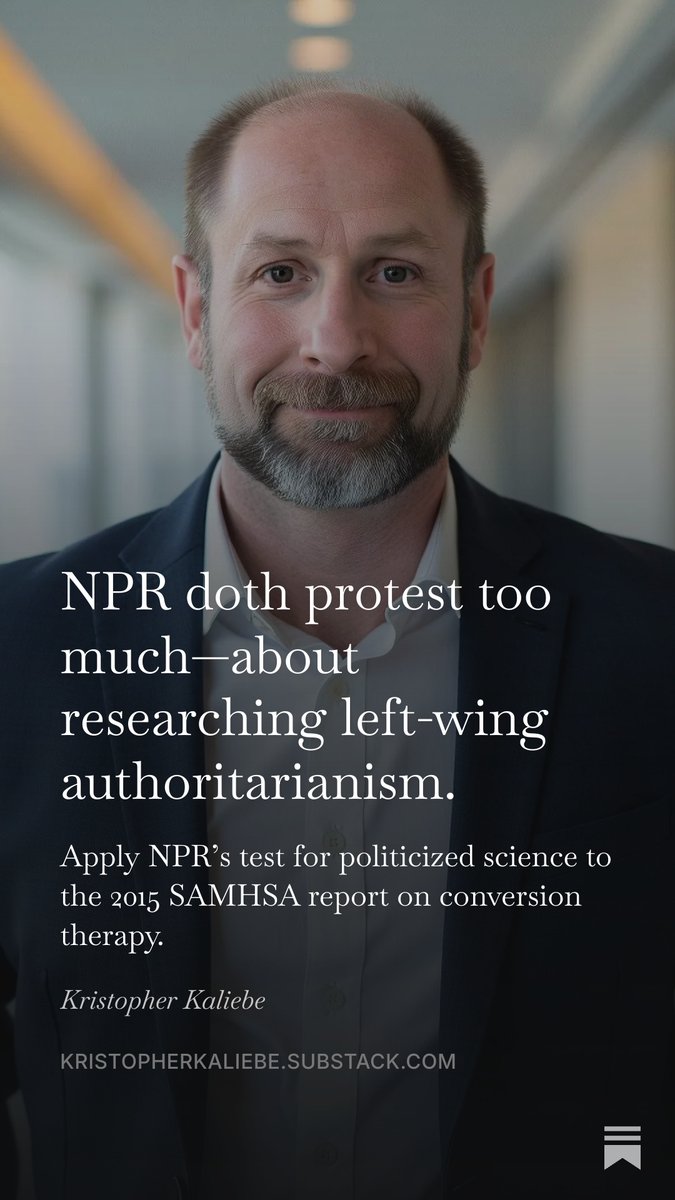
NPR’s test for politicized science, applied to the 2015 SAMHSA report. That report put the weight of the federal government behind dysfunctional ideas with profound consequences, including harming children and creating strife throughout society. Timeline: On April 8, 2015, the White House said conversion therapy for gender identity should be banned. Days later, SAMHSA and the APA agreed to write the report. The expert panel did not meet until July: https://t.co/aUQHBZeAec
At the World Congress of Psychiatry 2026
An expert said to a room full of psychiatrists:
Do not refer kids to gender clinics
Refer them to any child psyciatrist
The room of people clapped.
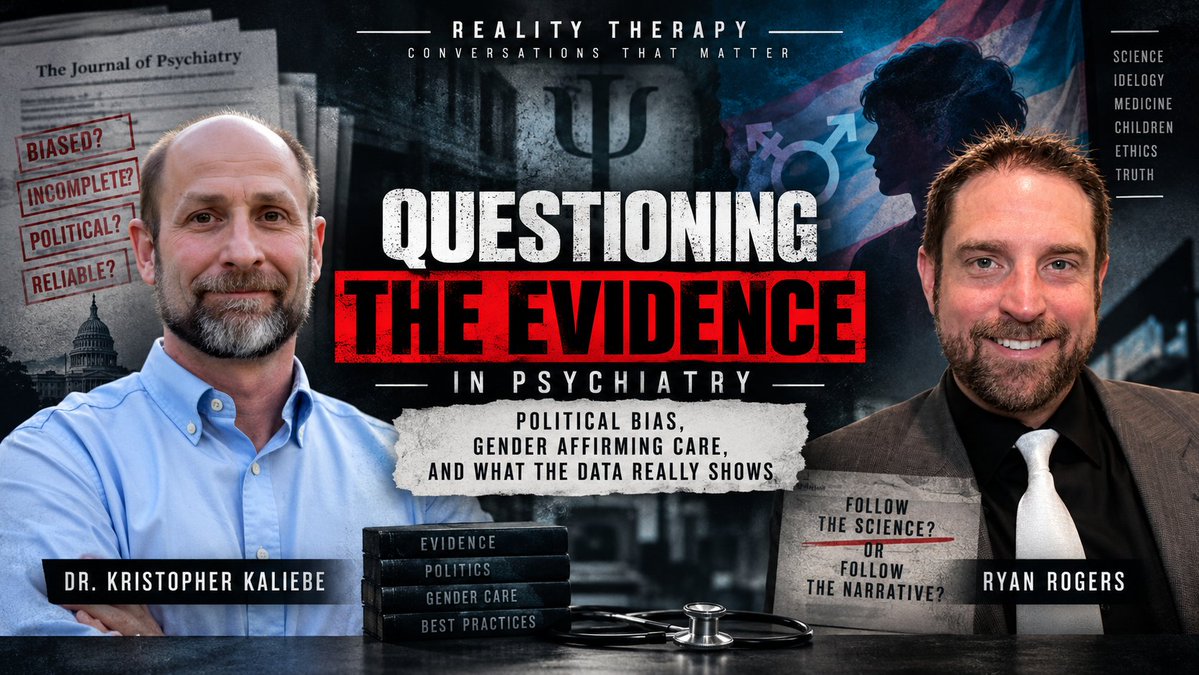
Has psychiatry gotten lazy? Does the evidence support gender affirming care for minors? How can we fix the mental health professions?
These are some questions I discussed with @drkaliebe in our fascinating conversation. I hope you enjoy this episode as much as I did. Cheers!
Pediatric gender medicine rests on several key myths:
•adolescent gender dysphoria is likely permanent
•puberty blockers are proven safe and fully reversible
•detransition is rare and results from external pressures
SEGM debunks 10 common myths in our latest Spotlight. ⬇️
Thinking more, doing less. That is harder than it sounds in modern psychiatry. Clinics are built to name, code, prescribe, and move on. Time is short, and prescribing is easier than sitting with uncertainty. This piece argues for shrinking that habit: more thought per patient, more ways out, less authority over everyday human difficulty. Shrinking the Scope of the Shrinks https://t.co/CqZILsUNOV
Every generation of psychiatry invents a desperate remedy, declares it a breakthrough, and only later notices the wreckage. The hubris is the same: Psychiatry, Insane Asylums, Mental Illness, ECT, Lobotomies, Freud & Jun... https://t.co/FB6j7UozkV via @YouTube
Important lessons learned from my 50 yrs working on & studying DSMs:
1)If any DSM diagnosis can be misused, it will be misused
2)Diagnoses that lead to services are most misused
3)This creates massive & unfair misallocation of very scarce resources
Terrific comment below:
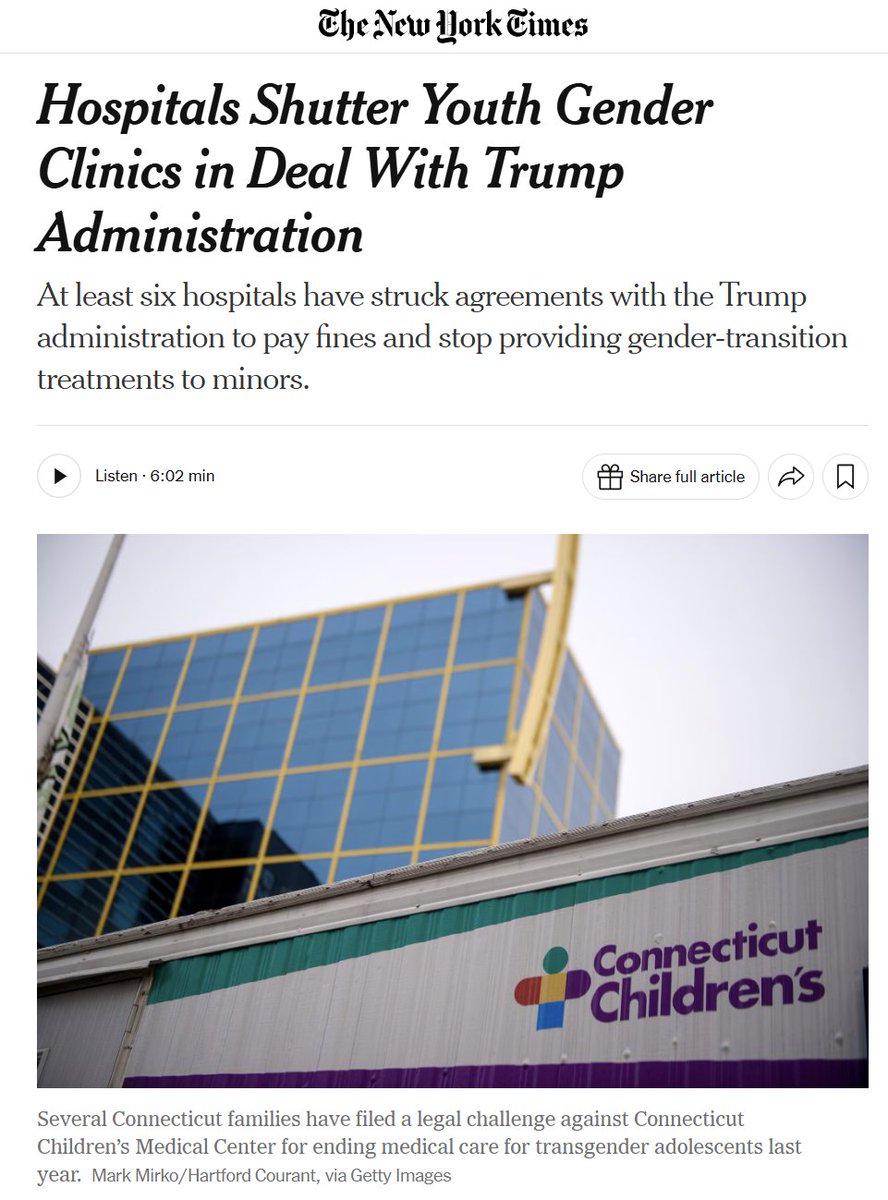
I don't think the New York Times coverage of gender clinic closures is that bad. What's missing, however, is genuine curiosity about why the hospitals agreed to settle.
This was not a decision taken lightly. It's fair to assume that gender clinicians and their allies within these hospitals, especially those located in blue states, face little-to-no opposition from other doctors or administrators.
It's also known that hospitals went to the mat to fight closure efforts previously. That's Exhibit A. So, what's changed? Why the seeming capitulation now?
Enter Exhibit B: mounting evidence of billing fraud, which comes from 3 sources.
(1) Inferentially, from billing of puberty blockers for treatment of central precocious (abnormally early) puberty in 14- and 15-year-olds.
(2) From gender clinicians and quasi-medical groups like WPATH, which has openly and explicitly recommended using "endocrine disorder" when billing for medical interventions in minors without an endocrine disorder (although they are likely to develop such a disorder as a result of treatment).
(3) From court records in resolved qui tam lawsuits (e.g., in Texas) that show evidence of False Claims Act violations.
The combination of these easily verifiable sources, together with the unexpected willingness of blue state hospitals to settle with the DOJ, should trigger curiosity about the leverage the DOJ actually had over NYU, Mt. Sinai, and other hospitals.
It seems highly implausible that hospitals in New York, with Letitia James and Mamdani paying close attention, would shutter their clinics and pay out millions of $ unless the DOJ had court-proof evidence of billing fraud.
Also, it's September 2026, and the New York Times still hasn't done an investigative report on how major medical associations and scientific journals have promoted misinformation and stifled debate on youth gender medicine.
Remembering L. Eugene “Gene” Arnold, MD, MEd (1936–2025).
I knew Gene mainly through his vast scholarly output and AACAP’s Complementary and Integrative Medicine Committee (CIMED), which he chaired. He brought to that work the habits that marked his whole career: intellectual curiosity, integrity, and compassion.
He helped lead the NIMH Multimodal Treatment Study of ADHD, tested neurofeedback and nutrition with the same seriousness he brought to medication trials, and kept asking what actually helps children, not what is fashionable.
In January 2024, he wrote me after David Atkinson and I published on adolescent-onset gender dysphoria in AACAP News. We had urged a psychotherapy-first approach and asked for scholarly exchange within an organization (AACAP) that suppresses the voices of members urging caution. He had chaired OSU’s transsexual-surgery evaluation committee in the 1970s. He thanked us for urging more critical thought, predicted heat for “noticing how few clothes the emperor has,” and praised the practical, empathic recommendations we ended with. He later told me I could share the note.
Gene spent a lifetime insisting that children with ADHD, autism, and other developmental conditions deserved evidence and curiosity rather than fashion. He applied the same habit here.
In memoriam:
https://t.co/4MXNKjy6kz


![benryanwriter's tweet photo. These are the 10 most recent papers of the new APA president, Candice Hargons:
1. “That’s Probably What Euphoria Feels Like”: Nonbinary Black Womxn’s Gender Expression in an Antitrans (and Anti-Black [Womxn]) America
American Psychologist, Sept. 2026
https://t.co/twOvzpHr9b
2. “Hard to Remember, then Hard to Forget”: A Qualitative Exploration into the Attitudes and Lived Experiences of Black People With Black Names
Journal of Black Psychology, Oct. 2025
https://t.co/ld0tboWfN5
3. A Content Analysis of Cultural Mistrust Among African Americans in Therapy Settings
Journal of Black Psychology, Oct. 2025
https://t.co/xvZ7tYy45e
4. “People Already Don’t Know What the Fuck I’m Saying”: Nonbinary Black Womxn Perspectives on Sharing Their Gendered-Racial Identity
Journal of Counseling Psychology, Oct. 2025
https://t.co/tsWb9PWwQI
5. “It’s an honor to be in this body”: A Black feminist grounded theory of embodiment through yoga among Black womxn
Body Image, Oct. 2025
https://t.co/Xi8gzrwssy
6. Brief Report: Naloxone Decline Among African American Kentuckians
Substance Use & Addiction Journal, July 2025
https://t.co/CWlezBG1zH
7. “Nobody Ever Sat Me Down to Talk About That Kind of Stuff”: A Thematic Analysis of Heterosexual Black Men’s Genital Hygiene Messages
Health Communication, May 2025
https://t.co/9c6sB0OMiK
8. “God Did for Me What I Couldn’t Do for Myself”: Understanding Religiosity, Spirituality, and Locus of Control Among Black Americans Who Use Opioids
Journal of Religion and Health, Feb. 2025
https://t.co/P1BwZP6IBO
9. Understanding Coping Strategies and Sociocultural Context in Black Americans’ Mental Health
Journal of Racial and Ethnic Health Disparities, Feb. 2025
https://t.co/jb8WfrRY4u
10. The Nonbinary God: Disaggregating Spirituality and Christian Religiosity Among Nonbinary Black Womxn (NBBW)
Journal of Counseling Psychology, Jan. 2025
https://t.co/CuaIMQprB7](https://pbs.twimg.com/media/HT6DQauXYAA3UCP.jpg)