Our paper “Difference-in-Differences Designs: A Practitioner’s Guide” is now published in the Journal of Economic Literature. It took us a while but we are happy!
We put together a lot of material to make the paper useful in practice: https://t.co/30TbAgihlz
Hope you like!
A professor at MIT spent his life studying uncertainty.
Near the end, he compressed everything into a single one-hour lecture.
No buzzwords. No heavy theory.
Just a clear explanation of how prediction really works.
Not long after, he was gone.
This is that talk.
The idea at its core is simple but powerful:
prediction isn’t about being certain
it’s about understanding probabilities
Most people will scroll past it.
A few will see it and start thinking differently.
Save it.
AI engineers at top labs earn $500K+ a year to build agentic AI systems.
Stanford just dropped a 90 min lecture that covers the entire playbook. For FREE.
Prompting. Chains. RAG. Multi-agent systems. All of it.
Worth more than any "AI agent mastery" course. Bookmark it:
🚨 Anthropic's own team just showed how to actually prompt Claude.
24 minutes. free. from the people who built it.
watch the workshop. bookmark it.
worth more than every $300 course you almost bought.
you've been using Claude without knowing 40 of its prompts.
Then read the guide below.
In 2013, Yale professor Ben Polak gave a legendary 1-hour lecture on Game Theory.
It will change how you make decisions in negotiations, business, and life.
His frameworks:
• Dominance arguments
• Backward induction
• The proactive bias
12 lessons to make better decisions:
🚨 In 1992, a MIT lecture quietly revealed more about product and sales than most 2-year MBAs ever will.
Most people have never seen it.
It came from Steve Jobs and instead of teaching theory, he broke down how great products actually win.
Watching it today feels unreal.
He explained that people don’t buy products they buy meaning. The best products aren’t just functional, they connect with how people see themselves. That’s why some ideas spread effortlessly while others die, even if they’re technically better.
He also made it clear that marketing isn’t about features. It’s about clarity. If you can’t explain why your product matters in simple terms, it won’t matter at all. Complexity doesn’t impress it confuses.
And his biggest edge? Obsession with experience. Not just what the product does, but how it feels. The small details, the simplicity, the story that’s what separates good from unforgettable.
That’s why this MIT lecture still hits hard.
Because while most people are building products…
Very few understand why people actually buy them.
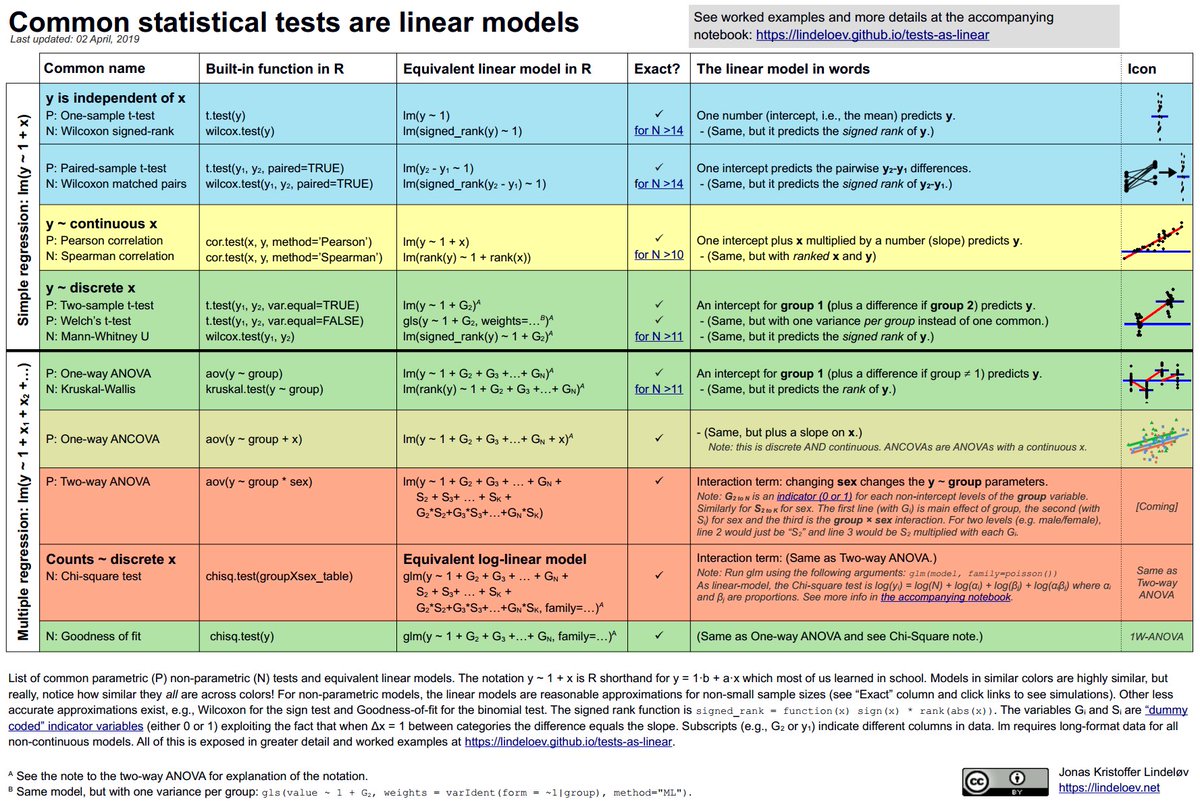
Most statistical tests you learned separately are the same thing.
t-test, ANOVA, Mann-Whitney, Chi-square, Wilcoxon... all just special cases of linear models. y = b0 + b1*x covers almost everything.
🚨 BREAKING: AI can now teach machine learning like Stanford's CS229 professors (for free).
Here are 15 insane Claude prompts that replace $50,000 ML bootcamps (Save for later)