We are excited to share our new paper – “IL-17RA signalling modifies cardiovascular disease risk in JAK2 clonal haematopoiesis” published in European Heart Journal 🧬🫀 1/n
https://t.co/8vETgTdyG5
@AlexBickMDPhD@yash_pershad@VUMCDiscoveries@ehj_ed
Every person who lives long enough will develop cancer mutations in their blood. By age 70, between 10% and 30% of us carry detectable clones of mutant white blood cells, each descended from a single stem cell that picked up a mutation in a cancer-driver gene and started outcompeting its neighbors. The condition has a clinical name, clonal hematopoiesis of indeterminate potential (CHIP). For most people, it never causes symptoms. But CHIP raises the risk for leukemia and can accelerate atherosclerosis.
Recently, two research groups asked what happens when these mutant blood cells reach the brain. Despite both groups studying the same mutations in the same genes, finding them in the same cell type in the same organ, and agreeing on the basic mechanism by which they get there, they arrived at starkly different answers. Read more: https://t.co/fjSpaKJBFx
📢@AeronSmallMD and I (https://t.co/r6duPFjXyv) are jointly hiring a computational associate at @MGBResearchNews and @broadinstitute!
We (1) are productive in publications, (2) work with large-scale multi-omics 🧬 and medical imaging 🩻 data, (3) offer a competitive salary, and (4) have a strong track record placing our master's-level trainees into PhD programs 🎓 and industry roles 🖥️
If you are a post-master's graduate with a strong quantitative background and are interested in using a wealth of multi-modal data to study cardiovascular disease🫀and aging, we hope you apply!
We’re excited to share our latest publication in @NatureComms: “Integrating common and rare variants improves polygenic risk prediction across diverse populations” 🧬🧪🫀
https://t.co/h6JsnL7OLY
Sincere thanks to Jacob Williams (lead), @AndrewHaoyu (senior), @Tony_Chen6, Xing Hua, @wendyWongSW, Kai Yu, @GENES_PK, and all @uk_biobank + @AllofUsResearch participants whose data made this work possible.
Most polygenic risk score (PRS) models focus on common variants. But rare variants can have larger effects for the people who carry them, and they may explain part of the genetic risk not captured by common-variant PRSs.
To address this, we developed RICE (polygenic Risk predictions Integrating Common and rarE variants), a framework for integrating rare variant signals with common-variant PRSs across ancestries.
RICE provides a unified framework to:
• Build a robust common-variant PRS (RICE-CV) by ensembling existing PRS methods
• Identify rare variant sets independent of RICE-CV using STAARpipeline + functional annotations
• Collapse significant rare variant sets into burden scores
• Train rare-variant PRSs (RICE-RV) with penalized regression
• Combine RICE-CV and RICE-RV in an independent validation set for integrated risk prediction
We evaluated RICE using extensive simulations and sequencing data from @uk_biobank and @AllofUsResearch, up to 740M genetic variants from 361,939 individuals across diverse ancestries and 11 complex traits.
A few key findings:
• RICE-CV consistently improved common-variant PRS performance, with average R² gains of 9.4% over the best alternative method for continuous traits across trait–ancestry combinations.
• Adding rare variants through RICE-RV produced further gains, especially for lipid traits and height.
• For lipid traits, incorporating rare variants increased R² by up to ~11.2% in Europeans and ~60.7% in African ancestry compared with common-variant PRS alone.
• Rare variants also helped identify individuals with extreme lipid profiles that common-variant PRS alone may miss. For HDL cholesterol, 6.3% of individuals in the top phenotype decile had high RICE-RV but low RICE-CV.
• The rare-variant signal was not limited to established high-penetrance lipid genes. RICE-RV captured predictive signal beyond LDLR, APOB, and PCSK9, supporting a broader polygenic rare-variant architecture.
Key takeaway: Integrating common and rare variants can significantly improve genetic risk prediction and risk stratification across populations, while rare variants do not improve every trait equally - their value depends on genetic architecture and available sample size.
The software and tutorial are open source:
RICE package: https://t.co/NtDLBa5jWj
Tutorial: https://t.co/m1OCFdmBRT
Manuscript code: https://t.co/WeynM1c180
Clonal hematopoiesis (CHIP) is associated with increased risk of both ischemic and hemorrhagic #stroke in a large multicohort analysis (>800,000 individuals). Risk is highest for specific mutations (e.g., JAK2, TET2) and in postmenopausal women. https://t.co/N9tjYyYE6n
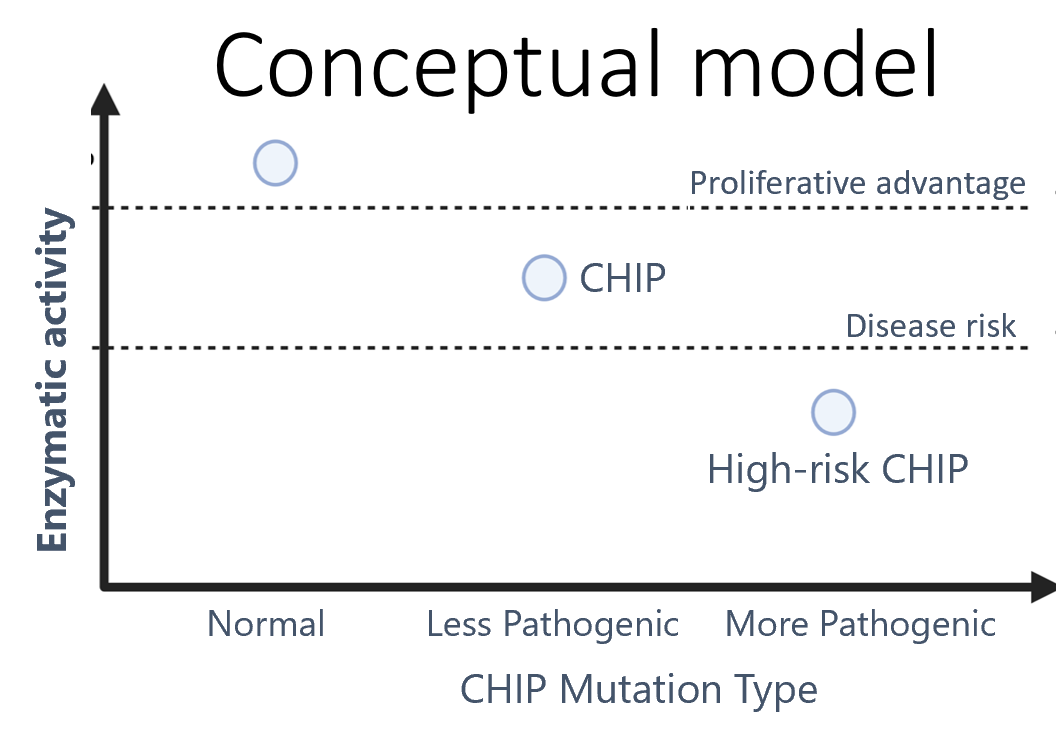
Exciting new work led by @yash_pershad & @drkunzhao! We find that only a subset of TET2 and DNMT3A CHIP, which are most disruptive to enzyme activity, actually cause disease. We can quantify enzyme activity by profiling peripheral blood DNA methylation.
Update: our CHIP–stroke study is now published in Stroke!
For those who followed the earlier preprint thread — the final version incorporates additional analyses and revisions from peer review.
Here’s the published version: https://t.co/HaXV17CAC8
We’re excited to share our new preprint on medRxiv
🧬 “Clonal Hematopoiesis and Risk of Stroke: Evidence from Over 800,000 Individuals Across Three Cohorts.” The largest study to date exploring CHIP & stroke
👉https://t.co/RzLmdHKTGk
@AlexBickMDPhD@yash_pershad@VUMCDiscoveries
Clonal hematopoiesis of indeterminate potential (CHIP) is a risk factor for many chronic inflammatory diseases of aging. In the largest study to date on CHIP and RA, Zhao et al ascertained RA status in >600,000 participants from the @uk_biobank, NIH @AllofUsResearch, and @VUMCDiscoveries BioVU. CHIP was associated with an increased risk of late-onset, seropositive RA. This work has implications for understanding the consequences of CHIP and the provenance of late-onset RA
@rheumrob & 1st author @drkunzhao
A&R
https://t.co/gZULS5Dky4
Many thanks to my mentor @AlexBickMDPhD, co-authors @drkunzhao & @brettheimlich, the participants, and @artschuermans & @mchonig for discovering this fascinating association initially.
VUMC health article here - https://t.co/w1NVxAd6iC (4/4)
We are excited to share our recent work in @CCR_AACR demonstrating that in humans in @VUMCDiscoveries BioVU and the @WHIStudy, metformin does not alter the longitudinal dynamics of clonal hematopoiesis to a clinically significant degree... 🧵 1/7
https://t.co/CiSheD1Bxd
With more work coming out on leukocyte telomere length (LTL) and clonal hematopoiesis, a brief thread...
1) LTL is under considerable cellular selection
2) Driver gene heterogeneity and germline context must be more fully understood
3) Many mechanisms yet to be discovered 1/n
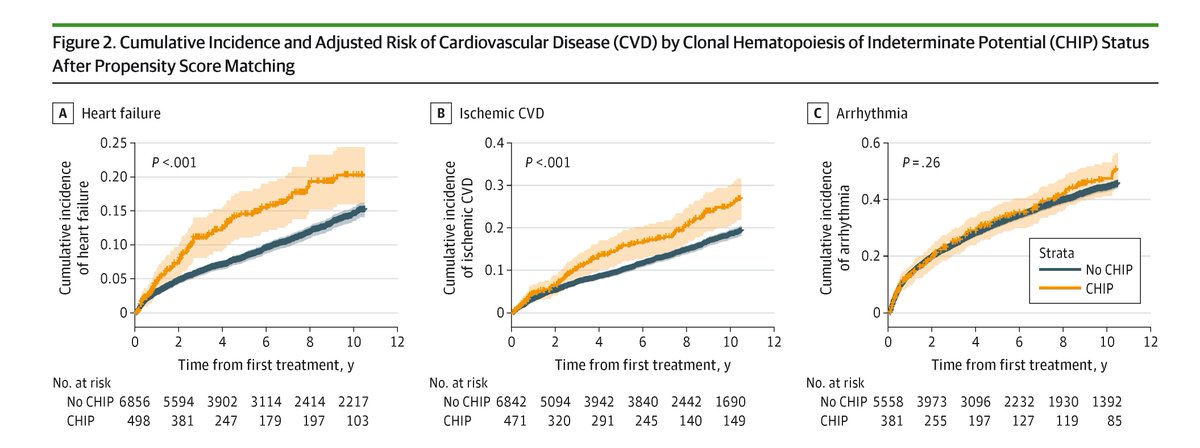
CHIP was associated with increased heart failure and ischemic cardiovascular disease risk after #cancer therapy in patients with solid tumors, especially among those with higher #chemotherapy exposure. https://t.co/YLirctG8gI
Our study led by @ArielXue1 & R. Bhattacharya, using targeted sequencing in the REPRIEVE clinical trial, shows that nearly 1 in 5 early middle-aged (mean 50y) adults living the HIV at low clinical cardiovascular risk have mutations indicative of clonal hematopoiesis. https://t.co/mwtaydxcQX @atvbahajournals
Clonal hematopoiesis has emerged as a multifaceted health risk factor with consequences spanning to CVD. The presence and expansion of mutations indicative of clonal hematopoiesis have been linked to various endogenous and exogenous factors, with inflammation / immune dysregulation playing a key role in potentially the causes and consequences of clonal hematopoiesis. Work by us and others has suggested that people living with HIV in later middle-age have an increased prevalence of clonal hematopoiesis. We now sought to better characterize the prevalence and consequences of clonal hematopoiesis in a younger cohort of people living with HIV using technology more sensitive than blood-based whole exome/genome sequencing.
CD4+ nadir was a key risk factor for clonal expansion but cause-effect needs to be examined.
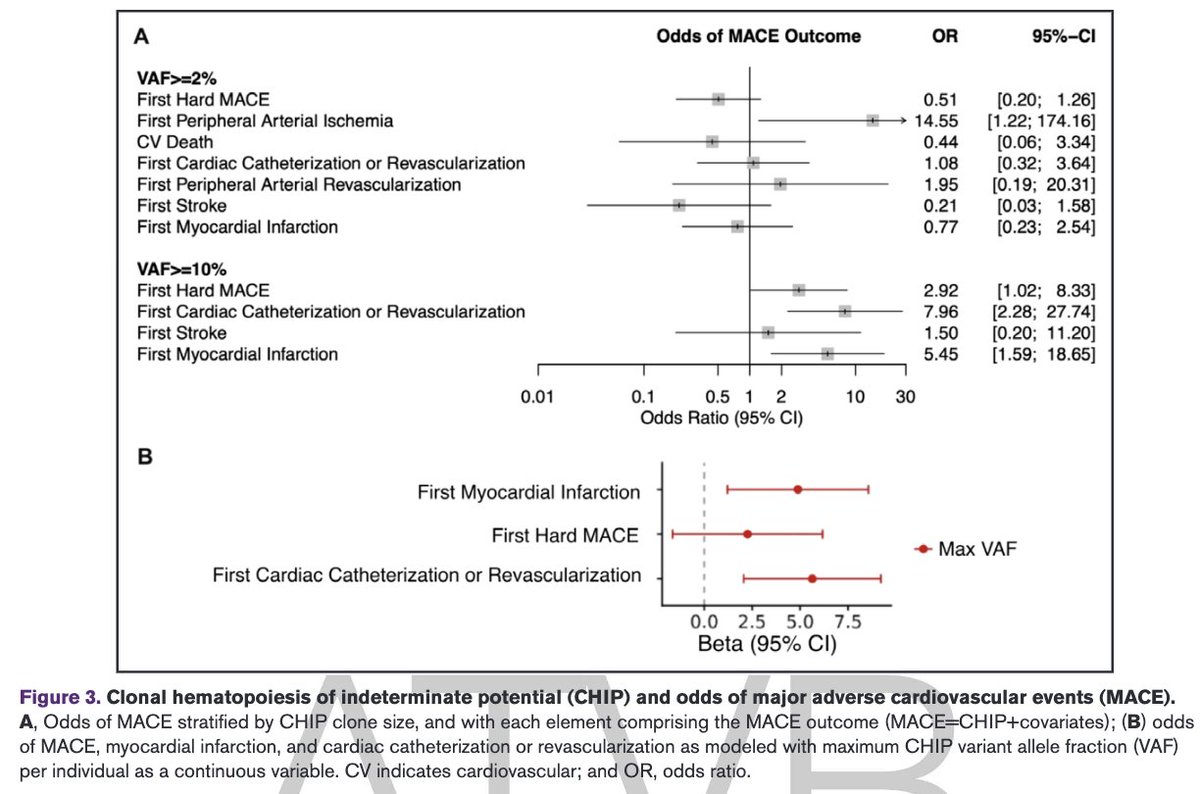
While clonal hematopoiesis overall wasn't associated with the primary trial outcome (MACE), there appeared to be a potential association for greater risk for incident myocardial infarction and coronary revascularization. This finding requires replication.
Lastly, pitavastatin vs placebo had similarly lower MACE risk among those with vs without clonal hematopoiesis in REPRIEVE.
Thanks to the team!
@M_Mesbah_Uddin@NakaoTetsushi@rogerszou@AniruddhPatelMD@abhinrl@dasha_post1@_aarushib@rachelbernardo_@pamelasdouglas@SteveGrinspoon & many others!
CHIP variants are often discovered incidentally in liquid biopsy testing, but is plasma cell-free DNA reliable when CHIP variants are the desired finding? 🩸@BloodAdvances@AlexBickMDPhD 🧵1/12
We’re excited to share our new preprint on medRxiv
🧬 “Clonal Hematopoiesis and Risk of Stroke: Evidence from Over 800,000 Individuals Across Three Cohorts.” The largest study to date exploring CHIP & stroke
👉https://t.co/RzLmdHKTGk
@AlexBickMDPhD@yash_pershad@VUMCDiscoveries
Finally, human genetic evidence nominates IL-1 blockade as a potential therapy to reduce CHIP-associated stroke risk. Among participants with CHIP, but not among participants without CHIP, genetically predicted IL-1RAP protein levels associated with higher stroke risk.