In The Conversation @theconversation .com, Philip Cohen @familyundequal and I provide a guide to understanding expert consensus -- and how to incorporate expertise in regulation without limiting scholars' rights to speak freely. https://t.co/h82Zf4OFAI
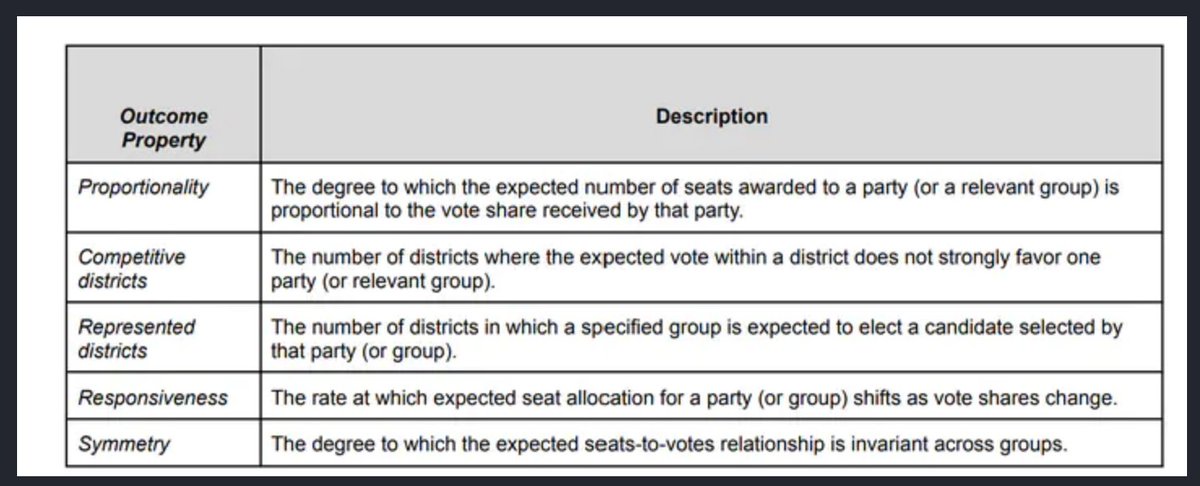
In contrast to politics in the US, it is possible to take a principle approach to redistricting that promotes electoral integrity. We summarize theory and practice in a new Oxford handbook: https://t.co/dLDEniDlnA
In contrast to the US is now , it is possible to take a principled approach to redistricting. We review the state of theory and practice as part of a new Oxford handbook: https://t.co/3gPx1Km7qJ
In a forthcoming article, @electproject and I review the state of election data availability, and discuss how gaps in records management create the opportunity for soft voter suppression and pretextual challenges to election results. Preprint available https://t.co/GQu7OKr1it
(Reposting ) It’s magical thinking for politicians to expect to receive truthful answers about the world when they ... ignore data they dislike." https://t.co/FG5y2FoRZ6
Privacy researchers and practitioners may be interested in this proposal for a differential privacy deployment registry: https://t.co/vSBpkiD4t1 (comments requested by 11/14)
Speaking with Michael Mcdonald @electproject.bsky.social about research on integrity in election administration at ADRCon 2025 in June. For more on how administrative data offers crucial insights into our democracy and communities, check out: https://t.co/ptTMmBn3mN
Released this week - useful guide for college students on using Generative AI by by @ITDFuture https://t.co/1ByYT8FS1e Published by
@elonuniversity & @aacu ( full disclosure, I served as a reviewer for this latest version )
Expert crystal ball gazing is speculative but provocative. The majority of my colleagues in this survey predict substantial diminishment of human capacity in the near future. My take is that this generation of technologies is accelerating the development of artificial relationships (for better and worse) -- but not a major shift in the meaning of 'being human' or in individual human capacity.
Our new report releases today: Being Human in 2035. Global tech experts discuss how the adoption of AI is changing the ways humans think, feel, act and relate to one another. https://t.co/U7BO4PO1HW
For data privacy week, some advice on protecting your information as a consumer:
https://t.co/7MRruB49Hh
(And thanks to @TheOfficialACM for facilitating the conversation...)
This presentationt https://t.co/YEIkS3xBma , for the recent MIT workshop on Research Ecosystem and Peer-review Practice traces the history of peer review and what we know about it .. it complements our observations on making peer review more scientific: https://t.co/PoV9AqyQCO
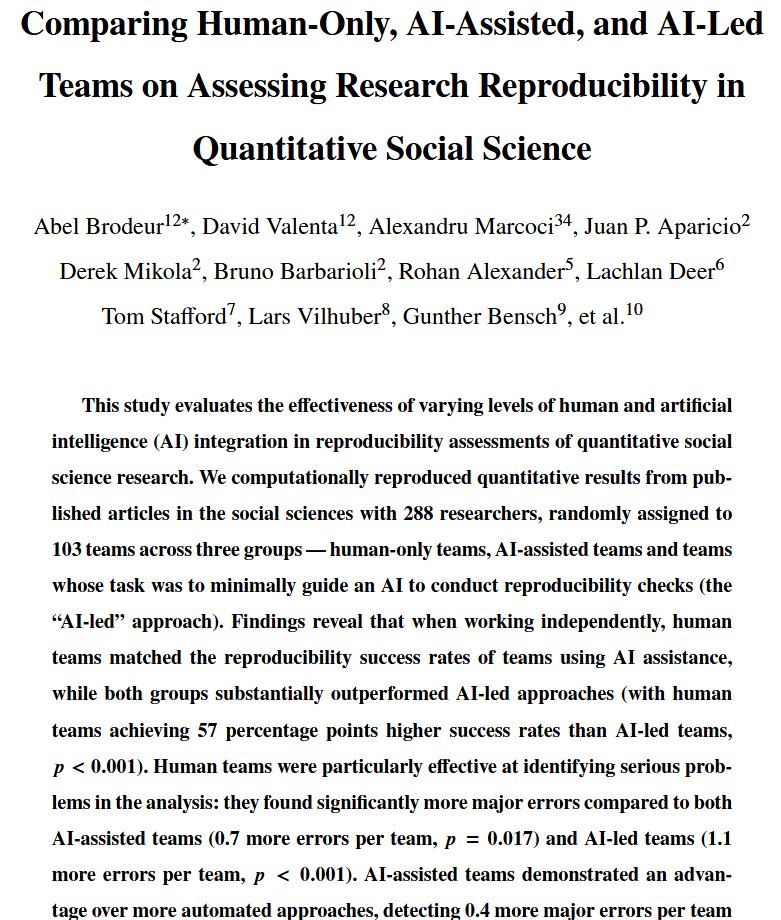
New research alert! Our study investigates the effectiveness of human-only, AI-assisted, and AI-led teams in assessing the reproducibility of quantitative social science research. We've got some surprising findings!
Check out Claudia R. Schneider @CRSchneider's and colleagues's review on communicating scientific evidence! It offers practical advice and emphasizes the importance of transparency in science and science communication. Read more here: https://t.co/JLtpc3jhTH
Need DAGs? This recent article by Charlotte Fowler and Amy Pitts is a useful guide to tools for producing directed acyclic graphs for causal inference. https://t.co/3O0WGButWd (Spoiler alert, DAGitty rocks..., and ggdag Tidy's it up )
Fascinating review of thirty years of theory of information cascades (by Bikhchandani, Hirshleifer, Tamuz and @ivowelch
Tamuz) : https://t.co/BxwvFV3HbK . The complexity that arises from these models is beautiful, and the intuitions are illuminating.
Studying open science, open access, or equitable science? Our preprint guides design, measurement, and reporting: "Guidance for Reporting on Studies of Open and Equitable Scholarship" https://t.co/wuWsdYtIti
I found this recent article on the neurodiversity of information systems users interesting. We need more efforts of this type -- incrementally accumulating empirical evidence about an neglected area. 10.17705/1jais.00877 https://t.co/BPciAMacAC
In my conversation with David Rothkopf (@djrothkopf) we discuss some challenges of AI and privacy -- starting with some key points from our recent ACM tech policy @USTPC brief. Many thanks to David/ DSR Network for hosting: https://t.co/Oiqg9IHW3K