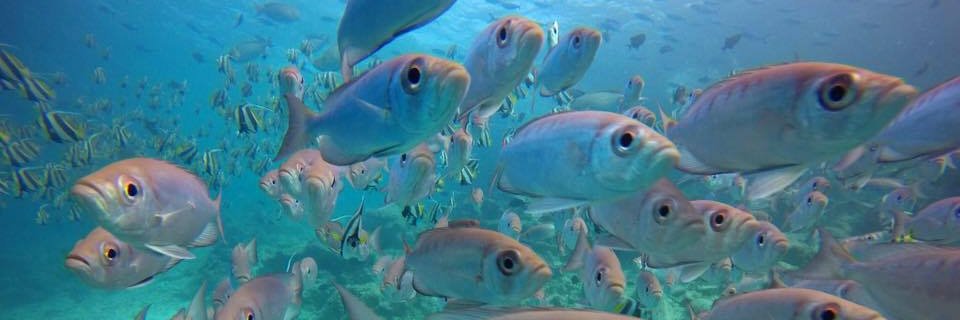
New paper out in @SpringerCORE 🚨 We show that fishery target groupers and snappers overlap spatially with planktivores 🐠 This is likely the way that oceanic subsidies enter the reef food web in the #Maldives!
Paper link here: https://t.co/mJVyRGR6wU
1/n
JOB OPPORTUNITY: Postdoc Researcher in Cryptobenthic Coral Reef Fish - Brandl Lab Fish Functions
https://t.co/3KoXwlNVUt
The postdoc will investigate seascape genomics and community structure of cryptobenthic fishes, a group that includes small, often inconspicuous species that play crucial roles in coral reef ecosystems. The project will combine extensive field sampling across the Indo-Pacific with molecular, ecological, and quantitative modeling approaches, focusing on the ecological and evolutionary correlates of small body size in these fishes.
#coralreefs #coralreeffish #cryptobenthicfish #coraljobs #coralcareers #postdoctoral #researchjobs #marinescience #marinebiology
Our extensive review of the power and pitfalls of amino acid specific carbon stable isotope analysis is finally out in Ecological Monographs! Only 5 years in the making 😅 Please enjoy! Link below⬇️
📢New Paper Alert📢
🪸Selective breeding enhances tolerance of corals to marine heatwaves
Take-home message:
-Breeding corals for heat tolerance is feasible
-R&D needed to optimise outcomes
-Not a silver bullet solution
-Still need climate action
https://t.co/5Hzj2Cgjcs
1/9
There's a lot we still don't know about CoTS populations, but hopefully we've gone some way to exploring these patterns. Thanks to co-authors, funders, and those who collected the survey data!🥰 @petemumby@sammatthews990@ReefChiefSci@gbrmarinepark YM, and Dave Williamson!
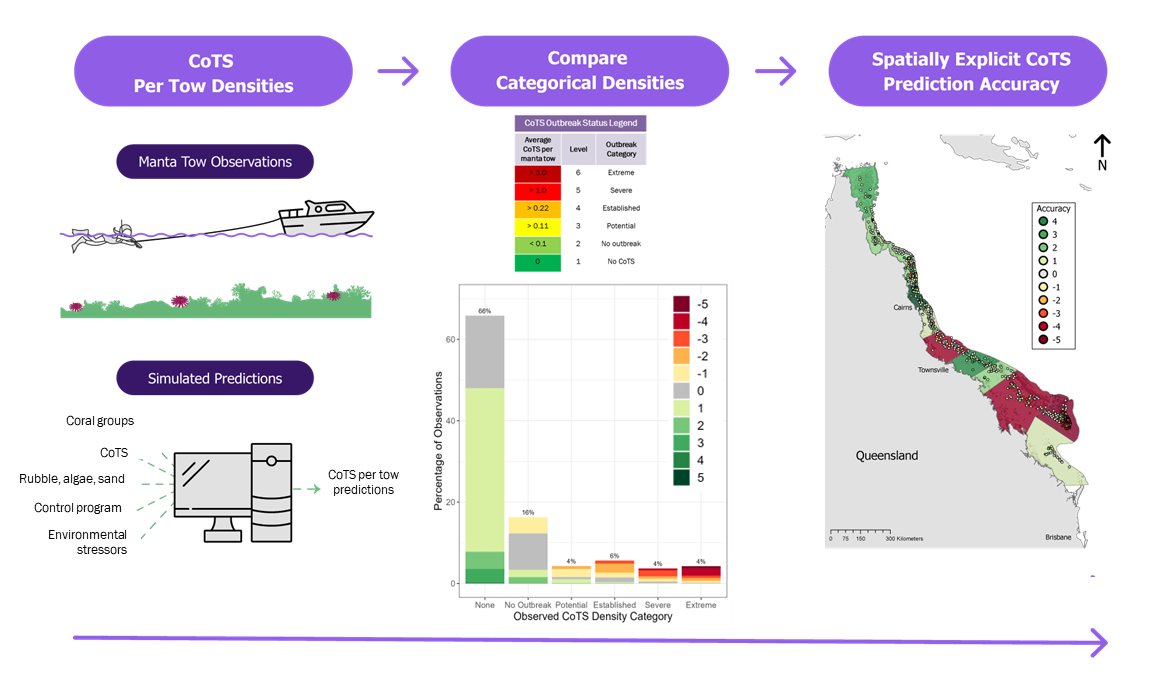
🚨 A little slow on the update as I'm back in 🇪🇺, but check out our new paper in @STOTEN_journal ! We test the accuracy of #CrownofThornsStarfish predictions from our #ecosystem model by comparing them to survey observations and find good agreement..
https://t.co/gA83mGIMbK
1/n
While the predictions were fairly good, there were patterns in their accuracy! Accuracy was lower in certain regions, particularly areas of high CoTS densities and known outbreaks such as Cairns and Swains regions.
4/n
High coral cover amid intense heatwaves and bleaching? Here’s how both can be true on the Great Barrier Reef https://t.co/bIR0CzFNxp via @ConversationEDU,ConversationEDU
New comment in @NatureClimate.
"This is not a call for inaction. We must act - with haste. But popular urgency should not prioritize technological and scientific feasibility over climate action and evidence-driven care for social-ecological systems."
https://t.co/FGtcntTI8V
Thanks to lovely co-authors - @aileencmill @PoluninNick@AmeliaDesbiens Sam Gallimore, Steve Newman, and Steve Rushton!
Side note, I really enjoyed using #SEMs for this work 🤓 highly recommend for disentangling multiple complex direct + indirect relationships 📈
4/n
New paper out in @SpringerCORE 🚨 We show that fishery target groupers and snappers overlap spatially with planktivores 🐠 This is likely the way that oceanic subsidies enter the reef food web in the #Maldives!
Paper link here: https://t.co/mJVyRGR6wU
1/n
So even though #groupers and #snappers are supported by oceanic energy, their prey rely on live coral habitat...
This highlights the importance of protecting both #benthic and #pelagic pathways 🪸🐠 Declining coral cover 🟰 direct and indirect impacts to the reef food web!
3/n
"It is a disgrace that the most vulnerable are being left stranded, struggling desperately to deal with a climate crisis they did nothing to create.”
https://t.co/w3DC2m8bNz
Garrido-de León, F., Naya, D.E. & Franco-Trecu, V. Individuals matter more than replicates: distribution of sampling effort in isotopic niche estimation. Mar Biol 171, 97 (2024). https://t.co/5ZZIlpr5fJ #stableisotopes
May issue out now https://t.co/cSP2Q31tCD
Cover by James Robinson and colleagues. "Quantifying energy and nutrient fluxes in coral reef food webs". Photo credit Tane Sinclair-Taylor.
Featured articles Antunes et al, Pottier et al @PatriceEcoEvo, Peralta et al.