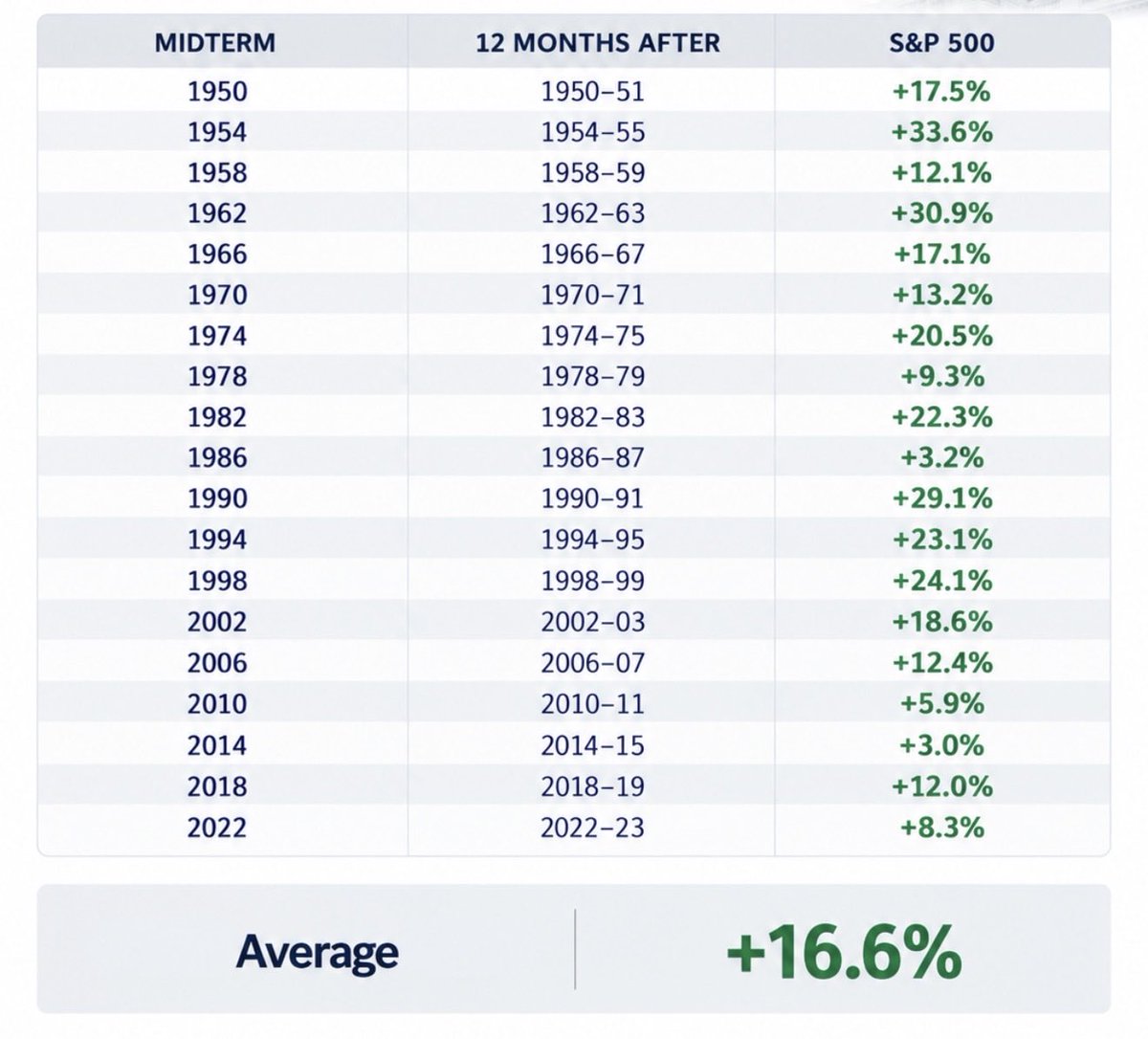
This is the WILDEST stat I have ever seen in the Stock Market
READ this. This is how GENERATIONAL wealth is made.
21/21.
Since 1942, $SPX EVERY November-to-June period following a midterm has been positive.
21 straight. A 100% WIN RATE.
Average gain: +16.6%.
Then zoom out:
Since 1950, the S&P 500 $SPY has been higher 12 months after EVERY midterm.
19 midterms.
19/19 positive.
Average gain: ~15%.
Two different time windows.
Zero negative outcomes.
21/21.
19/19.
That doesn’t guarantee 2027 follows history.
But when midterm fear gets loud, remember what has historically happened after the uncertainty clears.
Keep this.
30 Years Ago Today
September 1, 1996
The NFL returns to #Baltimore after a 12-season absence as the #Ravens play their inaugural game.
Baltimore icon Johnny Unitas, other Colts legends, and a then-record Memorial Stadium crowd watch the Ravens top the Raiders late, 19-14.
It’s the 50th anniversary of an investment idea that changed the world.
Fifty years ago, on August 31, 1976, @Vanguard_Group Chairman and CEO John C. Bogle launched a new mutual fund, the First Index Investment Trust, now known as the Vanguard 500 Index Fund.
The purpose of the fund was to track the S&P 500.
It was based on a simple premise: instead of trying to beat the market, investors should own the market.
That simple idea would forever change the investing world.
The fund opened with little fanfare, and almost no support from Wall Street. Bogle had hoped to raise $50-$150 million to launch the fund. He raised only a little more than $11 million, “an abject failure,” as he later called it.
It had little support for a simple reason: Wall Street hated the idea.
Financial advisors had been selling their services for decades on one central idea: let us help you beat the market.
But by 1976, there was growing evidence that the vast majority of Wall Street advisors could not beat the markets.
Nobel laureate Paul Samuelson had already suggested that investors would benefit from the creation of a low-cost fund that would track the market. Princeton Professor Burton Malkiel also called for the creation of an index fund in his 1973 book, A Random Walk Down Wall Street.
The key was to find a way to provide diversification at low cost.
A simple idea: own the market at a low cost
In a 1997 introduction for an article on the indexing revolution, Bogle outlined, in a few paragraphs, the basic idea of index investing. The first concept was staying with the market and accepting market returns: “investors as a group cannot outperform the market, because they are the market,” he said.
The second concept was to keep costs low. Bogle and others recognized that even the tiny fraction of active managers that beat the indexes underperformed because the fees they were charging destroyed any alpha (outperformance) that they had generated. Those fees included operating expenses, advisory fees, and portfolio transaction costs.
Bogle’s fund, however, paid no advisory fees and limited portfolio turnover. An initial sales load for the fund was quickly dropped.
All of this kept costs down.
Back in 1976, it was not unusual for the all-in costs of a mutual fund, including management fees, expense ratio, and sales loads, to be in the 1.5%-2.0% range (150 to 200 basis points).
While the fees have changed over the decades, the trend has been down, and down dramatically.
Today, you can own the Vanguard 500 Index Fund ETF (VOO) for three basis points (0.03%), as well as most other S&P 500 ETF index funds, including the iShares Core S&P 500 ETF (IVV).
Indexing: a victim of its own success
Since then, index investing has increasingly come under attack by active managers, who, 50 years later, still resent the loss of fee income that passive investments have taken from them.
The most recent attacks include assertions that market-cap weighted indexes have become too concentrated, that it makes the biggest stocks even bigger, that index investors inhibit price discovery, or that index funds make the markets more volatile.
Some of these complaints, such as concentration risk, are legitimate issues, while others smell of desperation, the concerns of an industry that fears it cannot compete against three basis point ETFs and cannot justify significantly higher fees.
What’s the role for active management?
Active management is by no means dead. Indeed, the first half of 2026 saw a record $1 trillion in inflows into ETFs, of which $350 billion was into actively managed funds, also a record, according to Fidelity.
Much of these active inflows are due to investors seek to buy protection against a downturn in the markets, or generate income by selling calls against indexes like the S&P 500. These are significant new products for active management, and while we can debate about the cost of providing these products, they have struck a nerve with a part of the investing public.
But there are plenty of active managers today that engage in fundamental stock picking, or pick stocks by sector, themes or factors (size, value vs. growth, momentum, quality, etc.).
The issue for active managers, particularly stock pickers, is to pick areas of the market where they might outperform, and do it a reasonable price.
Jack Bogle himself was never against active management. Indeed, he was instrumental in the creation of several actively managed funds at Vanguard.
He was against high-priced active management.
Active management in stock picking, particularly large-cap stock picking, has become very difficult because the market is extremely efficient and is mostly dominated by professional investors that have little informational advantage.
Rather than attacking index investing, active managers should mine areas of the investment world that are inefficient.
There are plenty of inefficient nooks and crannies in the investment world: in equities, there are micro-cap and small-cap stocks, as well as emerging market and frontier markets. There are millions of bonds that trade in the U.S. alone, particularly in the muni market.
Indeed, there is good evidence that many actively managed bond funds outperform passively managed bond funds.
The central message of the index revolution
None of this debate should detract from the central message: that index investing has allowed investors to stay invested in the market at far lower expense than paying high-priced active management. Vanguard estimates that investors have saved approximately $570 billion since 2000 in the form of lower expense ratios for index fund investors.
More important is the wealth creation of staying consistently invested. Vanguard estimates that $10,000 invested in what is now known as the Vanguard 500 Index Fund in 1976 would now be worth $2 million.
Bogle never tired of spreading the indexing gospel
In the summer of 1997, just as I was assuming the job of On-Air Stocks Editor for CNBC (I had been Real Estate Correspondent from 1990-1996), I called Bogle and asked if I could chat with him regularly.
It did not start off well.
“I’m not very happy with your television station, Mr. Pisani,” was the first words out of his mouth.
I thought it was quaint, calling CNBC a “television station” (it is a cable television network).
We were in the habit of having “superstar” investors like Bill Miller from Legg Mason, Bill Gross from Pimco, or Jim Rogers on the air on a regular basis. Bogle launched into a lecture, insisting these “superstars” were very rare, that most pundits never outperformed their benchmarks, and that CNBC was spending far too much time promoting a small group of pundits and not enough time on long-term buy-and-hold investing principles, particularly the power of owning index funds, which of course included the Vanguard 500 Index Fund.
Still, at the end of the conversation he gave me his direct line, told me I could call him with questions, and also gave me the phone number of Gus Sauter, who was running Vanguard’s equity index funds and would prove to be a key player in the index revolution.
That began a relationship with Bogle (and Sauter) that continued until Bogle’s passing in 2019.
Jack Bogle was fond of saying, “Don’t look for the needle in the haystack! Just buy the haystack!”
Fifty years later, that vision of staying invested and owning the market at the lowest cost remains as valid as ever.
https://t.co/sdWb5S9KXN
I’m not even sure I have the words…
This is literally one of the NASTIEST moves to score a game winner & win a gold medal that you could ever dream of…
MEGAN KELLER ARE YOU KIDDING?!?! UNBELIEVABLE!!!!! SPEECHLESS!!!
US WINS GOLD!!!!!!! 🇺🇸🦅🥇
You don't get rich by:
Cutting lattes
Using coupons
Maximizing credit card reward points
You get rich by:
Consistently raising your income
Owning equity in a growing business
Buying income-producing assets every single month
Don't major in the minor. Focus on your career and investments if you want to build wealth.
The average stock market return of 10% is misleading.
Most years aren’t average - they’re extreme.
Big gains. Sharp losses.
That’s how long-term returns are made.
Despite investing for over 12 years, only 25% of my net worth can be attributed to investment gains. The remaining 75% came directly from my income/savings.
If you are trying to figure out where to focus your attention, look at your paycheck not your portfolio.
A retirement truth no one wants to talk about:
Once you have some base level of financial security, your day to day happiness in retirement will be impacted more by your relationships, your hobbies, and your sense of purpose than your financial assets.
#lockerstrong ❤️ update: my dad is stable after undergoing what the surgeon said was a successful surgery. He still has a long way to go on his road to recovery, and will be in the ICU for at least another day. Thank you to our #ALLCAPS family for every message and prayer 🙏