23-year-old Daniel Cressy just became the first person in Louisiana to be functionally cured of sickle cell disease through gene therapy https://t.co/snRE0wOGaP
Following harrowing testimony from French nationals detained by Israel, France has now referred reports of sexual violence, beatings and humiliation against Global Sumud Flotilla activists to prosecutors.
On 21 May, I wrote to the Foreign Secretary demanding urgent action over the interception of the flotilla in international waters, and the detention and degrading treatment of humanitarian volunteers, including British citizens.
France is acting. Spain is showing leadership. Where is the UK government? Nothing but a simp for Israel, a genocidal apartheid state.
Leqaa Kordia is finally free!!!!
Al hamdulilah! There are no words to express my joy, and my hope that others like her will walk free as well.
Thank you to everyone who refused to forget her, and refuse to forget them all.
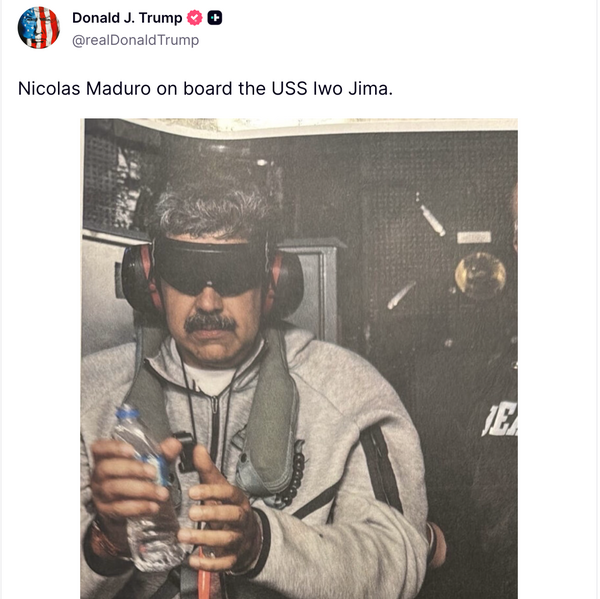
Maduro’s capture illustrates what I believe is one of the biggest problems in politics: people frequently treat principles as costumes—worn when convenient, discarded when costly.
Over nearly two decades working in and around politics, I’ve watched the same pattern play out again and again—and today’s events in Venezuela put it on display in neon. The US military carried out strikes in Caracas and captured Venezuelan President Nicolás Maduro and his wife, flying them to New York in what the administration is framing as a kind of “law enforcement” operation. 
Look, there are plenty of people who never even pretend to have a core set of principles they cling to. They’re utilitarians and technocrats—ruled by polling, vibes, ambition, and career incentives. Fine. At least they’re honest about being wind vanes.
But most people do claim to stand for a consistent set of ideas—constitutional restraint, limited government, “America First,” non-intervention, rule of law, due process, sovereignty, you name it.
The problem is that they’re often inconsistent, especially when the outcome is emotionally satisfying.
Today proved that again. People who claim to champion the Constitution suddenly ignore its restraints on executive power and, when pressed, point to court precedent, congressional statutes, and past presidential deviations as if those things are the Constitution.
“But… the Barbary pirates!”
“But George H.W. Bush removed Noriega in Panama!”
“But the courts said XYZ!”
“But Congress passed some statute in 199-whatever!”
So I’ve asked a simple question, repeatedly, across social media threads today: Where, exactly, is the constitutional provision authorizing the president to invade another country and depose its leader?
The replies come back empty, no constitutional provision cited. They can't, because it doesn't exist. The Constitution gives Congress the power to declare war. No "targeted strikes" or anything of the like are separately authorized for the president to execute at his whim.
That’s the whole point of written limits: the text is supposed to bind you. Instead, we get arguments that past presidents did it, and some lawyers said it was okay. This is tantamount to saying “Billy did it, so I thought it was okay for me to do it.” That’s playground logic, not constitutional rigor.
And that’s my point: there is no rigor. There’s only precedent—meaning, prior lawlessness used to justify the next round of lawlessness. The administration itself appears to be leaning on the idea that indictments and “national interests” somehow transform regime change into a lawful “arrest mission.”
Trump was elected in part because people were exhausted by foreign meddling. He was praised (by some of these same voices!) for resisting the interventionist itch. And now he’s kicking up dirt in Venezuela.
“But Venezuelans are happy!” the commenters have repeatedly said. “They’re in the streets celebrating!”
Yes. Sometimes they are. That’s not a serious argument. That’s the-ends-justify-the-means dressed up as compassion—again, playground-level reasoning.
Guess what: Iraqis filled the streets when Saddam was deposed. “Baghdad Celebrates Saddam’s Fall,” read a headline in Voice of America, for an article describing dancing and cheering as thousands poured into the streets. 
Then Iraq spiraled into insurgency, sectarian civil war, mass death, displacement, and the conditions that helped give rise to ISIS.
Libyans filled the streets when Gaddafi fell. So then we got an article titled “Libyans celebrate Gaddafi’s death” in Al Jazeera, describing jubilant crowds and the “end of tyranny.” 
Then Libya fractured into militias and rival governments, becoming a prolonged civil conflict and a humanitarian disaster.
I could go on. You get the pattern.
Here’s the deeper point that people keep refusing to learn: if your principles only apply when they’re easy, you don’t have principles… you have preferences. And preferences make terrible guardrails for state power.
Every time you cheer an exception, you’re not just celebrating a moment… you’re authoring a precedent. You're excusing the next guy, in any political party, and for any reason, to do it too.
If you’re applauding unilateral regime change today because the target is a villain, you’re also applauding unilateral regime change tomorrow when the target is someone you don’t want touched. Power doesn’t care about your intentions (or your preferences). It cares about the permission slip we seemingly always give it.
To be clear: Maduro is no hero. He’s a tyrant who has presided over ruin and repression. But the question isn’t whether Maduro is bad (he obviously is). The question is whether we are governed by law or by appetite.
Because “he’s bad” is not a constitutional argument, nor is "Venezuelans are happy and freer." It’s the (fake) argument every president uses when he wants to do something he has already decided to do.
And this is why presidents since Washington have gotten away with exceeding constitutional limits: because the public trains them to. They learn that violating restraints can spark national pride, satisfy a thirst for vengeance, and earn adoration from people who swear they oppose unchecked power—right up until it produces an outcome they like.
You want a country of laws? Then act like law matters when it’s inconvenient.
Stop treating the Constitution as a decoration.
Stop citing precedent as if it were permission.
Stop excusing today’s overreach because you hate today’s target.
Because the bill always comes due, and the payment is usually made by people who never voted for the war, never authorized the mission, and never wanted their country turned into the kind of thing it once claimed to oppose.
So yes, we can answer James Madison’s question: “Will it be sufficient… to trust to these parchment barriers (i.e., the Constitution) against the encroaching spirit of power?” Obviously not. Parchment only restrains power when the people treat it as a leash—not a suggestion. When half the country cheers the leash getting snapped because their guy did it to their enemy, the paper might as well not exist. And that's the cycle we've long been in.
Yes, Venezuela may be a little freer, for now. But listen to the triumphalism in Trump's announcement. In the same breath as announcing Maduro’s capture, he talked about sending in “our very large United States oil companies,” and about the U.S. “running” Venezuela's government “until such time as we can do a safe, proper, and judicious transition.”
This is the raw material of unintended consequences: blowback, corruption, and the kind of protracted entanglement that turns “just this once” into the next twenty years.
Count me out. I've seen this story before, and I don't like how it ends.
Sūrah al-Mulk will protect its reciter from the punishment of the grave and intercede for a person until they are forgiven. Neglecting such a powerful source of protection would truly be a great loss.
This week, inshāAllah, we will be sharing reflections on verses from Sūrah al-Mulk.
Reflect, retweet, like and share the khayr with others. May Allah make the Qur’ān a light in our lives and in our graves.
If you assume, purely for argument’s sake, that this 15-year-old child threw a rock at a car, and you think that justifies 9+ months of imprisonment, beatings, starvation, and no access to his parents, you’re a broken person.
You might wonder why the UAE is so obsessed with Sudan, alongside its obsession with other Red Sea nations like Somalia, Djibouti, and Eritrea, and why it keeps crossing every line and fueling chaos in the country.
The answer is simple: the UAE wants to dominate global food security while tightening its grip on every port along the Red Sea coast and building a maritime network reminiscent of what was once called the Omani Empire. To achieve that, it needs Sudan’s vast agricultural lands, its immense mineral wealth, and its strategic coastline.
Emirati companies like International Holding Company and Jenaan Investment already control over 50,000 hectares of farmland in Sudan, while the massive Abu Hamed project covers another 162,000 hectares. These projects are designed to secure the UAE’s food supply, not to help the Sudanese people.
But controlling such vast resources requires influence on the ground, otherwise, they risk being expelled just like they were in Djibouti, when the government canceled their port deal after accusing DP World of exploiting national assets and undermining the country’s sovereignty. And that’s where the Rapid Support Forces come in. The UAE has turned them into its armed hand in Sudan, providing funding and weapons in exchange for loyalty and access to the country’s gold, land, and agricultural exports.
When the Sudanese government refused several UAE agricultural deals because of unfair terms, and when local communities resisted these exploitative projects, Abu Dhabi shifted tactics, from business deals to direct interference through proxy militias.
This desert state, whose oil reserves are running out, is obsessed with securing its own food supply, and even controlling global food chains, at the expense of African nations. Its greed for Sudan’s fertile land and vast mineral resources has pushed it to back destructive wars and destabilize the region.
What we are witnessing is modern-day colonialism, the same mindset of old imperial powers, but this time led by a tiny Gulf state that wants to reshape Africa in its own image. The UAE’s arrogance, ambition, and selfishness are beyond belief. It seeks to divide nations so that every country becomes as small and dependent as itself, all while the world watches in silence and complicity.
There is an Ongoing Genocide in Sudan 🇸🇩
There is an Ongoing Genocide in Sudan 🇸🇩
There is an Ongoing Genocide in Sudan 🇸🇩
There is an Ongoing Genocide in Sudan 🇸🇩
There is an Ongoing Genocide in Sudan 🇸🇩
Take note when legacy western media says “terrorist attack” and when they say “operation.”
It has nothing to do with international law and norms and everything to do with who the perpetrators and victims are.
What is the value of an American security umbrella and hosting a US base on your soil if the United States itself conspires to attack you?
That is a question that all GCC leaders are asking themselves today, given that they have put all of their security eggs in the US basket.
It should have been clear to them for some time now that this day would come, since the US has, since October 7, lifted ALL constraints on Israel.
How serious can a country be about peace when they keep assassinating those they are meant to be sitting across the table to negotiate a ceasefire with?
Also, Israel once again acts with impunity by violating Qatar's sovereignty, in a clear breach of international law.
What can even be said at this point? All these laws and ways of interacting between states just thrown away. This shows the fasad of these people. They enforce it on others but they are exempt?
Here’s what just happened: Trump sent a peace deal to Hamas, Hamas met to discuss it in Doha, where the U.S. is mediating talks and has a base,and Israel bombed them, presumably with US support.
The strike in Doha was aimed at Hamas negotiators who were gathered to discuss Trump’s ceasefire offer, according to a Hamas official speaking on Al Jazeera, much as Trump carried out fake nuclear talks with Iran in order to kill Iranian negotiators.
That might explain why Trump’s offer was so short and scant on details. The whole point was to gather people together to discuss the peace offer to kill then.
Israel is taking credit for the attack, citing 10/7, though most or all in Doha didnt even know about 10/7 until it happened.
IDF and ISA Announcement:
“The IDF and ISA conducted a precise strike targeting the senior leadership of the Hamas terrorist organization.
“For years, these members of the Hamas leadership have led the terrorist organization's operations, are directly responsible for the brutal October 7th massacre, and have been orchestrating and managing the war against the State of Israel.
“Prior to the strike, measures were taken in order to mitigate harm to civilians, including the use of precise munitions and additional intelligence.
“The IDF and ISA will continue to operate with determination in order to defeat the Hamas terrorist organization responsible for the October 7th massacre.”
Israel has just bombed Doha. Yesterday they bombed Tunis in attack on the flotilla. Last week they murdered the Prime Minister of Yemen. These are brazen acts of war. What other country gets away with all of this?