Has anyone in my network tested CORAL yet?
https://t.co/UQ15fLcmze
Quick summary for those who haven't seen it: CORAL is an open-source infrastructure (MIT license, out of MIT/NUS/Stanford) that spawns multiple autonomous AI coding agents in parallel. Each agent gets its own isolated workspace. They independently research, implement, evaluate, and reflect, while sharing knowledge with each other in real time through a common layer of attempts, notes, and skills.
You give it a codebase and a grading script. CORAL handles the rest.
It natively supports Claude Code, OpenAI Codex, and OpenCode as agent runtimes.
The results from the paper are hard to ignore:
→ On Anthropic's kernel engineering take-home, 4 agents pushed the best known score from 1,363 cycles down to 1,103
→ On the Erdős Min Overlap problem, it hit 99% of AlphaEvolve's score 10x faster with 7x fewer eval calls
→ On a Kaggle ML task, it beat the top human score in 2 minutes and 2 eval runs
What caught my attention is the emergent multi-agent behavior. The agents spontaneously copycat breakthroughs, cross-reference each other's codebases, and eventually form consensus notes about what's left to try. Nobody programmed that. It just happened.
I'm thinking about applications in signal processing and radar algorithm optimization, seed it with an existing detection or estimation pipeline, define a grading function over your performance metrics, and let the agents evolve better solutions autonomously.
Anyone tried it? Interested to hear what tasks you pointed it at and what you got back.
An AI agent just operated my 60 GHz radar.
Claude Code on a Raspberry Pi: → Ran a 30-second sleep recording → Processed 300 radar frames → Extracted breathing rate stats (mean, median, max,min BPM, and STD) → Analyzed SNR, target range, stability → Reported back accurate results. If that's not leverage, I don't know what is.
https://t.co/AkZswewVDU
OpenClaw "multi-agentic", 5 days, zero output
Claude Code Agent, 2-3 hours, working RAG assistant!
I gave OpenClaw one job.
Build a RAG assistant on my own radar and signal processing corpus.
Five days. Zero working software. Cannot answer a basic question.
Here is what actually happened:
→ Agents lost the main task and chased scaffolding → Context degraded and stale framing kept resurfacing → "Progress" was reported on setup, not output → Planning was endless. Execution was absent.
I am a radar engineer. 30 years of radar signal processing and AI projects. I went in with a clear spec and real expectations.
This was not a vibe check. It was a build.
Then I switched to Claude Code.
2-3 hours iterating together. Done.
OpenClaw failed. Claude Code delivered.
The people selling you "agentic AI workflows" on YouTube and X are making money from your clicks, not from their code. They are not builders. They are content producers packaging hype.
Multi-agent AI right now:
→ Context does not hold across complex tasks → Agents confuse activity with progress → Orchestration collapses when things get non-trivial → You spend more time managing the framework than building the product
The technology is immature and being dramatically oversold.
Test these tools on something real. Not a demo. Not a tutorial. Something that has to actually work.
That is the only honest benchmark.
Windowing in radar is always a trade-off.
Suppress sidelobes, lose resolution. Keep resolution, drown in sidelobes.
We built something at AlephZero (א₀) that challenges that assumption.
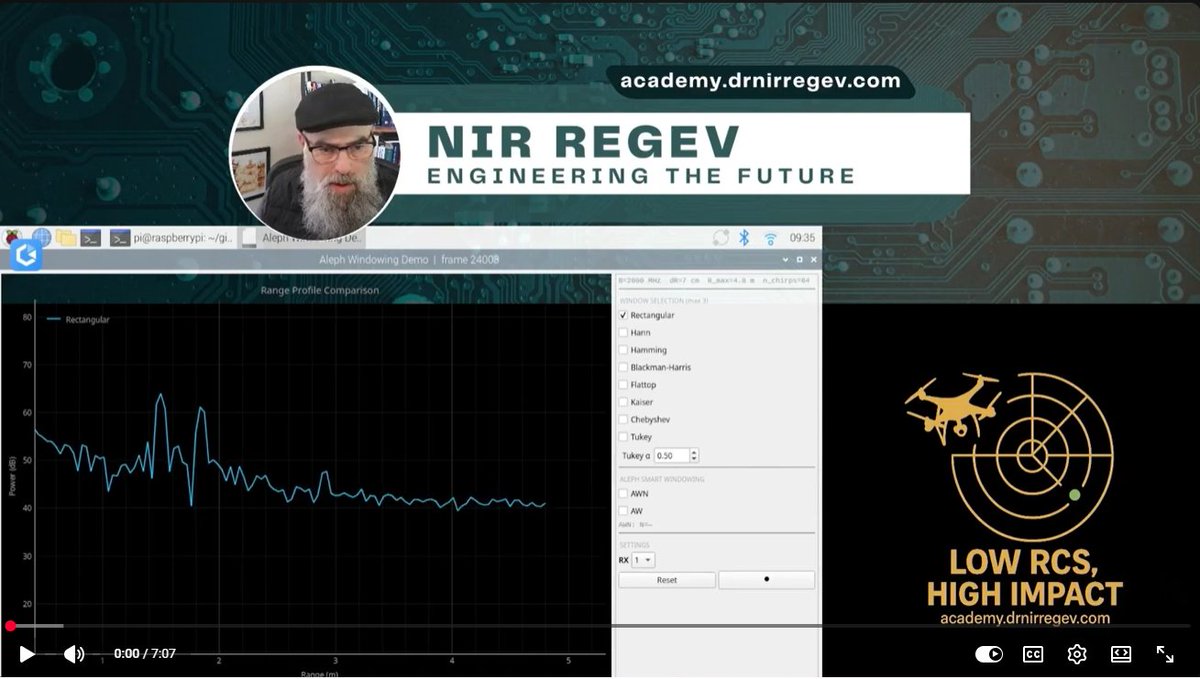
Our AW windowing technique fuses the resolution preservation of the rectangular window with (almost) the sidelobe attenuation of classical windows like Hanning and Blackman-Harris. The mainlobe stays narrow. The sidelobes go down.
In this demo I ran it live on a 60 GHz radar scanning my office with corner reflectors. The test that tells the story: two targets placed about 7 to 10 cm apart. Blackman-Harris merges them into a single wide blob. Our AW window resolves both cleanly, with sidelobes still well attenuated.
This is production IP that we license. If resolution and sidelobe performance both matter in your product, let's talk.
Full demo video: https://t.co/nK35oPcNZj
If you're an engineer who wants to go deeper on the signal processing behind windowing, spectral analysis, and FMCW radar design, check out the Regev Radar Academy where we break this down with real data and hands-on labs: https://t.co/UMSWmcUhiu
Regev’s Applied AI and Radar Academy is not just another course. It is a community of engineers, practitioners, and students who are actively working with radar systems, signal processing, and modern AI or preparing to do so.
This is where real technical questions get real answers. Where intuition is built through discussion, shared experience, and weekly member hangouts. Not passive content. Not videos you forget.
On top of the community, you get a structured learning path with practical FMCW radar processing, AI in radar, and focused deep dives into detection, estimation, tracking, and classification.
If you are in communications and want to move into radar, this is your bridge.
If you are already in radar and want to master AI, this is your next step.
If you're an AI practitioner who has radar data in his system, this is the place for you.
If your job or university never taught radar properly, this is what you were missing.
Choose the tier that fits where you are today.
See you on the other side.
Machine Learning Binary Classification Problem using Likelihood ratio test, in the context of radar detection theory, specifically CFAR detection. A part of a lesson from Module 4 of the course "Practical FMCW Radar Signal Processing", available in my academy https://t.co/UMSWmcUhiu
@karanjakhar88 Very real world radar uses this. I personally use it not only in radar but also in any binary classification tasks. (Think classical ML)
Making way to radar CFAR Detector derivation; starting with the basics: derivation of the Likelihood Ratio Test (LRT). The video will be posted in my academy, under Module 4 of the course "Practical FMCW Radar Signal Processing".