If your SaaS has a free plan here's how to get more paid upgrades. One, delete your free plan. Two, if you refuse to delete your free plan, improve your onboarding. Free users will never upgrade unless they are compelled to through rapid time-to-value.
Haters will say it's AI. But it's archive footage of @dropkickcopy taking emails out of spam and printing Ms in the process. Comment “Daigo” if you'd like to know more.
@SkunkDev Maybe it's the team synergy that creates the success no the individual devs? Do you mean even teams who have stuck together cannot consistently replicate success?
For indie games, in a world where distribution is important, being a solo developer means you have that much more self promotion to do. Building in a team, even small ones, means you can call in the favour of borrowing the teams distribution.
If a game is advertised as being from a 'solo developer' or 'solo developed', it does not mean it was created by one person. Most projects hire artists / audio engineers / animators etc. to create a large portion of the games content. I think some people are not aware of this when they hear it.
I dont know if this needs to change, but I feel even for my own project I will need to drop the terminology, as of when I start to add additional content from other artists, for both transparency and acknowledgement of the talent that helps to actually make a game.
How do other people feel about this?
@ID_AA_Carmack What if they were to build the fandom before the game? What would that look like? I feel like animators and video game developers start from the same place. Animators might produce the comic book web / comic first before investing in the animation.
We are in both an AI supercycle, and a collectibles supercycle.
This is not a coincidence. AI and the character economy sit at opposite ends of the same barbell.
Every dollar spent making intelligence cheaper... makes charizard more expensive.
To elaborate:
AI is a deflationary force on everything that can be copied. Character IP, and the collectibles markets that price it, is the inverse asset: it gets more valuable as copying gets cheaper, because meaning, scarcity, and true collector fandom can't easily be replicated.
The vast majority of teams and brands are undervaluing and underinvesting in their own IP.
We aren't.
That's why Gigaverse is driving a deep deep level of intentionality to the characters & world that form the bedrock of our future ecosystem.
And why we're growing our social channels like crazy, so we can introduce our characters to the world, at scale.
Today we're a game, tomorrow we're an ecosystem of loved characters you can interact with across a growing surface area of meaningful experiences and products.
Few.
6 essential SaaS email flows / sequences.
In this video we cover:
- What we mean by email flows / sequences
- How to choose yoru email service provider
- Mapping your user journey
- How to nurture your leads
- Who NOT to email
- Cleaning/scrubbing your list
- Onboarding new users
- Converting free users to paid
- How to survey users to improve your product
- Winning back lapsed trials and churned customers
- Triggering flows based on time or behaviour
- Transactional emails and flows
Drop an “UPGRADE” below and we'll send you our SaaS User Upgrade Checklist.
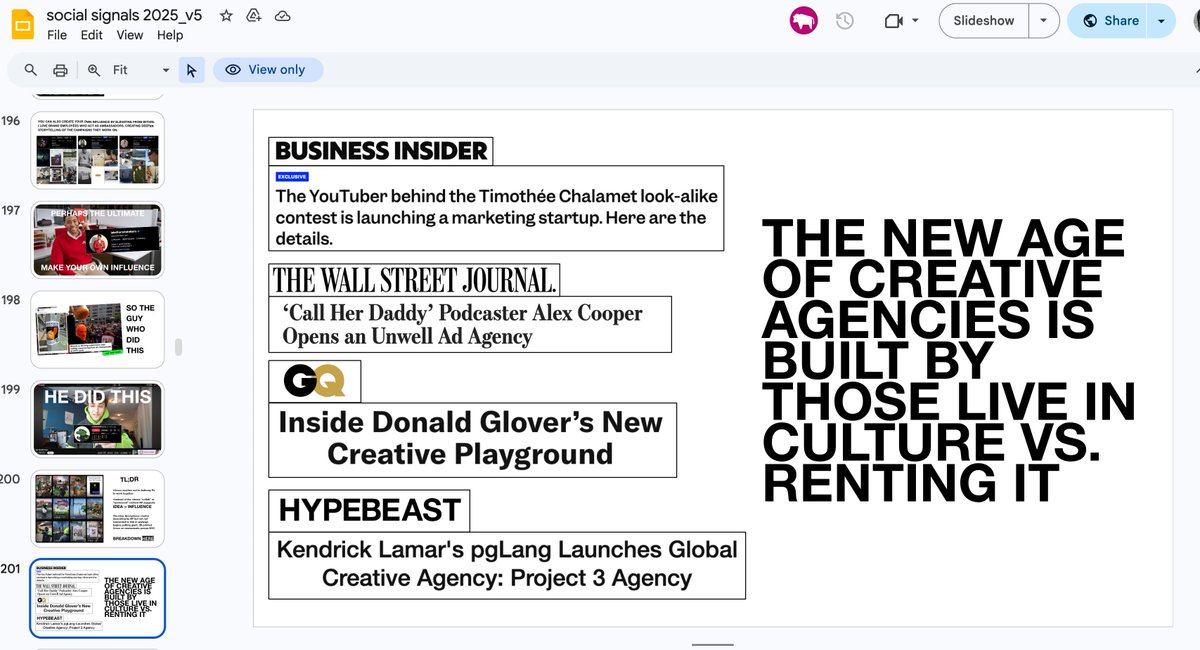
Claim: "the new creative agency is built buy those who live 'the culture'"
This one guy I knew in Dubai, he positioned himself as a the urban youth go-to person at his agency.
He was from Sudan. Race credentials check.
He followed mainstream american hip hop culture and african american discourse. Culture check.
But all the other Sudanese people found him corny. Plus he didn't produce anything or participate or risk anything for culture. He was always the consumer, led by culture.
His talent was code switching between corporate and colloquial, and presenting decks. That's fine.
The issue isn't that he didn't know whether he was living the culture or renting it. It's that his positioning was not anchored to something lindy; popular culture and trends are fickle.
This slide seems true on the surface but it glosses over the impermanence of this so-called culture thing. What it is calling culture is actually trends.
If the messaging is that "We are a creative agency built by those who live in culture and don't rent" then that's not enough to establish a creative agency brand.
Because all of this stuff is trends and trends are rented.
The AI industry is in an urgency to raise funds, so it speaks in ways that resonate with that strata of society. To pull at the emotions of people with deep pockets.
It is also in urgency to produce disruptive results to validate its big claims. So it speaks in ways that resonate with developers. To pull the emotions of people with deep technical pockets.
The trouble is their messaging pillars are anti-human and pro-machine.
And so they struggle with constructing consistent messaging that speaks to retail users. Why? Because they'd have to contradict the anti-human, pro-machine pillars they lead with to secure funds.
The AI industry is in an urgency to raise funds, so it speaks in ways that resonate with that strata of society. To pull at the emotions of people with deep pockets.
It is also in urgency to produce disruptive results to validate its big claims. So it speaks in ways that resonate with developers. To pull the emotions of people with deep technical pockets.
The trouble is their messaging pillars are anti-human and pro-machine.
And so they struggle with constructing consistent messaging that speaks to retail users. Why? Because they'd have to contradict the anti-human, pro-machine pillars they lead with to secure funds.