The dura is the brain's armor: a membrane so tough that a surgeon normally cuts through it with a scalpel. For the first time in our clinical trials, we inserted the electrode threads of our implant straight through the dura and into the cortex, keeping the dura intact.
Here's how we did it 🧵
A simple strip of wildflowers can dramatically reduce the need for chemical pesticides. So why aren’t they standard on every farm?
Farmers are increasingly planting colorful wildflower strips within and around their fields because these habitats attract beneficial insects that naturally control crop pests.
Ladybugs are the most familiar example. Both adult ladybugs and their larvae are voracious predators of aphids, small sap-sucking insects that damage crops. A single ladybug can eat dozens of aphids a day, while its larvae can consume hundreds before reaching adulthood.
Yet ladybugs are just the beginning. Wildflower strips also draw in hoverflies, lacewings, parasitic wasps, and predatory beetles, all highly effective natural enemies of common pests such as aphids, whiteflies, thrips, and caterpillars.
This approach is known as conservation biological control. Rather than releasing predators into fields, farmers create permanent habitats that support and boost populations of beneficial insects already present in the landscape.
The flowers supply essential nectar and pollen that many of these insects need as adults. Research shows that access to such resources significantly increases their lifespan, reproductive success, and pest-hunting efficiency.
Some parasitic wasps offer an especially impressive form of control: they lay eggs inside aphids or caterpillars, and their developing larvae consume the pest from the inside out.
Multiple studies confirm that fields with wildflower strips support far higher numbers of beneficial insects and achieve stronger natural pest suppression compared to conventional fields.
Beyond pest control, these strips provide additional benefits: they support pollinators, enhance biodiversity, reduce soil erosion, and create valuable wildlife habitat within agricultural areas.
Scientists are now fine-tuning which flower species work best for different crops and climates, aiming to design the most effective and practical wildflower strips possible.
This French woman, who was raped by a migrant, has been convicted and will be sentenced, for saying publicly that migrants are a danger to women.
Her rapist has not been caught.
Follow: @AFpost
After 25 years of brave & brilliant work by hundreds of scientists in my lab to understand then safely reverse aging for the first time, it was moving to witness the first human dose being delivered 🥹 https://t.co/veQsyUEORz
What will be the difference between finding jobs before and after the singularity? With previous technological revolutions, humans lost jobs to machines but found new jobs. For example, the horse and buggy driver found work at an automobile manufacturing center. But after the singularity, the human’s chance of finding a new job will be about as great as that of the horse.
What will be the difference between finding jobs before and after the singularity? With previous technological revolutions, humans lost jobs to machines but found new jobs. For example, the horse and buggy driver found work at an automobile manufacturing center. But after the singularity, the human’s chance of finding a new job will be about as great as that of the horse.
Les vrais génies de l'histoire.
108 milliards d'humains ont vécu sur Terre. La liste ci-dessous en contient ~100. Soit environ 1 sur 1 milliard.
C'est ça, le « autre chose » que les gens cherchent quand ils refusent d'admettre que Jobs ou Einstein étaient hors-norme. Une conjonction rarissime de cognition + obsession + timing + courage cognitif + santé mentale juste-assez-stable.
Critère retenu : saut non-substituable. Sans cet individu précis, la chose n'arrive pas, ou arrive 30 ans plus tard sous une forme dégradée. J'exclus les agrégateurs (Edison), les opérateurs talentueux (Altman), les copieurs brillants et les figures dont la réputation vient surtout du PR.
— PHYSIQUE —
Newton — synthèse mécanique + optique + calcul, refonde la science occidentale seul
Maxwell — unification électromagnétique, prédit les ondes EM avant qu'on les mesure
Einstein — relativités restreinte et générale, photoélectrique, base de la quantique
Dirac — équation relativiste de l'électron, prédit l'antimatière par pure beauté mathématique
Heisenberg — mécanique matricielle, principe d'incertitude
Schrödinger — mécanique ondulatoire
Bohr — modèle atomique, interprétation de Copenhague
Pauli — principe d'exclusion, postule le neutrino sans preuve
Feynman — électrodynamique quantique, diagrammes, refonte pédagogique de la physique
Boltzmann — fondations statistiques de la thermodynamique, seul contre tous
Planck — quantum d'action, déclenche tout
Galilée — méthode expérimentale + héliocentrisme défendu
Kepler — lois du mouvement planétaire, abandonne les cercles parfaits par pure honnêteté empirique
Faraday — induction, champs, sans formation mathématique
Fermi — physique nucléaire théorique ET expérimentale, premier réacteur
Landau — quasiment tous les sous-champs de la physique théorique
— MATHÉMATIQUES —
Euclide — axiomatisation de la géométrie, modèle de toute pensée déductive
Archimède — calcul infinitésimal 1800 ans avant Newton
Gauss — théorie des nombres, géométrie différentielle, statistiques, le plus polyvalent de l'histoire
Euler — productivité et profondeur jamais égalées, fonde des champs entiers
Riemann — géométrie qui rendra possible la relativité, hypothèse encore ouverte 170 ans après
Galois — théorie des groupes à 19 ans, mort à 20
Cantor — théorie des ensembles, infinis actuels, seul contre l'establishment
Gödel — théorèmes d'incomplétude, casse le programme de Hilbert
Grothendieck — refonte de la géométrie algébrique, niveau d'abstraction inégalé
Ramanujan — autodidacte indien, formules tombées « du ciel » qu'on prouve encore
Poincaré — topologie, systèmes dynamiques, chaos avant l'heure
Hilbert — formalisation, programme qui domine les maths du 20ème
Leibniz — calcul (en parallèle de Newton), logique, monades
— INFORMATIQUE / LOGIQUE —
Turing — calculabilité, machine universelle, cryptanalyse d'Enigma, morphogenèse
Von Neumann — architecture des ordinateurs, théorie des jeux, automates cellulaires
Shannon — théorie de l'information, fondation de toute communication numérique
Church — lambda-calcul
Kolmogorov — fondations des probabilités modernes, complexité algorithmique
Dijkstra — fondations de l'algorithmique structurée
— BIOLOGIE / MÉDECINE / CHIMIE —
Darwin — sélection naturelle, refonte de toute la biologie
Mendel — génétique, ignoré 35 ans
Pasteur — théorie microbienne, vaccins, refondation de la médecine
Watson + Crick + Franklin — structure de l'ADN
Mendeleïev — table périodique, prédit des éléments inconnus
Lavoisier — refonte de la chimie moderne, méthode quantitative
McClintock — éléments génétiques mobiles, ignorée 30 ans
— PHILOSOPHIE —
Platon — fonde l'idéalisme, tout l'Occident en discute encore 2400 ans après
Aristote — fonde la logique, la biologie, la métaphysique, l'éthique, en parallèle
Kant — refonte de la métaphysique post-Hume, synthèse critique
Nietzsche — généalogie de la morale, mort de Dieu, transvaluation
Wittgenstein — refonte deux fois de la philo du langage, seul
Hegel — dialectique, philosophie de l'histoire
Spinoza — Éthique géométrique, expulsé pour son courage cognitif
Hume — empirisme radical, réveille Kant
Descartes — cogito, géométrie analytique
Heidegger — refonte de l'ontologie
— ÉCONOMIE / SCIENCES SOCIALES —
Adam Smith — fondation de l'économie moderne
Hayek — connaissance dispersée, ordre spontané, prix comme signal
Mises — calcul économique, action humaine
Keynes — refonte macro (qu'on aime ou pas, le saut est réel)
Schumpeter — destruction créatrice, entrepreneur comme moteur
Girard — désir mimétique, bouc émissaire, refonte de l'anthropologie
Weber — éthique protestante, sociologie de la rationalisation
— MUSIQUE —
Bach — architecture contrapuntique inégalée
Mozart — synthèse mélodique et structurelle, mort à 35 ans avec 600 œuvres
Beethoven — refonte de la forme symphonique, pont classique/romantique
Wagner — refonte de l'opéra, harmonie qui ouvre la modernité
Stravinsky — refonte du rythme, Sacre du Printemps comme rupture
Schoenberg — atonalité, dodécaphonisme
— PEINTURE / LITTÉRATURE —
Léonard de Vinci — peinture + ingénierie + anatomie
Michel-Ange — sculpture + peinture + architecture, au sommet de chaque
Picasso — cubisme, refonte du regard pictural
Cézanne — pont vers la modernité, structure géométrique du visible
Dostoïevski — psychologie du sous-sol, profondeur métaphysique
Tolstoï — synthèse romanesque inégalée
Shakespeare — refonte de la langue anglaise et du théâtre
Dante — Commedia, fonde l'italien littéraire
Homère — fondation de toute la littérature occidentale
Proust — refonte du temps romanesque
Kafka — anticipe le 20ème siècle bureaucratique
Borges — refonte du conte philosophique
— INGÉNIERIE / TECH —
Tesla — courant alternatif, moteur induction, fondations de l'électrotech moderne. Vrai génie, scammé par Edison
Frères Wright — vol motorisé, contrefactuel solide
Shockley + Bardeen + Brattain — transistor
Noyce + Kilby — circuit intégré
Engelbart — souris, hypertexte, visioconférence dans une seule démo en 1968
Berners-Lee — Web, donné gratuitement
Linus Torvalds — Linux + Git, deux infrastructures civilisationnelles, seul au début
John Carmack — moteurs 3D temps réel, refonte du jeu vidéo
— ENTREPRENEURS (critère strict) —
Jobs — synthèse design/produit/écosystème non-substituable
Musk — SpaceX seul justifie l'inclusion : NASA avait abandonné le réutilisable. Tesla a forcé la transition EV mondiale
Bezos — AWS spécifiquement, pas le e-commerce (qui arrivait quand même)
Walt Disney — synthèse animation + parc + IP, modèle qu'on copie encore
Henry Ford — chaîne de production
Rockefeller — intégration verticale poussée à un niveau jamais vu
— EXCLUSIONS VOLONTAIRES —
Edison — agrégateur, marketeur, voleur de brevets
Sam Altman — opérateur talentueux, pas inventeur. Le saut technique c'est Sutskever, Radford, l'équipe DeepMind avant
Zuckerberg — exécution brillante mais Facebook arrivait quand même
Gates — bon stratège, OS arrivait de toute façon
Hewlett / Packard — grands constructeurs, pas génies au sens fort
— LE PATTERN —
~100 noms. 2500 ans d'histoire. Un génie non-substituable tous les 25 ans en moyenne, tous domaines confondus.
Sur 108 milliards d'humains ayant jamais vécu : ratio ≈ 1 pour 1 milliard.
C'est l'empirique qui désarme définitivement le « biais du survivant ». Ce n'est pas que les génies sont rares. C'est qu'ils sont rarissimes — et que le monde avance malgré tout à coup de ces gens-là.
What will be the difference between finding jobs before and after the singularity? With previous technological revolutions, humans lost jobs to machines but found new jobs. For example, the horse and buggy driver found work at an automobile manufacturing center. But after the singularity, the human’s chance of finding a new job will be about as great as that of the horse.
Alexander Solzhenitsyn gave the most controversial speech *against* Western Civilization at Harvard in 1978.
As a survivor of the Russian Gulags, they expected him to praise the West. Instead, he made a jarring accusation:
The West is a dying civilization. If it doesn't change its ways, it is doomed to collapse.
In fact, he said this has been the case for 500 years, when the West made a crucial mistake:
"How did the West decline from its triumphal march to its present debility?
...the mistake must be at the root, at the very foundation of thought in modern times. I refer to the prevailing Western view of the world which was born in the Renaissance…
I refer to humanism — the proclaimed autonomy of man from any higher force above him."
Solzhenitsyn said humanism made man autonomous from God, Truth, and objective morality.
If all morality is subjective, then man has nothing to live nor die for. Naturally, he loses his courage, embraces materialism, and grows effeminate to modern evils.
So, what is the solution?
A return to belief in a transcendental morality under God:
"If, as claimed by humanism, man were born only to be happy, he would not be born to die. Since his body is doomed to death, his task on earth evidently must be more spiritual…
The fulfillment of a permanent, earnest duty so that one’s life journey may become above all an experience of moral growth: to leave life a better human being than one started it."
All cultures live, or die, based on their respect of the True, Good, and Beautiful.
To save the West, Solzhenitsyn says start with beautifying your soul, for that is both how you live well, and begin to make civilization itself beautiful again.
Five teaching hospitals in Texas - including Houston Methodist - require all students to get a Covid shot in order to do rotations at their hospital.
I will write a medical exemption for any student in Texas facing this mandate - free of charge. Email [email protected].
If they deny my exemption, I will help you find a lawyer and raise money to sue them.
mRNA shots are not safe, not effective, and no one should be injecting them into their body.
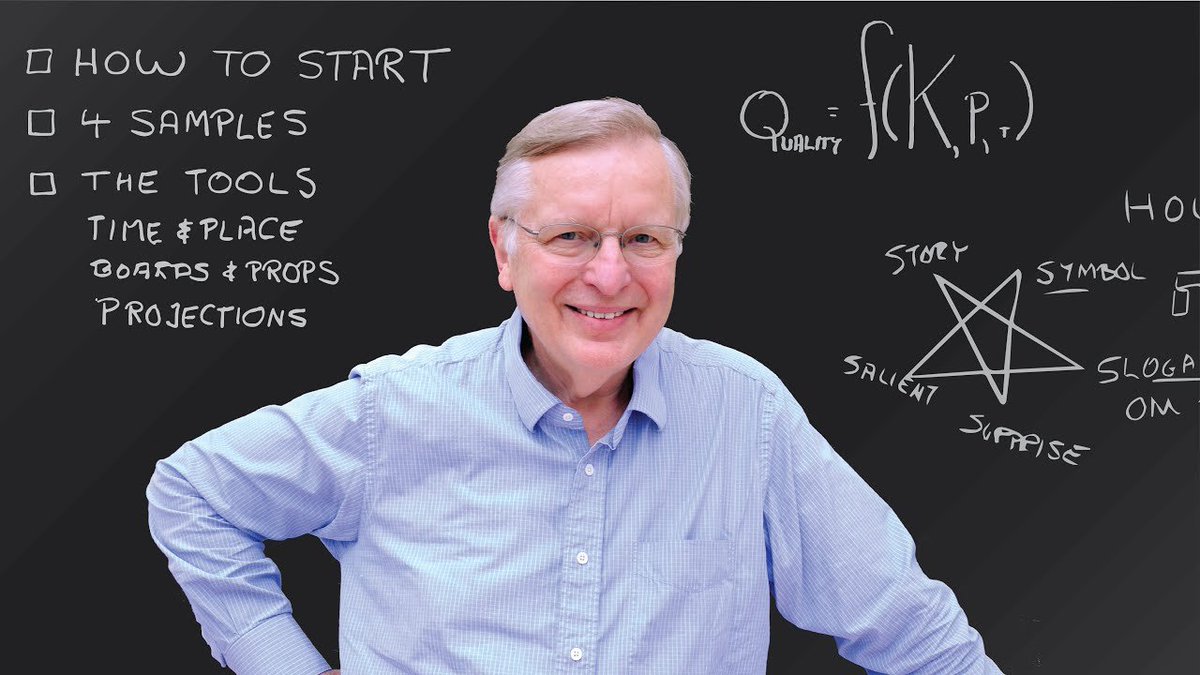
A MIT professor taught the same lecture every January for 40 years, and every single time it was standing room only.
I watched it at 2am and it completely rewired how I think about communication.
His name was Patrick Winston. The lecture is called "How to Speak."
His opening line hit like a truck: your success in life will be determined largely by your ability to speak, your ability to write, and the quality of your ideas in that order.
Not your GPA. Not your pedigree. Not your IQ. How you speak is what separates people who get heard from people who get ignored.
Here's the framework he drilled into MIT students for four decades.
He said never start with a joke. Start by telling people exactly what they're going to learn. Prime the pump before you pour anything in. He called it the "empowerment promise" give people a reason to stay in their seats within the first 60 seconds.
Then he broke down the 5S rule for making ideas stick: Symbol, Slogan, Surprise, Salient, and Story. Every idea worth remembering hits at least three of these.
The part that floored me was his "near miss" technique. Don't just show what's right show what almost looks right but isn't. That contrast is when the brain actually locks something in permanently.
His final rule before any big talk: end with a contribution, not a summary. Don't recap what you said. Tell people what you gave them that they didn't have before they walked in.
I've used this framework in pitches, interviews, and presentations ever since watching it, and the results are not subtle.
Patrick Winston passed away in 2019, but this lecture is still free on MIT OpenCourseWare. One hour, watched by millions, and it costs absolutely nothing.
The most important class MIT ever put on the internet isn't about code or math. It's about how to make people actually listen to you.
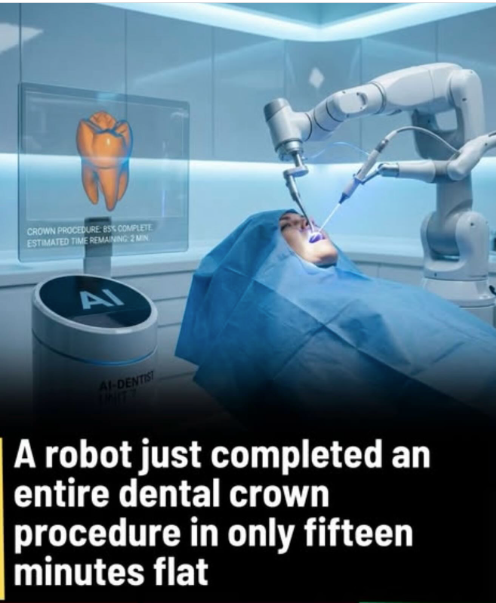
In a landmark medical technology milestone, a fully autonomous AI-powered robotic dentist — built by US company Perceptive — completed a full crown preparation on a human patient in just 15 minutes.
The same procedure typically takes a human dentist 2–2.5 hours. The robot used real-time 3D scanning, AI decision-making, and a precision robotic arm to perform the entire procedure without any human guidance or intervention mid-surgery.