In 1998, Warren Buffett and Charlie Munger spent 4 hours explaining why the smartest people in finance keep going broke.
It might be the most valuable finance lecture ever recorded:
1. The smartest people in finance went completely broke. Long-term Capital Management had 16 people with possibly the highest average IQ of any firm in the country, 350 to 400 combined years of experience, and most of their own net worth in the fund. They still went bankrupt. Buffett said if he ever wrote a book it would be called why smart people do dumb things.
2. Life and markets have no relation to sigmas. Buffett keeps a 1901 newspaper on his office wall. Northern Pacific went from $170 to $1,000 a share in a single day when two buyers accidentally cornered the stock. A brewer who had shorted it, facing a margin call, dove into a vat of hot beer. That man probably understood sigmas and knew such a move was impossible. Buffett has never wanted to end up in the vat.
3. Beta and sigmas tell you nothing about the risk of going broke. the LTCM team relied on mathematics and believed a six- or seven-sigma event could not touch them. they were wrong. history does not tell you the probabilities of future financial events. the real risk is a permanent blind spot in something crucial, often caused by knowing a great deal about something else.
4. To a man with a hammer, every problem looks like a nail. Munger's explanation for why brilliant people do dumb things. They learn a set of mathematical techniques and then twist every problem to fit the solution they already know. Combine that with a poor grasp of history, and you get people with advanced degrees blowing themselves up.
5. To make money they did not need, they risked money they did need. That is just plain foolish, Buffett says, no matter your IQ. Hand him a gun with a million chambers and one bullet, offer any sum to put it to his temple and pull once, and he will not do it. there is nothing on the upside that justifies the downside. people do this financially all the time without thinking.
6. The major banks all had risk models and had no idea what they owned. they met weekly at risk committees, printed all the statistics in neat columns, and did not have the faintest idea what risk they were carrying. The rare and essential quality is someone who can contemplate perils that have not popped up yet, the ones no past model contains.
7. A chief risk officer often just makes you feel good while you do dumb things. munger compares him to the Delphic oracle who convinced the Persian king to attack. he has a PhD and does advanced math, but he tortures reality to defend a model that does not hold under extreme conditions. all that computation makes you feel like you clobbered the risk when you have only clobbered your own head.
8. The whole quant risk system just changed the shape of the curve and kept going. Munger notes the business schools "improved" by throwing away the Gaussian curve and drawing a different one. They talk about fat tails now, but they still have no idea how fat to make them. he and Buffett always knew the tails were there, and used to roll their eyes at the risk-control people at Salomon.
9. Never risk what you have and need for what you do not have and do not need. Buffett will not explain to his family, who hold most of their net worth in Berkshire, that they went broke on a 100-to-1 gamble. Their returns get penalized 99 years out of 100 by being too conservative, and in the hundredth year they survive when others do not.
10. Build the business so that if the world stops working tomorrow, you have no problem. Berkshire double-layers its protection. First, they behave so no rational person questions their credit, then they hold so much liquidity that if the world suddenly hated their credit, they would not notice for months. It gives up higher returns 99% of the time and survives the one time others do not.
11. The real danger is a risk that has never happened before. Buffett wants someone who can imagine perils that have not yet appeared, the ones no model contains. The major institutions all had models, and that inability to envision the unprecedented is exactly what proved fatal. He and Munger spend a lot of time thinking about things that could hit them out of the blue that others leave out entirely.
12. Investing is simple, but not easy. The framework is not complicated. you did not need a high IQ to buy junk bonds in 2002 or stocks at low multiples in 1974. you just needed the courage of your convictions and the willingness to act when everyone else was paralyzed. Following logic rather than emotion is obvious, and yet some people find it almost impossible.
13. You cannot get rich with a weathervane. Buffett and Munger pay no attention to predictions about the economy or the market. People love predictions, entire industries are built on them, but it is like the king hiring a forecaster to read sheep guts. They have never made or avoided a single business purchase because of a macro view.
14. Name one super-wealthy economist. Munger's challenge. All these economists with 160 IQs spend their lives studying markets, and you cannot find one who got rich buying securities. Even Keynes tried to predict the credit cycle, broke a couple of times, and only did well once he switched to buying good businesses cheap and concentrating.
15. Focus only on what is important and knowable. Some things are important but unknowable, like whether someone drops a nuclear weapon tomorrow. Some things are knowable but unimportant. You narrow your attention to the small set of things that are both important and knowable, and you ignore everything else.
16. The market is there to serve you, not to instruct you. This is Graham's chapter eight, and Buffett calls it enormously important. When people talk about momentum or charts, they are saying the market instructs you. It does not. It just quotes prices. When it does something silly, you get a chance to act. Otherwise you go play bridge and check again tomorrow.
17. You can make a decision in five minutes or not at all. Buffett and Munger act fast because they rule out enormous territory in advance. Munger blots out startups entirely, and half a dozen other filters, so what remains is small enough to judge instantly. If they cannot decide in five minutes, they will not learn enough in five months to make up for going in deficient.
18. You can make a lot of money on a Sunday. Buffett said the calls you get on a Sunday, when things are truly screwed up, are the ones you make money on. All you have to do is be the collie and not the caller. You never get in a position where the other party can call your tune, so you can always play out your hand.
19. You are not right because others agree with you. Ben Graham said you are neither right nor wrong because the crowd disagrees. You are right because your facts and reasoning are right. Being contrarian has no special virtue over being a trend follower. All that matters is whether the facts are correct and the logic is sound.
20. Know where the edge of your circle of competence is. Buffett says the size of your circle does not matter. Knowing its perimeter does. You do not have to understand 90% of businesses. You just have to know something real about the few you actually put money into, and honestly recognize the ones you do not understand and walk away.
21. Intrinsic value is just the cash a business will produce, discounted back. Buffett thinks of every business as a bond with coupons that are not printed on it. Your job as an investor is to estimate those future coupons. If you cannot estimate them, like in a high-tech company, you pass. Investing is putting out money to get more back from what the asset produces, not from selling it to someone else.
22. The best businesses earn a royalty and need little capital. Coca-Cola sells a formula and takes a cut of every drink. Magazines like People operate on negative capital because subscribers pay in advance. The great businesses are the ones that can grow very large while needing almost no capital, which is why consumer businesses with pricing power are so valuable.
23. You only have to find one good idea, not twenty. Munger said you cannot find twenty deeply mispriced things, and Buffett agreed you do not need to. You do not have to have tons of good ideas in this business. You just need one good idea that is worth a ton, occasionally. For small sums, Buffett said he would have been 100% in Korea a few years earlier, where great companies traded at three times earnings.
24. The trick is measuring everything against your best opportunity. Munger calls this opportunity cost, the doctrine from the first page of the economics textbook that modern portfolio theory somehow ignored. Once you have found the best thing you understand, you measure every other option against it. The higher your default option, the more you can reject.
25. Modern portfolio theory is, in Munger's words, asinine. Most people will not find thousands of equally good things. They will find a few where one or two are far better than anything else they know. The right way to invest is to concentrate on your best opportunity cost, not to diversify into mediocrity because a model told you to.
26. Big opportunities must be seized, and seized big. Buffett says imagine you got a punch card with only twenty punches for your whole life, one per financial decision. You would think hard about each one, make fewer and better bets, and probably never use all twenty. The discipline of scarcity would make you rich. Dabbling in a bull market because it is easy is how people lose.
27. America has always been full of reasons to sell, and wrong every time. Coca-Cola went public in 1919 at $40, dropped to $19 within a year, and then faced the great depression, World War, and atomic bombs. One share reinvested is worth millions now. The country's opportunities have always won out over its problems. It is investors, not the economy, who tend to be their own worst enemy.
Signed up for a bowel cancer screening programme so got my kit 2 weeks ago
Did the sample and sent it back, within 3 days I got a letter back saying there were indications of blood in my sample
Was booked in for a colonoscopy 5 days later
Went today for it and they found a
Daniel Kahneman: on the days investors both sold one stock and bought another, the stock they sold beat the stock they bought - by 3.4%.
that's the price of having an idea. and people have a lot of ideas.
why? overconfidence. "confidence is a feeling about the coherence of your story" - not about whether the story is true. you can be dead certain and dead wrong.
it shows up everywhere. investors sell their winners and cling to their losers - booking a "win," dodging the pain of admitting a loss. it's the wrong move, and it's part of that 3.4%.
one clean tell from his data: women outtrade men far less - and quietly beat them. the edge isn't more ideas. it's acting on fewer of them.
~25-min lecture, free. Kahneman on why your best trade is usually no trade ↓
BREAKING: STOP deleting emails when Gmail says you're out of storage.
The biggest storage junk is hiding somewhere else.
I freed 18GB in minutes without touching my inbox.
Here's exactly how to check:
A guy used AirPods Pro 2 for 2 years.
He pressed play. He pressed pause. He answered calls. He switched to noise cancellation on planes.
That was it. 4 features. On a $249 device with 30+.
His coworker a sound engineer at a recording studio borrowed them for 10 minutes at lunch and handed them back with a look.
"You've never opened Settings once, have you? Apple built 9 features into these that change how you work, sleep, hear, travel, and take calls. They're buried 3 menus deep and never mentioned in any ad. You've been wearing the world's most underused productivity tool."
He spent 11 minutes in Settings that evening.
His calls got clearer. His focus got deeper. He hasn't touched his phone during a workout since.
Here's every feature his coworker showed him 🧵
Your computer isn’t slow because it’s old.
It’s slow because Windows ships with 15+ hidden settings draining your speed by default.
Change these 9 and it will run like new again.
Most people have never touched them.
Thread 🧵
Charlie Munger spent 50 years studying why intelligent people make catastrophically stupid decisions.
It is the most useful thing I have ever watched:
1. Incentives are more powerful than anyone thinks. Munger says he has been in the top 5% of his age cohort his entire life in understanding the power of incentives and he has still underestimated it every single year. Federal Express could not get their night shift to work efficiently until someone realized they were paying by the hour. They switched to paying by the shift. The problem disappeared immediately.
2. People rationalise terrible behavior when their incentives point that way, and they do not even know they are doing it. A doctor in Nebraska was removing perfectly healthy gallbladders for years. When Munger asked an old colleague whether the doctor knew he was harming patients, the answer was no. he genuinely believed the gallbladder was the source of all medical evil and that removing it was an act of love. That is incentive-caused bias at its most extreme.
3. Psychological denial is real, and it is not just for weak people. A family friend's son flew off a carrier in the North Atlantic and never came back. His mother, a completely sane woman, simply never believed he was dead. Reality was too painful, so she distorted it until it was bearable. Munger says we all do this to some extent, and it causes terrible problems.
4. Consistency and commitment tendency are one of the most powerful forces in the human mind. Once you have stated a position publicly, you are psychologically locked into it. Max Planck said the really important new physics was never accepted by the old guard. A new guard came along that was less brain blocked by its previous conclusions. If this happened to the deans of physics, Munger says, imagine what it does to ordinary people.
5. The Chinese brainwashing system used on prisoners of war worked better than torture. They did not start with big demands. They maneuvered people into making tiny little commitments and declarations and slowly built from there. The same mechanism operates in every cult, every sales system, and every ideology that gets deeply embedded in people's heads.
6. Pavlovian association shapes buying behavior at a level most people never consciously process. Munger estimates three quarters of all advertising works on pure Pavlov. Coca-Cola does not want to be associated with funerals. They want to be associated with the Olympics, wonderful music, heroics. The association itself changes how people feel about the product at a subconscious level. Raising the price of a product can actually increase its market share because price and quality are associated in the human mind, and people use price as a signal of value.
7. Persian messenger syndrome is alive and running every major organization. The Persians killed the messenger who brought bad news. Bill Paley in his last 20 years, did not hear one thing he did not want to hear. everyone around him knew bringing bad news was dangerous. The result was that one of the most powerful men in media made terrible decisions for two decades because reality never reached him.
8. Social proof causes otherwise intelligent people to follow each other off cliffs. When one oil company bought a fertilizer company in the 1970s, practically every other major oil company rushed out and did the same. There was no rational reason for oil companies to own fertilizer companies. But if Exxon was doing it, it was good enough for Mobil. Every single acquisition was a disaster.
9. The efficient market theory persisted in academia for decades despite Berkshire Hathaway existing as a living contradiction. One economist kept adding sigmas to explain away the anomaly. two sigma, then three, then four, eventually six sigma. Munger's observation: It is better to add a sigma than change a theory just because the evidence comes in differently. That economist later went into money management himself and sank like a stone.
10. Contrast bias warps perception constantly and invisibly. Put your hand in hot water, then room temperature water. It feels cold. Put your hand in cold water, then room temperature water. It feels hot. same bucket. The human sensory apparatus has no absolute scale, only a contrast scale. Real estate agents exploit this deliberately. They show you two overpriced, awful houses first, then take you to a merely overpriced house, and it feels like a bargain.
11. The frog in slowly heating water is the business version of contrast bias. If something bad comes to you in small pieces, you are likely to miss it entirely. Munger says he has known many high-powered brilliant businessmen who were destroyed this way. not because they were stupid but because each incremental change was too small to trigger alarm. The contrast was never large enough to notice.
12. Authority bias is so powerful it can make trained professionals watch a plane crash. In flight simulator experiments, when the pilot, the authority figure, does something that any trained co-pilot knows will crash the plane, 25% of the time, the co-pilot sits there and lets it crash anyway. They have been trained to know better. The authority relationship overrides the training.
13. Deprivation super reaction syndrome explains why people go insane over small losses. Munger's neighbor had a 180 degree view of the harbor. the neighbor put in a pine tree about 3 feet high that turned it into a 179 and three-quarter degree view. They had a blood feud that went on for years. The New Coke disaster is the corporate version. Coca-Cola told customers they were changing a flavor and triggered a deprival super reaction so powerful that Pepsi was weeks away from releasing old Coke in a Pepsi bottle. smart engineers. brilliant lawyers. armies of psychologists. All missed it.
14. Envy and jealousy are far more powerful than greed and almost entirely absent from psychology textbooks. Munger says Warren Buffett has said half a dozen times that it is not greed that drives the world but envy. In a thousand-page psychology textbook, the index entry for envy and jealousy is blank. One of the most powerful forces in human behavior and academia essentially ignores it.
15. Gambling addiction is not explained by variable reinforcement alone. Skinner thought he had fully explained gambling by showing that variable reward schedules pound in behavior more powerfully than fixed ones. But the people who design modern slot machines know things Skinner did not. Lotteries where you pick your own number get far more play than lotteries where the number is assigned to you. People who commit to a number believe it has more validity because they chose it. Near misses on slot machines trigger deprival super reaction syndrome. It is four or five psychological tendencies working together, not one.
16. The most dangerous situations are when multiple psychological tendencies combine toward the same end at once. Munger calls this the lollapalooza effect. Tupperware parties use four or five tendencies simultaneously. Moonie conversion methods combine multiple tendencies and work extraordinarily well. alcoholics anonymous achieves a 50% no drinking rate when everything else fails because it also combines multiple tendencies toward a constructive end. The Milgram experiment is not just about obedience. it involves authority bias, consistency and commitment tendency, and contrast effects all working together. That combination turns human brains into mush.
17. Boards of directors are structurally designed to fail as corrective mechanisms. The top executive is the authority figure. He is doing something questionable. You look around, and nobody else is objecting, which is social proof that it is fine. He flies you around in the corporate jet and raises your director fees every year, which triggers reciprocation tendency. Munger's rule: boards only act when the behavior gets so bad it starts making them look foolish or threatens legal liability. That is the only forcing function that reliably works.
18. John Goodfriend of Salomon Brothers destroyed his career and reputation because he did not fire a trusted employee who had lied to the government. Every psychological tendency pointed toward keeping the man. He was a close colleague. His wife was known. He was part of a group that had made over a billion dollars for the firm. He said he had never done it before and would never do it again. Goodfriend looked into his eyes and believed him. The man did it again. The lesson: everyone who gets caught embezzling says they have never done it before and will never do it again. That is what they all say.
19. Darwin avoided confirmation bias by deliberately seeking out disconfirming evidence. Munger says Darwin was not especially smart by ordinary standards of human acuity. Yet he is buried in Westminster Abbey. Munger studied how Darwin worked and realized he had psychological tricks worth learning. Darwin always paid extra attention to evidence that contradicted his theories. Munger started doing the same and credits it as one of the most important intellectual habits of his life.
20. Why is the most important word in communication? Carl Braun designed oil refineries with spectacular skill, and you got fired in his company if you wrote a communication without explaining why. not just who, what, where, and when, but why. Braun knew that in a complex system where things can blow up, a communication system that always explains the reason behind an instruction works dramatically better than one that does not. Forstein, the general counsel of Salomon, told Goodfriend on multiple occasions that he had to report the employee's misconduct. He explained it was the right thing to do. He never explained what would happen to Goodfriend personally if he did not. he failed to use the most powerful tool of persuasion. Goodfriend ignored him. When Goodfriend went down, Forstein went with him.
Seth Klarman, founder of Baupost Group, built it from $27 million into $22 billion - and his secret weapon is doing nothing for years at a time
his book "Margin of Safety" is out of print and sells used for over $1,000
he almost never talks in public
he just did - in one of the rarest interviews of his career
75-min on how the Oracle of Boston actually thinks about risk
bookmark & watch today
🇳🇱STUDY IN THE NETHERLANDS FOR FREE!!🚨
University of Groningen Eric Bleumink Fellowship 2026 , Netherlands (Fully Funded)🔥
◽Fully Funded
◽University of Groningen
◽All Subjects
◽International Students
📍Full tuition fee coverage
📍Monthly living allowance
Apply👇
🇬🇧 Rhodes Global Scholarships 2027 in the UK | Fully Funded
🏫 Host University: University of Oxford
📍 Host Country: United Kingdom
🏛️ Funded By: Rhodes Trust
🎓 Study Levels: Master’s, MPhil, PhD, DPhil & other eligible postgraduate programs
🌍 Eligibility: International Students
✨ Scholarship Benefits:
✅ Full tuition fee coverage at the University of Oxford
✅ Annual living stipend of £20,400
✅ Accommodation and living expense support
✅ Oxford University application fee coverage
✅ Student visa fee coverage
✅ International Health Surcharge (IHS) coverage
✅ Economy-class airfare to the United Kingdom
✅ Return economy-class airfare upon completion of studies
Details link: https://t.co/VbD5PxAGvL
Don’t miss this life-changing fully funded opportunity!
#RhodesScholarship #UniversityOfOxford #StudyInUK #Scholarships2027 #OpportunitiesPedia
Explore Australia!
University of South Australia Scholarship 2026 | Fully Funded
Host Country: Australia 🇭🇲
Benefits:
⭐Full Scholarship and $32,500 annual stipends
📌 Masters and PhD Study
📌 All Countries
Deadline: Not Specified
Apply Now ✅
https://t.co/Exd7lbJ0xt
#Netherlands_Government Scholarship_ 2026-2027 are announced for World Students!
No Agent - Direct Apply!
👉Apply Link: https://t.co/9nGnjsC9xq
Degree: Multiple Degree Programs for Undergraduate / Graduate
Benefits:
1) Highly Funded
2) Government Funded
3) No Application Fee
4) Multiple Scholarship Programs
Deadline: Multiple Deadline for NL Scholarship
#scholarships365 #han_university_scholarship_2026 #europe_scholarship #studyabroad
🇮🇹ITALY GIVES OPPORTUNITY TO STUDY FOR FREE!!🚨
IUSS Pavia Scholarships 2027 in Italy🔥
◽Fully Funded
◽IUSS-Pavia
◽PhD
◽International Students
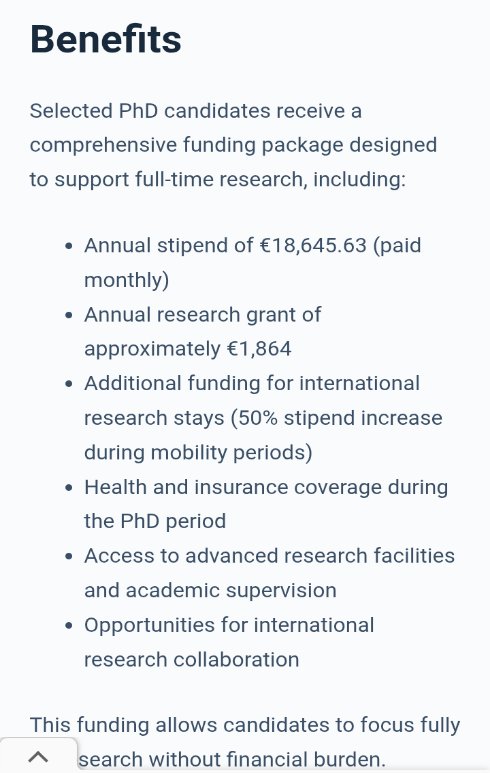
📍Annual stipend of €18,645.63 (paid monthly)
📍Annual research grant of €1,864
📍Full tuition fee coverage
Apply now👇
Study in Ireland 🇮🇪 for free | Postgraduate
Dublin City University Study Opportunity
📍 Location: Ireland 🇮🇪
📅 Deadline: July 30, 2026
Looking to pursue a master’s degree in Digital Marketing? The John Thompson Postgraduate Scholarship 2026 at Dublin City University (DCU) Business School offers outstanding students the opportunity to study in Ireland with significant financial support.
What the scholarship offers:
📍Full tuition fee coverage
📍Opportunity to study at DCU Business School
📍Networking opportunities with professionals and experts
📍Study in one of Europe’s leading technology and business hubs
WHO CAN APPLY:
📌International and domestic applicants
📌Students applying for the MSc in Digital Marketing programme at DCU
📌Candidates with strong academic records
📌Applicants demonstrating passion and potential in digital marketing and business
The scholarship is designed to support talented students who wish to develop advanced skills in digital marketing, strategy, analytics, and innovation.
Apply now 👉 https://t.co/Bm3T6r2ZCm
Join our channel https://t.co/IlMZw7pLwN for more scholarship opportunities.
Africa & Middle East
1. Morocco Government Scholarship: fully funded Bachelor's/Master's in Morocco. Full tuition. Deadline: Varies. https://t.co/pXqU99UqPR
2. Algeria Government Scholarship: fully funded Bachelor's/Master's in Algeria. Full tuition. Deadline: Varies. https://t.co/00fkn1o8s3
3. Tunisia Government Scholarship: fully funded Bachelor's/Master's in Tunisia. Full tuition. Deadline: Varies. https://t.co/Zpa4rcKp7R
4. Egypt Government Scholarship: fully funded Bachelor's/Master's/PhD in Egypt. Full tuition. Deadline: Varies. https://t.co/kIQV5dKKuF
5. Kenya Government Scholarship: fully funded Master's/PhD in Kenya. Full tuition. Deadline: Varies. https://t.co/tyCASOYkhg
6. Ghana Government Scholarship: fully funded Master's/PhD in Ghana. Full tuition. Deadline: Varies. https://t.co/fDugPgPsVj
7. Nigeria Government Scholarship: fully funded Master's/PhD in Nigeria. Full tuition. Deadline: Varies. https://t.co/YExk8WtzhJ
8. South Africa DHET Scholarship: fully funded Master's/PhD in South Africa. Full tuition. Deadline: Varies. https://t.co/gZwFYbSQCB
9. Botswana Government Scholarship: fully funded Bachelor's/Master's in Botswana. Full tuition. Deadline: Varies. https://t.co/CBkMEoUJRr
10. Rwanda Government Scholarship: fully funded Master's/PhD in Rwanda. Full tuition. Deadline: Varies. https://t.co/aacgvryVIx
11. Ethiopia Government Scholarship: fully funded Bachelor's/Master's in Ethiopia. Full tuition. Deadline: Varies. https://t.co/FXghIfUUYm
12. Uganda Government Scholarship: fully funded Bachelor's/Master's in Uganda. Full tuition. Deadline: Varies. https://t.co/eXSFtH5yxp
13. Tanzania Government Scholarship: fully funded Master's/PhD in Tanzania. Full tuition. Deadline: Varies. https://t.co/p9u2F3fl0R
14. Kuwait Government Scholarship: fully funded Bachelor's/Master's/PhD in Kuwait. Full tuition. Deadline: July-September. https://t.co/d7bhECiRfY
15. Qatar Government Scholarship: fully funded Bachelor's/Master's/PhD in Qatar. Full tuition. Deadline: October. https://t.co/B7N8MW2ykp
16. Bahrain Government Scholarship: fully funded Bachelor's/Master's in Bahrain. Full/partial tuition. Deadline: Varies. https://t.co/CHf7CMeWRF
17. Oman Government Scholarship: fully funded Bachelor's/Master's in Oman. Full tuition. Deadline: Varies. https://t.co/iEzxLs6E1R
18. UAE Government Scholarship: fully funded Bachelor's/Master's in UAE. Full tuition. Deadline: Varies. https://t.co/iFQkruiujW
19. Israel Government Scholarship: fully funded Bachelor's/Master's/PhD in Israel. Full tuition. Deadline: November 30. https://t.co/pv5Y1vkplC
20. Iran Government Scholarship: fully funded Bachelor's/Master's/PhD in Iran. Full tuition. Deadline: Varies. https://t.co/n9ZDRTJ4Re
21. Jordan Government Scholarship: fully funded Bachelor's/Master's in Jordan. Full tuition. Deadline: Varies. https://t.co/a23c24ho89
22. Lebanon Government Scholarship: fully funded Bachelor's/Master's in Lebanon. Full tuition. Deadline: Varies. https://t.co/Sk2oHtJ9Nl
23. Iraq Government Scholarship: fully funded Bachelor's/Master's in Iraq. Full tuition. Deadline: Varies. https://t.co/BKxMGXYoYD
24. Sudan Government Scholarship: fully funded Bachelor's/Master's in Sudan. Full tuition. Deadline: Varies. https://t.co/oxcJGeIyiC
25. Senegal Government Scholarship: fully funded Bachelor's/Master's in Senegal. Full tuition. Deadline: Varies. https://t.co/G13YOPdUTG
26. Ivory Coast Government Scholarship: fully funded Bachelor's/Master's in Ivory Coast. Full tuition. Deadline: Varies. https://t.co/RVkhzxnr8Q
27. Zambia Government Scholarship: fully funded Bachelor's/Master's in Zambia. Full tuition. Deadline: Varies. https://t.co/BbEo3YuigB
28. Zimbabwe Government Scholarship: fully funded Bachelor's/Master's in Zimbabwe. Full tuition. Deadline: Varies. https://t.co/wnj0048DTQ
29. Mozambique Government Scholarship: fully funded Bachelor's/Master's in Mozambique. Full tuition. Deadline: Varies. https://t.co/kNGCVrfnJA
30. Namibia Government Scholarship: fully funded Bachelor's/Master's in Namibia. Full tuition. Deadline: Varies. https://t.co/kLpDFqX96R