SenseNova-U1.6 has arrived with a new way to refine generated images: create, inspect, and correct in one native multimodal workflow.📜 Apache-2.0 License.
🤖 https://t.co/cEjW7DrGQx
🪄 Generate, inspect, correct: U1.6 adds a self-correction workflow for refining issues such as broken poster text and unwanted visual details.
🖼️ One model for the full image loop: The native checkpoint supports text-to-image generation, image editing, visual understanding, and interleaved text-and-image output.
🎞️ Edit without losing the shot: Its examples cover style transfer, camera looks, character and object edits, and layout-aware poster changes.
⚡ More ways to run it: The family includes native BF16 weights, GGUF weights, and 4-step or 8-step LoRAs for faster generation in Python or ComfyUI.
🧩 Use the matching U1.6 runtime: The new self-correction and interleaved protocol require the corresponding SenseNova-U1 runtime rather than older U1.5 assumptions.
SenseNova U1.6 is now available in ComfyUI.
→ Aesthetics: +10% over U1.5, tuned per image type
→ Self-correction: it reviews its own infographic and regenerates the broken text
→ +7% on dense text vs single-pass
→ Generate, review, and correct inside one model
Can an image model catch its own typos? Meet #SenseNova U1.6. 🎨
Built on Neo-unify, it pairs refined aesthetics with the ability to check and revise image text against your prompt. And for the first time, @ComfyUI natively supports U1.6’s self-correction!
🔹 𝗥𝗲𝗳𝗶𝗻𝗲𝗱 𝗔𝗲𝘀𝘁𝗵𝗲𝘁𝗶𝗰𝘀: 10% improvement in overall aesthetic quality vs. U1.5 in user evaluations, with richer visual expression across portraits, posters & illustrations.
🔹 𝗡𝗮𝘁𝗶𝘃𝗲 𝗦𝗲𝗹𝗳-𝗖𝗼𝗿𝗿𝗲𝗰𝘁𝗶𝗼𝗻: Generate → Review → Fix. U1.6 autonomously reviews and corrects text errors in its own infographics while preserving expressive typography and layout.
🔹 𝗜𝗺𝗽𝗿𝗼𝘃𝗲𝗱 𝘁𝗲𝘅𝘁 𝗮𝗰𝗰𝘂𝗿𝗮𝗰𝘆: +7% average relative improvement over single-pass generation on UltraTextBench dense infographic tasks.
🎨 SenseNova Studio: https://t.co/yaXjXJ4aeW
🛠️ ComfyUI: https://t.co/OAuxVNYNoH
💻 GitHub: https://t.co/VQfh3IKdu2
🤗 Hugging Face: https://t.co/TS6Ek5S8nD
🔑 Get your API key: https://t.co/Q6TmyMqxSO (1,500 free API requests every 5 hours)
👾 Discord: https://t.co/8MkRBA1ac5
#SenseNova-Loop-9B is officially here — now #OpenSource!
Just 9B parameters, competitive with Qwen3.8-27B across multiple benchmarks.
🔹 Big gains over Preview: NL2Repo 19.91 → 41.36; AutomationBench 14.33 → 36.67; GAIA 37.86 → 69.90
🔹 Loop + mHC: 32 unique layers, 56 layer executions
🔹 Day-0 4-bit AWQ weights (~4.9GB), with VRAM needs as low as ~9 GiB at 64K context
🔹 Up to 512K context, with text and image inputs
See what a 9B model can build: animated posters, interactive websites and 3D scenes.
💻 GitHub: https://t.co/2ptlScqToV
🤗 HF: https://t.co/aS2BLxXfyc
👾 Discord: https://t.co/8MkRBA1ac5
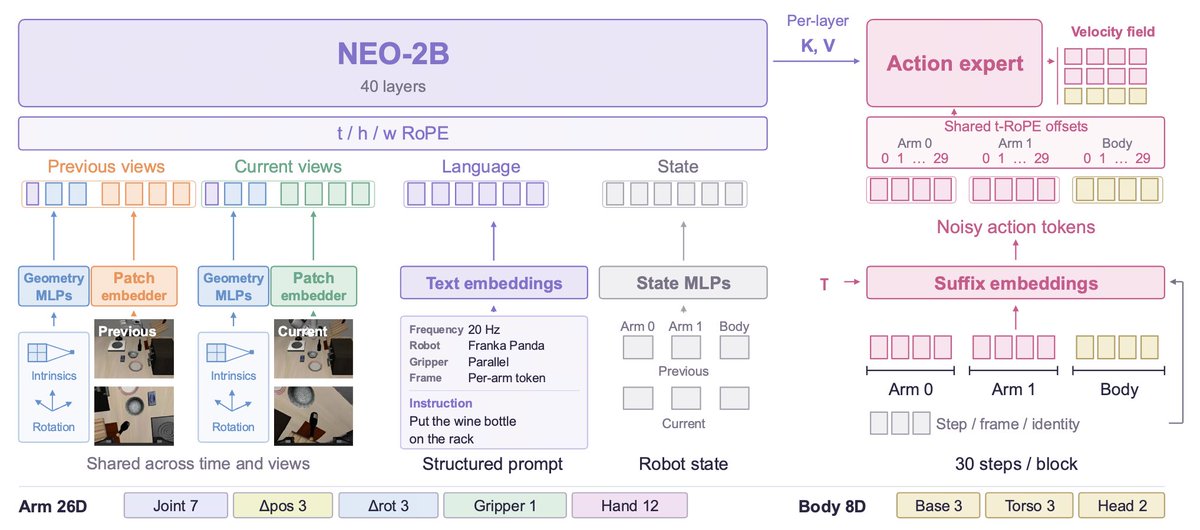
Sharing the 4th NEO-series work: NEO-VLA ✨
🔥 From Pixels to Actions for System-1.
📚 TL;DR
(1) Encoder-free Vision–Language–Action.
(2) Early visual features matter most for action.
(3) Native VLA outperforms encoder-based counterparts in robustness.
Spatial perception is more than recognizing images. It calls for a persistent spatial state—maintained beyond observation, updated under self-motion, used to act.
Do vision foundation models support such a state? We probe 10 models at 4 levels. 🧵
🌏 https://t.co/8DhOh8dCGX
We release the most comprehensive 𝗲𝗺𝗽𝗶𝗿𝗶𝗰𝗮𝗹 𝘀𝘁𝘂𝗱𝘆 𝗼𝗳 𝗚𝗣𝗧-𝟲-𝗔𝘀𝘁𝗿𝗮’𝘀 𝗲𝗺𝗯𝗼𝗱𝗶𝗲𝗱 𝗶𝗻𝘁𝗲𝗹𝗹𝗶𝗴𝗲𝗻𝗰𝗲 across 12 simulation benchmarks and 8 real-robot platforms, together with 𝗦𝗲𝗻𝘀𝗲𝗡𝗼𝘃𝗮-𝗥𝗼𝗯𝗼𝗥𝗦𝗜: an open-source harness framework and a 27B model that runs at ~1/50 the cost of GPT-6-Astra.
Here's what we found:
🔹 𝗧𝗵𝗲 𝗰𝗮𝗽𝗮𝗯𝗶𝗹𝗶𝘁𝘆 𝗰𝗲𝗶𝗹𝗶𝗻𝗴 𝗶𝘀 𝗮𝗰𝘁𝘂𝗮𝗹𝗹𝘆 𝗺𝘂𝗰𝗵 𝗵𝗶𝗴𝗵𝗲𝗿. Under a unified protocol (ICL + up to 10× the interaction budget), GPT-6-Astra achieves clear SOTA across all 12 benchmarks: RoboDojo: 27.6% at 1× → 81.9% at 10×, DexJoCo: 87.3% vs. 40.3% prior SOTA, while the LIBERO benchmarks are pushed to saturation.
🔹 𝗧𝗼𝗼 𝗺𝘂𝗰𝗵 𝗯𝘂𝗰𝗸 𝗳𝗼𝗿 𝘁𝗵𝗲 𝗯𝗮𝗻𝗴. Even a simple task like placing pens in a holder costs ~$55 in inference.
🔹 𝗧𝗵𝗲 𝘄𝗼𝗿𝗹𝗱 𝗱𝗼𝗲𝘀𝗻’𝘁 𝘄𝗮𝗶𝘁. Time matters as real robots overheat, and an egg burned while the model was still thinking.
Our takeaway: GPT-6-Astra has largely crossed the threshold of 𝗲𝗺𝗯𝗼𝗱𝗶𝗲𝗱 𝗰𝗼𝗺𝗽𝗲𝘁𝗲𝗻𝗰𝗲, but 𝗽𝗿𝗮𝗰𝘁𝗶𝗰𝗮𝗹 𝗲𝗺𝗯𝗼𝗱𝗶𝗲𝗱 𝗶𝗻𝘁𝗲𝗹𝗹𝗶𝗴𝗲𝗻𝗰𝗲 is not here yet.
🌐 Project page: https://t.co/m0ntdtBamB
📄 Report: https://t.co/ySEnd7oIj9
💻 Code & model: https://t.co/iTVQ1YD7mP
Blog for our ECCV paper Demystifying Video Reasoning
In 1935, Erwin Schrödinger put a cat in a box with a Geiger counter. Until you open the box, you do not know if the cat is alive or dead. According to Schrödinger, the cat is alive and dead, at the same time.
90 years later, it is the best picture I have for how a video model solves a problem.
Link: https://t.co/3CMjvwtOvY
A coding model may build a world model, but it is not a world model itself. The neuroscience examples, especially rats' cognition maps, are fascinating. Well worth reading.
Wrote this article in the past few days. GPT-6 stunned many people with its spatial and embodied abilities. Some people shout out: "Coding is All You Need", "Coding is AGI", "Coding is World Model".
Here is a rebuttal. https://t.co/6bjvS260Ku
We hope to launch the Verification Age for video models: 50 scientists, 6 months, 100 rule-based verifiers, 300 new tasks, and a worked RL recipe.
Coding models are advancing crazily thanks to the synthetic RL envs paradigms. Verification via codes or Lean gives models super-human math/coding intelligence like that in Astra and Fable.
However, video models are still in the GPT-3 stage, where we just dump million hours video data into the model training and hope for magic.
In this work,
1) we built 100 rule-based verifiers each paired with a synthetic data generators which give 10k+ diverse samples within the task domain
2) we made additional 300 tasks generators, including classic games i.e. Snake, Gold Miner, Mario, to further scale training data distribution with million samples rendered ready available on HuggingFace
3) ~60 experiments to find a worked RL recipe for video model post-training
4) comparison studies between image models, unified models, video models - which is the best model for visual thinking?
5) failure modes of how VLM-as-Judge will not satisfy video models RL in long term
6) interpretability studies show all image models, unified models, video models emerged "Schrödinger Effect", CoS reasoning through diffusion steps
7) many more insights
A detailed thread [1/n]
Full support @haozhangml and FastVideo! As LightX2V contributors, we also shared H3-Turbo. Quality-preserving speedups are hard, but we share the same vision: making good models accessible on affordable GPUs. Calling it “random pixels” is unfair. We appreciate FastVideo's effort.
oh, thanks for evaluting this for us. We wish we had more compute to distill with more data (like you would have), but it is happy to see that, with our very limited dozens of GPUs, we are already generating good videos.
Also, I hope you could be less mean to us next time, as I believe fastH3 generates sufficient decent videos that many users can already use at much lower cost, definitely not a "random pixel generator"
Accepted at ECCV 2026: "Demystifying Video Reasoning"
On Friday Aug 28, first author Ruisi Wang @Rui147000038622 the work at our journal club. The finding: video models don't reason across frames (Chain-of-Frames) — they reason along diffusion denoising steps (Chain-of-Steps).
Paper: https://t.co/D4e3lhkI35
Fri Aug 28 · 7:30 PM PT
RSVP: https://t.co/DSQrJAHFov
Excited to share VBVR-Pro! 💡Our findings suggest that intermediate visual states can matter more than textual rationales, while verifiable rewards enable stronger generative RL than VLM judges. Looking forward to further exploring visual intelligence beyond language. 🚀
💡Videos and images should not be treated merely as inputs to understand or outputs to render. They can be first-class substrates for problem solving beyond language.
🎉Introducing VBVR-Pro: an infrastructure suite for visual intelligence: trainable, verifiable, RL-optimizable, and experimentally controllable.
🔗Homepage: https://t.co/QrYH2zne7u
SenseNova U1.5 is here. Exciting to see such a big progress since U1.
🎯 Highly controllable: Complex conditioned generation and precise editing
🖼️ High resolution: Stunning 4K output with fine-grained details
⚡ Highly cost-effective: An 8B-MoT model that rivals the latest commercial models
Smaller model. Powerful performance. Limitless creativity.
A big thank you to @HuggingApps for building this Space! More people can now try our latest model directly, with no deployment required. Give it a try 🤗
https://t.co/yF5MYw4tFf
SenseNova U1 is the best open image model you maybe didn't heard of yet
Unified language-image (like Nano Banana 2 / GPT-Image-2) that does precise generations and edits
It has a general version and a specialized infographics one, where it shines
▶️ https://t.co/luhSkv2Rf4
👑 The #WorldCupFinal is set! A true coronation.
Past 👑 Messi 🆚 Future 👑 Yamal.
Detailed analysis by SenseNova U1 Pro predicts a 1-2 Argentina win!
🔁 RT if 🇦🇷 takes the 4th star
❤️ LIKE if 🇪🇸 takes the crown
Congrats on the impressive GenCeption! Beyond the strong results, we are inspired by a broader message: the choice of generative pretraining shapes what a general-purpose vision model can naturally understand. Perhaps @CeyuanY's Omni Model offers a ultimate way to unify them all
Can video generation models do for vision what LLMs did for language?
Introducing GenCeption from @GoogleDeepMind: one feed-forward video model for various vision tasks — SOTA, data-efficient, and emerging behaviors (ECCV 2026)
🌐 https://t.co/3rwVgTolZz
(1/8)