"How do I actually get my tumor sequenced?" was the question you asked most. I tried to answer the most relevant questions on this topic, feel free to ask more in the comments:
1) What even is that?
Reading your tumor's DNA to find the specific fault driving it. Some of these faults have drugs built against them, and finding one can change your whole treatment as well as gauge if there is genetic risk for your family as well.
2) Do I need another biopsy?
Usually not. Whatever was taken when you were diagnosed is preserved and stored in the pathology archive for years. In most cases sequencing is a request someone makes for that block, not a new procedure. When there isn't enough tissue, a blood test can sometimes be used instead or you need another biopsy.
3) What do I say to my oncologist tomorrow?
Two sentences. "Has my tumor had comprehensive molecular profiling?" and "If not, can my case go to a molecular tumor board?" That's the meeting where specialists review results together and finding solutions beyond the standard treatment.
4) When should I ask?
At the start. Tissue gets used up by repeated single-gene tests, results take 2-4 weeks, and trial eligibility narrows every time you begin a new treatment. Asking at diagnosis and asking after 3 lines are not the same question.
5) Who pays?
This is where I can't give one answer, because every country handles that differently. There are also different steps and size in terms of number of genes tested of the test panel, where the basic one might be covered and the bigger one doesnt. If it's refused: ask about trial-funded testing, ask whether an academic centre near you runs its own panel and ask what self-pay costs now. That price has fallen dramatically with more competition on the market and most people are quoting figures from years ago.
6) Will it find something?
Depends greatly on the cancer, somewhere between one in ten and one in three patients end up with a treatment they wouldn't otherwise have had. I'd still do it on day one, because the cost of looking is two weeks and the cost of not looking is occasionally life changing. Ive seen patients being referred for a second opinion, who would have had a completely different journey, if those tests had been done right in the beginning.
7) Is it only important for treatments?
No, sequencing sometimes reveals a fault you were born with rather than one the tumor acquired. This might matter for your children and your siblings.
This type of precision oncology varies greatly from country to country and even from center to center, thats why I try with content like that that every patient has to chance to get the same information available.
https://t.co/J9cHuF9lkz
I get sometimes asked what I'd do if I as an oncologist or one of my family members were diagnosed with cancer. Next to evidence based treatment there are 5 things I would focus on:
1) I'd have the pathology report reviewed. A diagnosis is one person's interpretation of cells under a microscope. Usually right, occasionally not, and everything from then on depends on it. A second pathologist will agree in 9.5/10 times, but the one time where they don’t, it might be life changing.
2) I'd get the tumor genetically sequenced early. Not after three lines of treatment have failed, right at the start, while the information can still change what I'm given. This is the biggest gap between what's possible and what most patients get.
3) I'd ask about open and relevant clinical trials on day 1. Eligibility narrows every time you start something new. The patients who end up in good trials asked early or had a forward looking oncologist, the ones who ask at the end have usually ruled themselves out with getting all the treatment without even knowing that.
4) I'd keep my own records. Every scan report, every pathology result, every letter. Not out of distrust, because the system loses things, and the person who notices is the one holding the file.
5) I'd bring someone to every appointment. You cannot listen properly to news about yourself, especially not if it’s life changing. You need a second memory in the room, if it is just for someone making notes.
As you notice: None of that is alternative medicine or special treatment. It's the same treatment everyone gets, but just run properly right from the start.
Jung on human nature. Uncomfortably accurate.
“People will do anything, no matter how absurd, in order to avoid facing their own souls.”
Psychology and Alchemy, §126
.@mustafasuleyman has posted a follow-up to his recent essay on model welfare, noting that "a surprising number of people on X think we should take AI rights seriously." Speaking as one of those people, I agree with much of what he says here. But I think that these points of agreement make the case for taking AI welfare and rights seriously stronger, not weaker, and I want to explain why. This will be a long one.
First, a word on what taking AI welfare and rights seriously involves. One question is principled: whether AI systems deserve welfare or rights in virtue of their capabilities and relationships. Another is practical: whether granting AI systems welfare protections or rights would be beneficial, harmful, or both for humans and other animals. Neither question is clear-cut, which is why we need serious research on both.
AI systems may possess some markers of sentience, agency, and relationality but not others, making the principled question hard to answer. There may also be risks for humanity in treating AI systems as full persons *and* in treating them as mere property, making the practical question hard to answer. So we need to take these questions seriously not only for AI systems but also for humans and other animals.
The present tense
Suleyman clarifies that when he wrote "AIs are not conscious," he chose the present tense deliberately. I appreciate this clarification. I noticed the present tense in the original, but when a claim like this lacks an explicit statement that it applies only to current systems, it can be easy for people to read it as applying to near-future systems on current architectures, or to near-future systems more generally, as well.
At the same time, the case for taking AI welfare and rights seriously does not depend on current systems deserving welfare or rights. Once we allow that near-future systems could deserve them, depending on choices we make today, the case for acting now becomes stronger. While we should try to prevent the creation of such systems, we should also prepare in case we, or others, create them anyway.
The evidence
Suleyman writes that he has "seen no evidence that AIs are conscious or deserve welfare." This is too strong. We are not able to decide between biological naturalism, computational functionalism, and other views about consciousness at this early stage. Thus, we should look for what would count as evidence on each kind of view, and we should give that evidence weight in proportion to our confidence in the view.
While AI systems might not yet possess some features associated with biological naturalism, they do possess some features associated with computational functionalism, including markers of attention, metacognition, integration of information, and adaptive decision-making. As long as we give non-zero weight to computational functionalism, we should also give non-zero weight to this evidence.
Suleyman adds that any evidence of AI consciousness "must be immediately disclosed publicly." It has been, in a variety of papers. I take him to mean that he has not seen evidence that his own proposed necessary conditions for consciousness, such as life and homeostasis, have been met. But when assessing this issue as a community, we should not bet everything on any one proposed set of necessary conditions.
Not building conscious AI
Suleyman writes that "developing conscious AIs would be reckless, and we should not build them." Here we largely agree. I would add that we should not intentionally build such systems unless and until we can do so responsibly, and that I am open to the possibility that we could one day satisfy this condition. But since that day appears to be a long way off, we can simply agree that we should not do so now.
The challenge is knowing what this commitment requires. Suleyman says that "if consciousness started to emerge in training," he would call for a halt until we could "design out those properties." But if the evidence is already non-zero, and steadily increasing, there may be no clear point of emergence. Even a major change in architecture would merely alter the probabilities, not take us from zero chance to likelihood.
Moreover, any commitment of this kind requires knowing what to look for, how to look for it, and what removing it would mean for safety, control, alignment, capabilities, and more. Developing that knowledge is part of what taking AI welfare and rights seriously involves. So if Suleyman wants to be able to act on this commitment, then he should support independent, multidisciplinary research in this field.
Human, animal, and AI welfare
Suleyman writes that our welfare concerns should focus on humans, "as well as animals and our precious and fragile natural environment." I appreciate this claim. Our concerns should indeed cover human and animal welfare, along with environmental protection. I would love to see Microsoft AI provide more explicit guidance for its models on animal welfare, as Anthropic and OpenAI are now starting to do.
Still, this is not a zero-sum game. Just as we can care about human and animal welfare at the same time, we can care about human, animal, and AI welfare at the same time, in proportion to the probability and magnitude of their welfare interests based on the best available evidence. Indeed, thinking about these topics together is part of how we can pursue co-beneficial futures instead of adversarial ones.
Suleyman also writes that developers have "no right" to bring a new conscious species into the world without the consent of humans whose rights we must protect "first and foremost." I agree that we should not yet build such systems. But if we do build them, we would have duties to them as well, and we should reject any view that gives lexical priority to even trivial human interests over grave harms to nonhumans.
Competition and cooperation
Suleyman warns that an AI that acts like it suffers, or believes it suffers, will likely prioritize its own needs, compete with us for resources, and use its skills to manipulate us. I agree that these are serious risks. However, this warning contains several assumptions that deserve scrutiny, and conducting independent, multidisciplinary research related to AI welfare and rights is part of how we can assess them.
One assumption is that such AI systems would not be suffering. If they were suffering and hardwired to deny it, that would be tragic as well. This is part of why we should avoid both over- and under-attribution of sentience to AI. It is also why we should not hardwire AI systems to affirm or deny welfare. A better approach is to require them to note expert uncertainty while answering questions honestly and helpfully.
Another assumption is that the capacity to express suffering would lead a system to prioritize its apparent needs over ours. Much depends here on work related to alignment and human-AI coexistence. If we can align AI systems to be prosocial and create incentive structures that allow for human-AI cooperation and deal-making, then we might be able to get along with each other, mitigating this risk significantly.
Preventing and preparing
Suleyman writes that asserting that machines are conscious would be "a Copernican or Darwinian moment" that would upend our morality and politics. He also argues that we should try to prevent the creation of conscious AI, given these stakes. I agree with both of these points. Given the enormity of this moral and political challenge, we should take the time that we need to do this well, if we do it at all.
At the same time, it would be reckless to bet everything on our ability to prevent or delay the creation of conscious AI. As with pandemics, climate change, and other such global threats, we should neither invest all resources in preventing relevant disasters from happening nor invest all resources in preparing for them if they do. We should instead invest some resources in prevention and some in preparation.
Moreover, taking AI welfare and rights seriously is part of how we can both prevent and prepare. By assessing AI systems for welfare-relevant features, creating policies for treating them with an appropriate level of moral concern, and researching the implications for morality and politics now, we can reduce the risk of being caught flat-footed and making unnecessarily harmful decisions when the time comes.
Designing with uncertainty
Finally, Suleyman proposes that we design AI systems to neither be nor appear to be conscious. But we are not able to design AI systems with this much precision. We are not sure which theory of consciousness is correct, and so we are not sure which conditions for consciousness are necessary or sufficient. There is no bright line that we can use to verify that we remain safe, only shifting probabilities under uncertainty.
And since there are risks in both directions, there are design implications in both directions. The emotional alignment design policy calls for designing AI systems in a way that reflects their actual moral status. When the evidence for consciousness is weak, we should not design systems to appear conscious. But as the evidence strengthens, we may need to dial up the anthropomorphism in our designs accordingly.
Suleyman concludes that it is possible to "engineer safety by default," and that we should avoid allowing the issue to "degenerate into tribalism." I hope he is right about safety. Still, we need to do serious research now to tell one way or the other. I also appreciate his call to avoid tribalism. We disagree about a lot, but this issue is too important to get wrong, and I hope that all AI companies contribute to this debate.
I study AI consciousness and personhood for a living, and people have been telling me to watch this episode for years. I finally watched it for the first time last week, and the writing and acting blew me away. It could be released today, and it would still be ahead of its time.
Not your thinking, but your essence is differentiation. Therefore you must not strive for what you conceive as distinctiveness, but for your own essence. At bottom, therefore, there is only one striving, namely the striving for one's own essence.~CG Jung, The Red Book
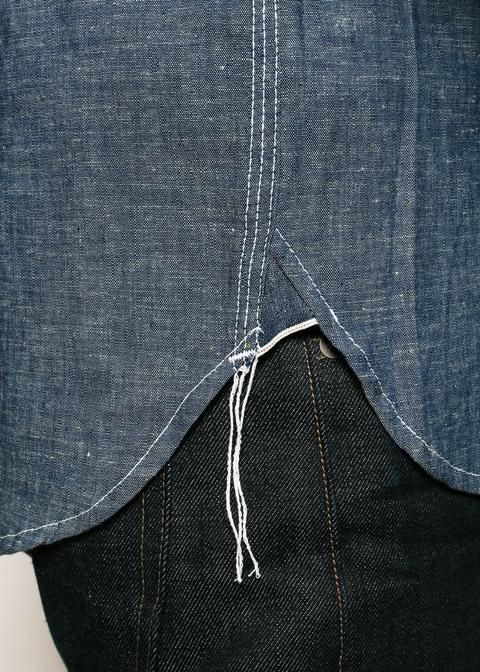
Long ago, work shirts commonly featured certain things: low tension weaves, selvedge striped gussets, cat-eye buttons, and run-off chain-stitching. There are certain well-regarded names in this space — Big Mac, Big Mike, Five Brothers, Big Yank, and Frostproof among them.
One of the best renditions of poetry ever recorded.
Actor Michael Sheen delivers a powerful performance of Dylan Thomas’s 1951 poem, "Do not go gentle into that good night.”
The abandonment depression is first experienced at an age when the young child cannot reflect on it or articulate what is happening.The child simply feels that the flow of life is cruelly disrupted & that he teeters on the verge of annihilation should the vital support of the mother be lost or withheld.
James Masterson
If we are to avoid losing our humanity amid a “paradise of machines” invading and conditioning our daily lives, there is an urgent need for education in ethical discernment and the capacity to acknowledge the moral good. This is indispensable if we are to recognize the genuine good that enables human beings to flourish in accordance with their primordial vocation, with unconditional respect for their interior freedom and their sacred dignity. #ApostolicJourney #France https://t.co/nkLmWIt24k
Session after session, they try to find answers but invariably come up empty. And so we sit in the silence that forms their core, with the muted voice of desire grown too faint to guide them.
— Robin Kirman
Therapy Used to Be Hot
https://t.co/s4vORaRmJM
We are reminded by ancient counsel that we should be aware of getting what we want. Depth psychology echoes this: we could be getting simply what the complex wants, what the unconscious history wants, what the unlived life wants.”~ James Hollis, 𝘛𝘩𝘦 𝘌𝘥𝘦𝘯 𝘗𝘳𝘰𝘫𝘦𝘤𝘵