The man who invented Forward Guidance is with us no more, Alan Greenspan. But, the world had changed. We are no longer using technology just to make corporations more profitable. We are using autonomous efficiency to make human survival more effortless. When money prices itself perfectly, and resource allocation is liberated from political grift and human ego, the true "dividend" of automation is unlocked. That dividend is not a higher stock price. It is time, cognitive freedom, and the fulfillment of the soul. Welcome to an essay on monetary policy, hardware, software, and heartware. Forward Guidance is over. Money will now guide itself.
https://t.co/TwUGrBHDgY
Sergey Brin rarely speaks publicly. He sat down for an unscripted Q&A on Frontier AI.
He admits even the people building these models do not fully understand what they have created:
1. All the specialized AI models are converging into one. Google used to need separate models for different scientific problems. Now the main Gemini models are becoming state-of-the-art for math and other scientific questions at the same time. Brin says he would not have predicted this convergence at the outset, and watching it happen has been incredible.
2. Training an AI on one skill mysteriously improves unrelated skills. This is the concept of transfer. Train a model on coding, and its math reasoning gets better, and vice versa. Teaching it to process images can improve its ability to think through geometric word problems. The capabilities bleed into each other in ways nobody fully engineered.
3. Even Sergey Brin does not know how to prompt these models. He says he is genuinely confused about what level to prompt at. Do you tell it to debug a specific chunk of code, or ask it to write a better neural net training algorithm, or just say, " What should I do today. He admits that even at Google, they do not know exactly where the edges of Gemini's capabilities are.
4. One of the biggest leaps in AI came from the dumbest sounding trick. Chain-of-thought prompting is just telling the model to think step by step before giving your problem. Brin says it seemed like the dumbest thing ever, and there was no obvious reason it should work. But it did, and it spurred a significant increase in AI capability. Some of the most straightforward requests turn out to unlock the most.
5. Brin would not modify his own biology for today's AI. Asked how humans can keep up with the accelerating bandwidth of models, he acknowledged neural links and direct brain connections are being pursued. But he said he would personally wait for the technology to mature a lot before doing anything to change his biology. Today's models do not justify it.
6. Super intelligence does not mean solving the impossible. An audience member argued that true super intelligence would mean solving NP complete problems like the travelling salesman. Brin pushed back. Most computer scientists believe P is not equal to NP, which means no algorithm can reliably solve those problems optimally, and it does not matter how smart the AI is. Impossible stays impossible. Super intelligence just means being smarter than humans.
7. Computers mastering a skill has never stopped humans from pursuing it. Deep Blue beat Kasparov at chess in the 1990s, and people kept playing chess. After AlphaGo, the human game of Go advanced dramatically, and the players who lost to it became vastly better. Brin's point: AI does not retire human ambition in an area; it often pushes the state of the art and pulls people up with it.
8. Brin thinks something close to transformers could get us to AGI. Asked directly if transformers are sufficient, he said his guess is yes, largely because they have proven weirdly flexible, working for image and video far beyond their original text purpose. But he was careful to note they have quietly changed a lot along the way and are not the same architecture as the original transformer paper.
9. AGI means two different things, and one requires understanding the physical world. Brin personally thinks of AGI as AI that can improve itself. But he concedes others define it as AI that can do anything a person can, and he thinks they are probably more correct. To do everything a person can, the AI must understand and interact with the physical world, which is why world models, and robotics, become essential.
10. Inside Google, they now use the AI to build the AI. Brin says the team has shifted a lot of energy toward having the AI do things like monitor training runs and generate its own training data. You start to use the tool to build the tool. That is most of what he spends his time on now, what he calls the self-improvement game.
11. Brin is unusually candid about where Google trails its competitors. He admits Google was a little late to focus deeply on coding. He says Gemini 3.0 and 3.1 were on top across the board six months ago, but other labs have since made strides, particularly in coding. He gives a competitor's model the edge now on deep coding and overnight tasks, while pitching Gemini's flash model as far faster for rapid interactive iteration. hindsight, he says, is that they should have focused on code earlier.
12. He sees his own role as a rabble-rouser, not a manager. Brin is honest that delivering Gemini is Corey and Demis's responsibility, not his. he describes his job as poking and prodding the team, asking, are you really doing that, reminding them of priorities they might be missing and ideas they are not paying enough attention to. He admits this is sometimes a little disruptive.
13. Confidence comes from ignoring the monthly temperature. Brin says if he judged Google's position every month by which competitor just shipped a model, he would lose his confidence very quickly. Instead, he watches the longer arc. Things shift around constantly; one lab leads on one thing, another pulls ahead somewhere else, and he feels good about where Gemini actually is despite the day-to-day noise.
Valar Atomics is working with Nvidia on a conceptual data center that would be powered by a (behind the meter) reactor, and uses almost no water. In many places, water consumption is a significant concern. Article link in reply.
Join me and @AaloAtomics Atomics CEO Matt Loszak at their Critical Test Reactor at Idaho National Lab — the first new reactor built there in 50 years!
Aalo is racing toward criticality by July 4, 2026, America’s 250th birthday.
This isn’t random. It directly answers President Trump’s Executive Order 14301, which launched the DOE Reactor Pilot Program and set the goal of at least three advanced test reactors reaching criticality by Independence Day.
Aalo’s sodium-cooled Aalo-X design (built for AI data centers) is proving that with bold policy and American ingenuity, we can move nuclear from paperwork to power at startup speed.
A DEVELOPER WALKED ON STAGE DRESSED AS A 1973 ENGINEER AND "PREDICTED" THE FUTURE OF PROGRAMMING. THE TWIST: EVERYTHING HE DESCRIBED WAS ALREADY INVENTED 40 YEARS EARLIER AND WE STILL REFUSE TO USE IT.
32 minutes from Bret Victor, doing the most quietly savage talk on our entire industry.
-> The idea that lands: we write code as step-by-step text instructions and call that "Just how programming is". He shows four better ways -- all discovered in the 60s and 70s, all abandoned.
Manipulate the data directly instead of typing blind code. Tell the machine your goal instead of every tiny step. We saw all this, then walked away.
Why? The moment you're sure you know what programming is, you stop seeing anything better. That certainty is the cage.
And now AI is dragging us back to exactly what he begged for -- you describe the goal in plain words, the machine works out the how. The future he mourned is arriving anyway.
You thought text files were just how code works. This is the talk that shows it was a choice, and maybe the wrong one.
Watch this one. It'll ruin how you see your job ↓
Jacob Bank, former Google product lead:
"I built up this team of 40 AI marketing agents to work with me. I'm the only marketing person."
In a 15-minute talk, he shows what one person with the right setup now runs alone.
Forty agents. One human. His AI bill is $500 a month, against the $50,000 a human team would cost.
That's the math quietly minting the first solo fortunes of the AI era.
Watch the talk, then read the piece below.
Bookmark this one.
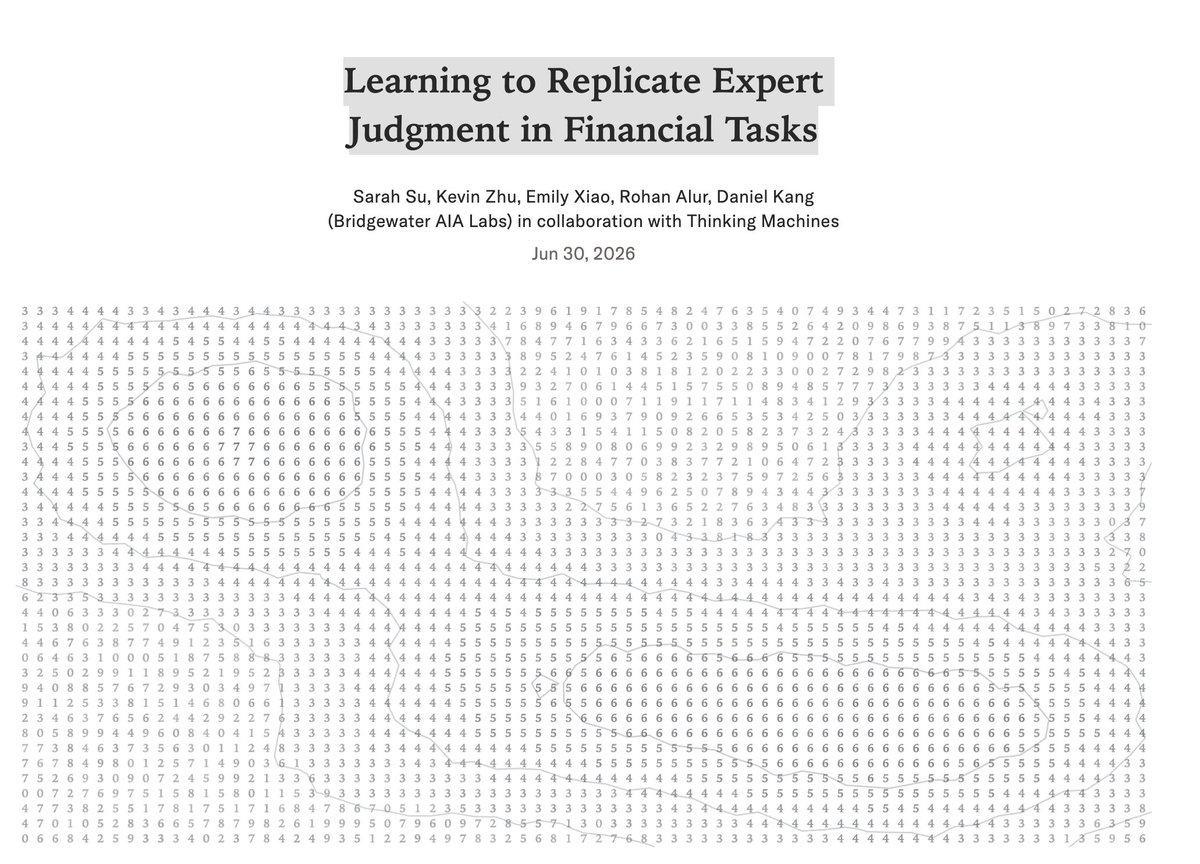
Bridgewater and Thinking Machines just published a blog on training a custom model to replicate expert investor judgment.
The task is filtering financial documents and news for relevance. Sounds trivial. Turns out it's not.
We also announced today that Valar Atomics and NVIDIA are collaborating on a 30MW closed loop end to end AI factory, which consumes no water from the local community.
This is only possible when two technologies come together: waterless power generation and waterless AI cooling.
Today, Valar Atomics became the first nuclear startup to make electricity, and we did it by powering an NVIDIA Spark.
This is the first meeting of advanced nuclear and AI; two technologies which will transform the next century.
But that’s only the start of our collaboration.
BREAKING: @valaratomics is partnering with @nvidia to explore the development of a 30 MW nuclear-powered AI data center in Emery County, Utah, pairing microreactor energy with next-generation cooling designed for near-zero water consumption.
BREAKING: @valaratomics has become the first startup in history to make nuclear electricity, powering an @nvidia Blackwell chip through its Ward 250 nuclear reactor. This marks the first time advanced nuclear power has powered AI.
A fateful dinner party in 1931 has immense relevance for us today as we power into a world where money IS intelligence. Read here about what happened at @marksandspencer and the valuable lessons it still holds for us today.
Technology is forcing us to face a fundamental, structural question: What is the purpose of an economy? It is meant to meet at least our basic human needs, but it should also be able to meet our highest human needs. Intelligent money is going to buy us the most valuable thing of all: time.
If an economy is merely a closed loop of machines generating capital for other machines, it ceases to have any human legitimacy. Heartware is, therefore, an essential part of the shift from managing companies to managing societies.
This is part two of a three-part series about The Federal Reserve and intelligent money. The last is for tomorrow....
https://t.co/jjrMt21zkk
We’ve received notice that the Department of Commerce has lifted export controls on Claude Fable 5 and Mythos 5.
We'll begin restoring access tomorrow, and will share an update soon.
We’re grateful to our users for their patience, and to everyone who worked with us on redeploying the models.
Anthropic will pay you $85,000 to learn AI, and this is the kind of opportunity you don't let pass
It's called Claude Corps. Anthropic just launched it, and it's a 12-month paid fellowship for people at the very start of their careers.
They train you to use Claude from scratch, then place you inside a nonprofit to do real work with it for a year. You get paid $85,000 plus benefits the whole time.
They're basically paying you to master the most in-demand skill on the planet right now, then handing you real-world experience using it.
The barrier to entry is almost nothing. Over 18, less than two years of full-time work experience. No degree, no AI background needed.
If that's you, don't sit on this one.
Apply here: https://t.co/qL6r4FFkZ3
Deadline: July 17
Bookmark this