The Hidden Math Behind Cutting 20 Questions From an Exam
A recent shift in a major medical entrance-style exam from 200 MCQs to 180 MCQs, while keeping the total duration at 3 hours 30 minutes looks like a minor tweak on paper. It isn’t. Here’s what actually changes, statistically, for both candidates and examiners.
Read 🧵 below
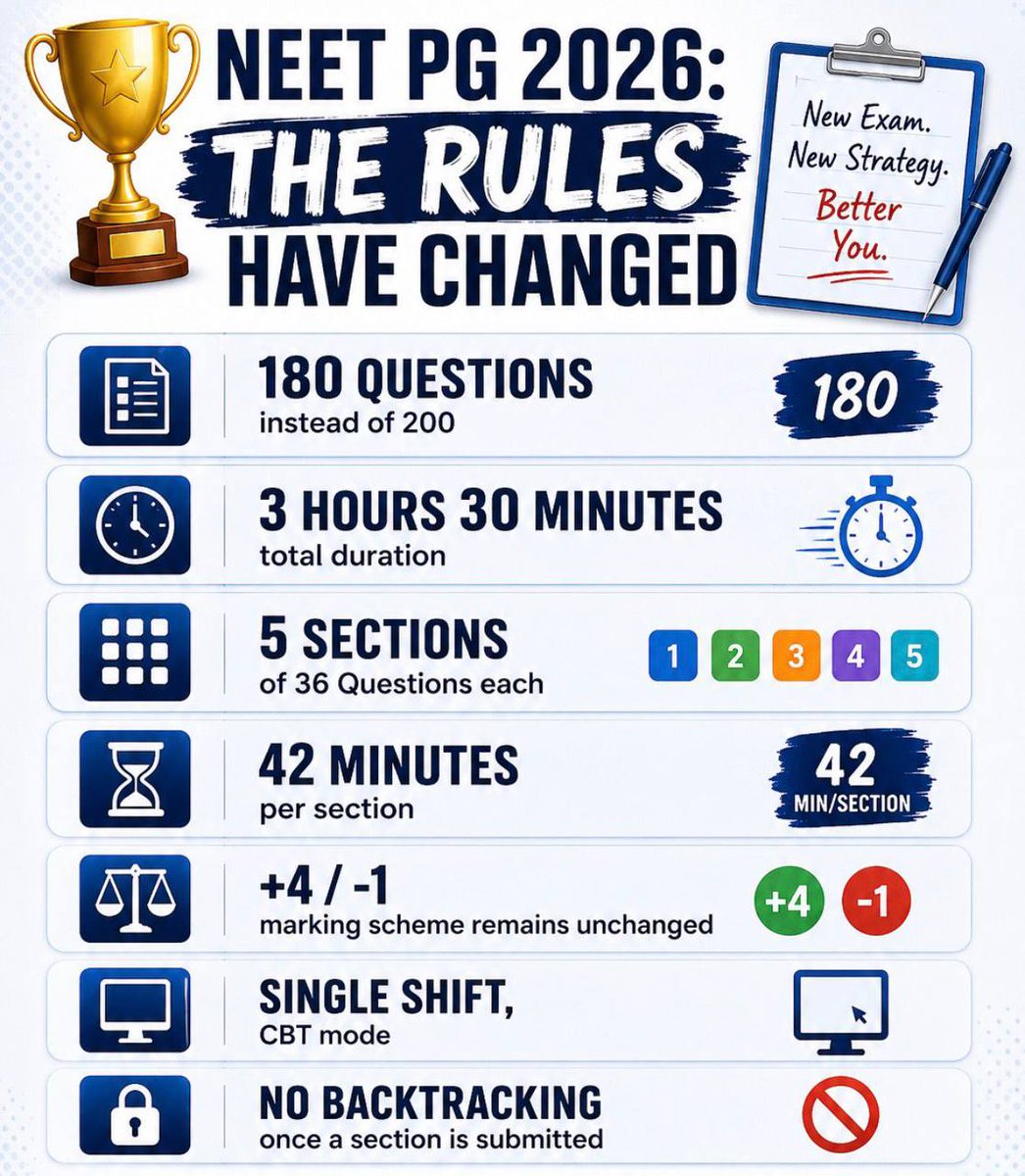
🚨 NEET-PG 2026 Pattern Changed: Here’s what every aspirant must know.
✅ 180 MCQs (instead of 200)
✅ 5 sections of 36 questions each
✅ 42 minutes per section
✅ Total duration: 3 hours 30 minutes
✅ Single shift, Computer-Based Test
✅ +4 for correct, -1 for incorrect, 0 for unattempted
❌ Once a section ends, you cannot go back.
What this means for your preparation:
• Time management is now as important as knowledge.
• Practice 42-minute sectional tests regularly.
• Expect more clinical case-based and “most appropriate answer” questions.
• Stronger focus on clinical reasoning, not just factual recall.
• Prepare for integrated, multi-subject questions and image-based interpretation.
• Learn to make quick decisions—there will be no opportunity to revisit difficult questions later.
My prediction
The overall difficulty level may not increase dramatically, but the quality of questions is likely to improve. I would expect:
20–25% direct recall questions
50–60% clinical application questions
15–20% integrated multi-subject questions
5–10% image/video or data-based interpretation questions
The old preparation strategy may no longer be enough. Adapt early, because this pattern will reward concepts, speed, accuracy, and smart decision-making—not just memory.
#NEETPG2026 #NEETPG #NBEMS #MedicalEducation #MedicalStudents #MBBS #DoctorsOfIndia
A highly prestigious honour for a great of the game 🙌
President of India, Smt Droupadi Murmuji @rashtrapatibhvn confers former #TeamIndia captain Rohit Sharma @ImRo45 with the Padma Shri award 👏
Glycogen Storage Diseases.
You were once a NEET/JEE topper, now struggling again for NEET PG.
So, mnemonic is the same.
Voh Physics Chemistry Aur Maths main Hoshiar Tha
Voh. Von Gierke (I)
Physics Pompe’s (II)
Chemistry Cori (III)
Aur Anderson (IV)
Maths main Mccardle (V)
Hoshiar Hers (VI)
Tha. Tarui (VII)
Mnemonic doesn’t end here.
Von gierke is first - affects the last enzyme of gycogenolysis - Glucose 6 P04tase (glucose 6 phosphate to glucose - last enzyme)
P for pompe, p for pediatric - children have good hearts - affects heart.
C for Cori. After C comes D - Debranching enzyme is absent.
A - Anderson - after A comes B - branching enzyme is absent.
M for Mccrdle , m for muscle phosphorylase.
H for Her, H for hepatic Phosphorylase.
Previous Year Questions (PYQs) are one of the most important parts of NEET PG and INI-CET preparation but many students are confused about the right way to solve them
Here are a few suggestions👇
IV Labetalol ➡️ Emergency Doses👇
➡️ General Hypertensive Emergency
• 20 mg IV over 2 min
• Then 20–80 mg every 10 min
• Max: 300 mg
• Infusion: 0.5–2 mg/min
➡️ Intracerebral Hemorrhage / Hemorrhagic Stroke
• 10–20 mg IV over 1–2 min
• Repeat or start infusion if needed
Ischemic Stroke (when BP lowering indicated)
• 10–20 mg IV over 1–2 min
• May repeat once
➡️ Severe Pre-eclampsia / Eclampsia
• 20 mg IV
• Then 40 mg after 10 min
• Then 80 mg every 10 min if BP remains high
• Max: 220–300 mg
➡️ Aortic Dissection
• 20 mg IV bolus
• Then infusion 0.5–2 mg/min
• Goal HR <60/min before vasodilators
➡️ Hypertensive Emergency with AKI
• 20 mg IV over 2 min
• Then 20–80 mg every 10 min
• Or infusion 0.5–2 mg/min
➡️ Avoid / Use cautiously in:
• Asthma or active bronchospasm
• Bradycardia
• Heart block
• Acute decompensated heart failure