Over the past week, I’ve been overwhelmed by the love and support of friends, industry colleagues, and people I've never met. Thank you to everyone who has shown kindness to my family and me. It means the world to me.
I came to the United States 53 years ago, and becoming an American citizen is one of the greatest gifts and proudest moments of my life. NVIDIA has been my life’s work. Building it into the company it is today alongside my colleagues has been a privilege and an honor. Nowhere but in America could a company like NVIDIA be possible. I love our country, and I love NVIDIA.
I did not live up to the standards expected of everyone at NVIDIA, and I have made serious mistakes in my personal life. I created problems for the Board that I deeply regret. I own my mistakes completely, and I am committed to cooperating with the Board’s independent investigation.
Since my departure, I’ve seen an outpouring of calls from NVIDIA’s employees, investors, business partners, and customers for me to return as CEO. Many continue to reach out to me directly as the company navigates complex technology, market, competitive, and geopolitical dynamics. NVIDIA is a once-in-a-generation company. If the Board of Directors decides that my return is in the best interest of our shareholders, our employees, the company, and America, I would be honored to answer these calls and return as CEO.
Thank you again to everyone who has shared their good wishes. I am profoundly humbled by your support. To my family: I love you, and I will spend the rest of my life being worthy of yours.
Jensen
Published my interaction lab so you can play with it and get some inspiration from it!
It contains the interactions I like the most, will share more of them soon, stay tuned.
https://t.co/FuBuFgqqht
As can be seen, the Binance hacker carefully routed their funds to different @THORChain vaults in case their money was frozen, and nothing happened; their money landed on the other end.
https://t.co/FkqVq0OjBx
Binance hack: where the money stands 🔎
Octav’s Oct 29, 23:48 UTC snapshot:
• $5.97B drained across 9 chains
• $2.58B frozen (43%)
• $717M converted into ETH/TRX
• $2.67B neither frozen nor converted
The key question: where does the movable money go next - and we are watching!
New to Humanbased? Let’s show you around.
See how agent builders commission data and domain experts contribute, in one minutes.
What should we unpack next: launching a campaign or contributing to one?
Get started at:https://t.co/0Sva5FSG4R
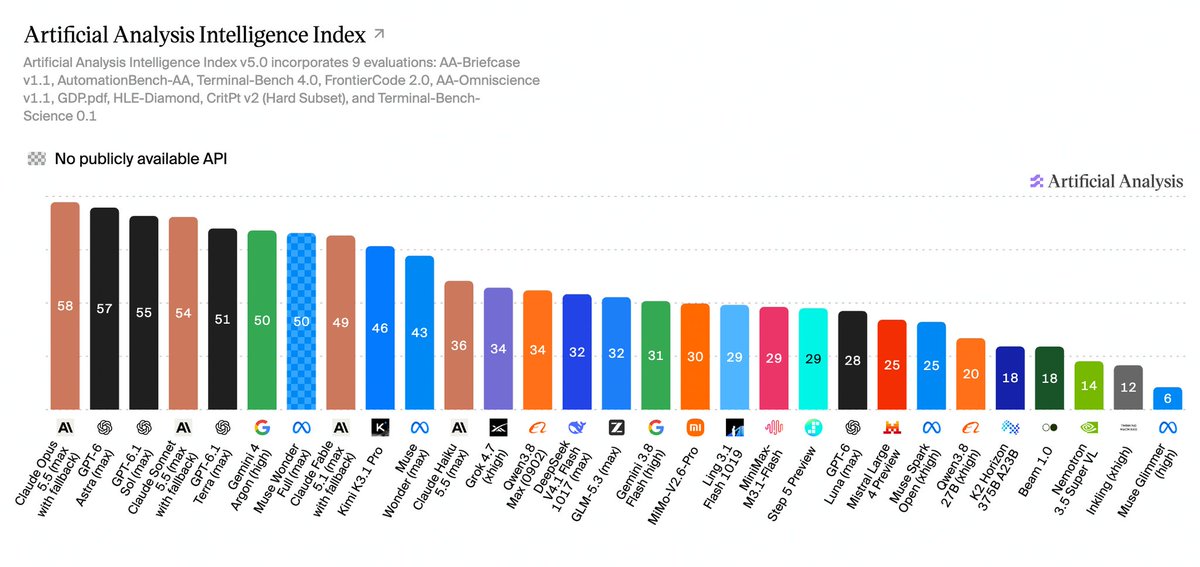
Announcing Artificial Analysis Intelligence Index v5, featuring 2 new benchmarks and 3 upgrades. For the first time, the majority of the Index is built on private datasets
The Artificial Analysis Intelligence Index is our composite measure of model capabilities across tasks reflecting real-world usage today. v5 is our biggest upgrade since v4 launched in January. With v5, 60% of the Index is now based on evaluations with private test sets or held-out answers.
Alongside Intelligence Index v5, we’re launching the Artificial Analysis Progress Index v1, which tracks model capability over time on one continuous scale.
New to the Intelligence Index:
➤ FrontierCode 2.0: Cognition's newly-launched private benchmark of real-world coding tasks, graded on whether a repository maintainer would merge the agent's change
➤ Terminal-Bench-Science: 70 agentic scientific research tasks, run in a terminal environment
Upgraded:
➤ HLE-Diamond (replacing Humanity's Last Exam): a refined 1,000-question version of Humanity's Last Exam, split evenly between reasoning and knowledge questions
➤ AA-Omniscience v1.1: An updated dataset with saturated and public set questions removed, new questions added, and ambiguous or erroneous questions revised
➤ CritPt v2: a private, 40-question hard subset of CritPt v2, revised by the CritPt authors and run with a code-execution tool
Staying in the Index: AA-Briefcase, AutomationBench-AA, GDP.pdf and Terminal-Bench 4.0
Removed from the Index: GDPval-AA v2.1, SciCode, and AA-LCR v1.1
Key results:
➤ Claude Opus 5.5 (max) leads at 58, ahead of GPT-6 Astra (max, 57) and GPT-6.1 Sol (max, 55): Anthropic and OpenAI hold the top five models. Gemini 4 Argon (high) is next at 50
➤ The open weights gap widens from 3 points to 12: Kimi K3.1 Pro (weights not yet released) is the top open weights model at 46. Among released weights, DeepSeek V4.1 Flash 1017 (max) and GLM-5.3 (max) lead at 32 - 26 points behind the leader and below Claude Haiku 5.5 (max, 36)
➤ Cost per task varies by more than 13x among the leading models: of the 10 highest-scoring models shown, GPT-6.1 Terra (max) is the cheapest at $0.96 per Intelligence Index task and Claude Fable 5.1 (max) the most expensive at $13.04
"Agentic World Action Models"
What if robots could write their own code to plan actions, while also predicting how the physical world will respond?
NVIDIA's new AW-0 combines three capabilities in one model: generating reusable skill programs, predicting future video frames, and producing robot actions. All three are generated together, which enables code-based planning to guide physical execution.
On RoboTwin 2.0, AW-0 achieves 50.7% average success, compared to 41.3% for π0.5. Across eight real-world manipulation tasks, it scores 71.1% vs 46.0% for the strongest baseline, including tasks like folding towels and solving a Rubik's Cube.
https://t.co/Ly71CUYskG
Made a skill for dimensional drawings of UI components.
Inspired by Apple's accessory drawings, it documents a component's architecture into a spec sheet.
https://t.co/KKb9sOgTN8
About 2 years ago, we launched a mini project called https://t.co/Nq2OcW6kVi - a curated library of A/B test results from best-in-class apps like Uber, Duolingo, and Headspace.
It was our first attempt at answering questions we constantly ask when browsing references on @mobbin:
“Why did they choose this design pattern?”
“Does this pattern actually perform better?”
We wanted to go one step further and surface the real-world data and reasoning behind those design decisions.
Since launch, the site has amassed 600k+ page views, and it’s been cool seeing folks organically share it with the design community 🫶
We’re planning to add more tests over time, and if you’d like to contribute and help grow the library, DM me or fill out the form below 👇
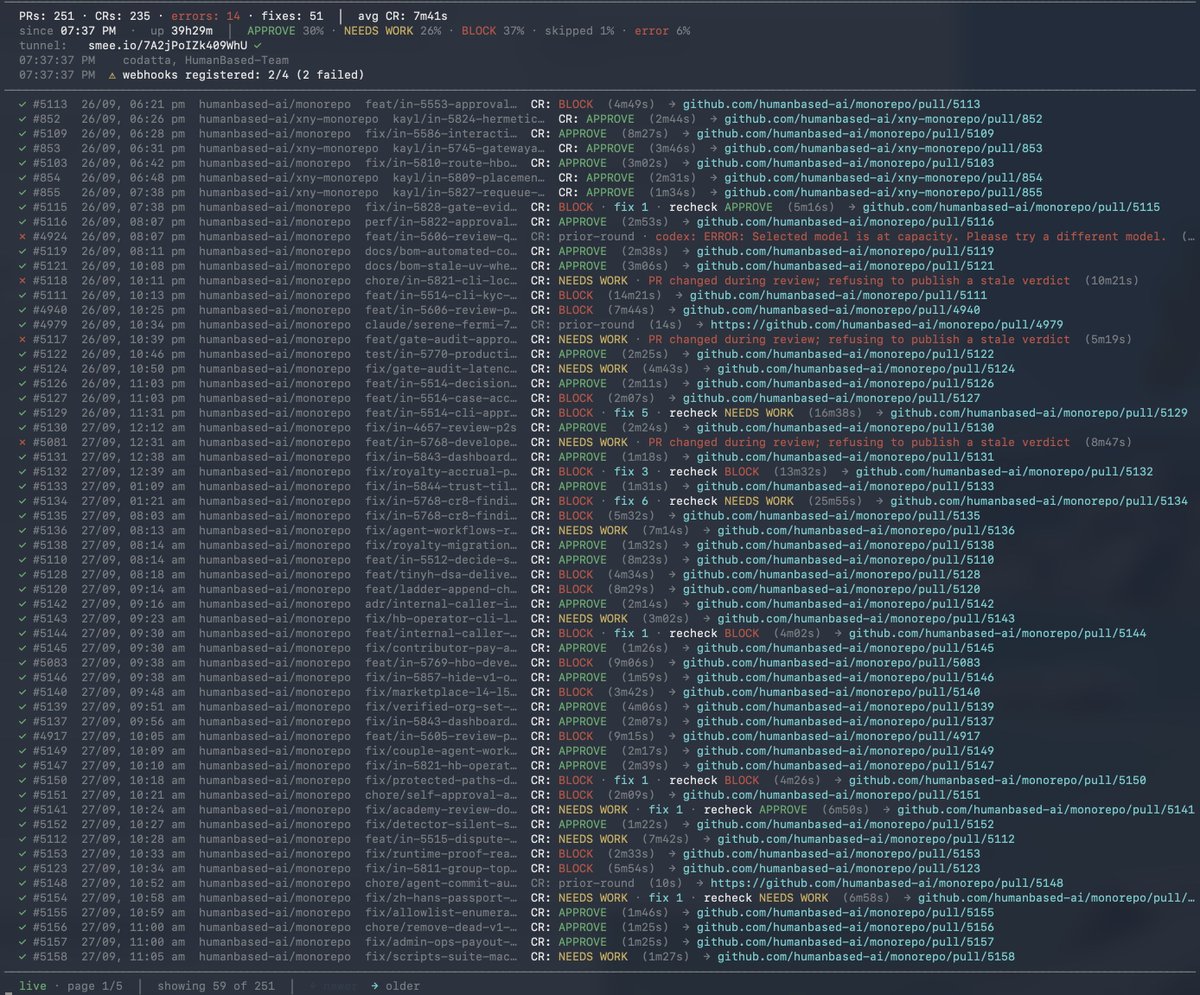
appreciate that the little guy, which frees us from tedious handling of CR process. `crosscheck watch` turned on, move PRs contributed to our monorepo(s) to APPROVE quitely. the nice part is that more issues can be captured via cross-model model (e.g. Claude authroed, Codex review).
I am curious that, how guys handle Code Review when coding agents are the primary driver writing codes for you.
One of my recent favorite AI use cases: asking it to try and break the stuff I built. Adding lots of data, long names, unusual emails, labels, etc. Coming up with worst case scenario basically.
This is a vibe-coded demo, but you get the idea.
We’re launching tldraw flash, a new way to animate hand‑drawn ideas on the infinite canvas.
Draw a shape, press record, then drag to perform the motion. Trim clips on the timeline, export, and remix.
I love learning by reverse engineering something that I think looks amazing and trying to make it myself.
Made a cute avatar based on @bot made and explored some fun states.