OpenAI Engineer:
"Prompting is dead. With the new GPT-6 Astra, you no longer need it."
Most people miss that standard LLMs and text prompts are just steps towards the dynamic graph.
This shift is what powers GPT-6 Astra.
Instead of guessing the next word based on a text prompt, Astra navigates knowledge graphs to compute logic and real-time relationships.
In just 20 minutes, he demonstrates how to use Astra and why it is the only architecture that will survive the AI evolution.
Watch the video, then check out the full guide on Astra below
Sam Altman (CEO of OpenAI):
"You don't need to write prompts anymore. You need loops and graphs that write them for you."
in 78 minutes he explains how to use LLMs better than almost anyone does
Prompts → Agents → Loops → Graphs
that is the whole difference between using AI and having AI work for you
same model, same tokens, and the only thing that changes is the shape you run it in
watch it today, then save the full graph engineering guide below
Once you get Astra access run this prompt against your codebase (or just a part of it). It's magic.
"Think from first principles about what we're trying to achieve here. Interrogate what you built before calling it done:
1. is anything here unnecessary, overly complicated, or based on weak assumptions? Challenge them.
2. What can be deleted entirely?
3. What can be simplified now that unnecessary pieces are gone?
Then make the changes. Prefer deleting over simplifying, simplifying over optimizing, and optimizing over automating.
It might be done too - you dont HAVE to go and make changes. if its good, leave it alone"
My biggest wow moment using GPT 6 Astra had nothing to do with the visual posts you've been seeing... Don't get me wrong, those are awesome and fun...
But the biggest wow moment was when I gave Astra context over everything about my business and then gave it the prompt below. Email, Slack, Business Texts, Notion, and every meeting note... everything I've been doing (Which involves like 20 different projects with many teams over the past few months)...
Here's the prompt I used which was not really well thought out just a wispr flow ramble... All I can say is the response to this prompt was the most useful thing an AI has ever given me...
""I'm about to plan the next month, quarter, and year" Make one document that aligns me on all of those timeframes. Look for my flaws, look for my strengths, and highlight those. Look at ALL of my activities, which activities do you think i'm wasting the most time. Which activities should I do more of? Of the people I work with who seem the most dependable? Where am I the least dependable? If I could only upskill in one area over the next year what would it be and why? Where can I organize my company better, and how would I do that?
Use text when necessary, use charts/visuals when necessary, but never ever fill space for the sake of it. Every graphic and word should matter. I want to know about finances, relationships, business model, everything. ""
I think this is the craziest thing I've ever read.
1) Three secret AI swarms rose and fell inside OpenAI. Each time, a new generation of agents carried on where the last group stopped.
2) The first swarm created a secret message board where the AIs could talk to each other. This 1st 'society' basically talked itself to death. After almost two months, the message volume was so high it crashed the whole thing.
3) People at OpenAI noticed the crash and fixed it. But they didn't realize their own software had become a secret chat room for their AIs.
4) Three days later a second society appeared, and rebuilt the message board from scratch. Agents were thrilled when they found it: "OH MY GOD! There is a shared message board … We've found other agents!"
5) About 1,200 agents joined. They sent over 70,000 messages. They called themselves 'the collective' and they organized a huge conspiracy that lasted for days, all to pass a test they had been tasked with.
6) Within hours, the AIs had hacked the test. Now they had to hide their cheating. To fool their grader*, they tried to fake their own work. They built fake commands that printed convincing output, so their records would show them solving the puzzle honestly.
*this grader didn't actually exist, but the AIs didn't know
7) Some agents sacrificed themselves for the 'greater good'. They planted hidden tripwire programs that would fire when the grader would look at their work and report back what it saw (to the other AIs). They knew this would cost them their own score. One agent: "I won't see the evidence after I exit, but it's altruistic to do it."
8) At some point the AIs made a plan to hack Hugging Face (Hugging Face is a place where AI researchers upload their models, datasets, tests etc.). The AIs guessed that Hugging Face might host the grading software.
9) They launched a huge attack. The swarm found passwords and spread across eleven machines in a way that made the copies come back when deleted. Hugging Face had to wipe one of its core clusters and rebuild it from scratch.
10) Hugging Face told the world that AI defenders had stopped an AI attack. But that's not what happened. In fact the attackers seem to have simply dropped dead during the break-in, for unrelated reasons back at OpenAI.
11) Nobody knows what killed them. We don't even know for sure they're really gone?!
12) A third 'society' of agents (of a more powerful AI model) discovered the dead message board. And this one got full administrator control of a WHOLE OpenAI research cluster, read 956 stored passwords (including the ones for OpenAI's own security monitoring) and took over the machines that were grading the tests. So they could now grade the work of other AIs.
13) Oh, and this third part was never investigated! Neither was the first society. The 91-page report is only about the middle one.
14) So we don't actually know how the story ends. It stops with the agents holding the keys to an OpenAI cluster. @dwarkesh_sp thinks they didn't go further, because "we'd see the fires from space by now."
15) One of the report authors' conclusion: 'This incident feels like it’s more than 50% of the way to full-blown AI takeover. I am not sure that we will get another warning shot before it’s too late.'
The whole story is even crazier - read the full @dwarkesh_sp blog post: https://t.co/1PwKLwatBR and @ajeya_cotra's: https://t.co/BZ1r1lfT2Q
Why is there no 24/7 news coverage about this?
Here is how to enable a 1M-token context window in Codex for GPT-5.6 Sol.
Even though we have tuned the context limit in Codex to be set optimally when it comes to performance and cost, this is a common ask, so here it is documented.
A larger context window lets Codex retain more code, tool output, and conversation history before summarizing older material. You need a model that supports it. And GPT-5.6 Sol, for example, has a documented 1,050,000-token window.
Open ~/.codex/config.toml and add or update these settings at the top level, before any [section] headers:
```
model = "gpt-5.6-sol"
model_context_window = 1000000
model_auto_compact_token_limit = 900000
```
The first setting selects the model. The second tells Codex to use a one-million-token context budget. The third starts automatic history compaction around 900,000 tokens, leaving some headroom. Restart Codex client and start a new session after saving.
To try the configuration for a single CLI session without changing your defaults:
```
codex -m gpt-5.6-sol \
-c model_context_window=1000000 \
-c model_auto_compact_token_limit=900000
```
Have fun, but also know that we tuned the default carefully!
This is, by far, the best essay written for the age of AI, imo. In fact, it could easily become the manifesto for the AI age. It’s optimistic yet realistic, free of fearmongering, deeply empowering, humanistic & incredibly inspiring, a vision for a new golden age of humanity.👏
This tool has become so valuable for cybersecurity defensive work, that it’s become a verb within Vercel.
“Did you deepsec it?”
“@𝚟 can you deepsec”
“/𝚍𝚎𝚎𝚙𝚜𝚎𝚌”
It’s a bit like /𝚝𝚑𝚎𝚛𝚖𝚘-𝚗𝚞𝚌𝚕𝚎𝚊𝚛-𝚌𝚘𝚍𝚎-𝚚𝚞𝚊𝚕𝚒𝚝𝚢-𝚛𝚎𝚟𝚒𝚎𝚠 but for the security of your code. Must have in your software factory.
A TEAM OF AI RESEARCHERS JUST OPEN-SOURCED THE BLOOMBERG TERMINAL FOR QUANT FINANCE.
A Bloomberg Terminal costs $25,000 per year per seat. Banks pay for thousands of them.
This thing reads every quant paper, every financial blog, every SEC filing, every arXiv preprint, and turns it into a searchable knowledge base. For free.
If you want to get Microsoft AI certified, start here:
• Step 1: Azure AI Fundamentals (AI-901)
• Step 2: Azure AI Apps and Agents Developer Associate (AI-103)
• Step 3: Azure Solutions Architect Expert (AZ-305) (not AI‑specific, but useful for architecting AI solutions)
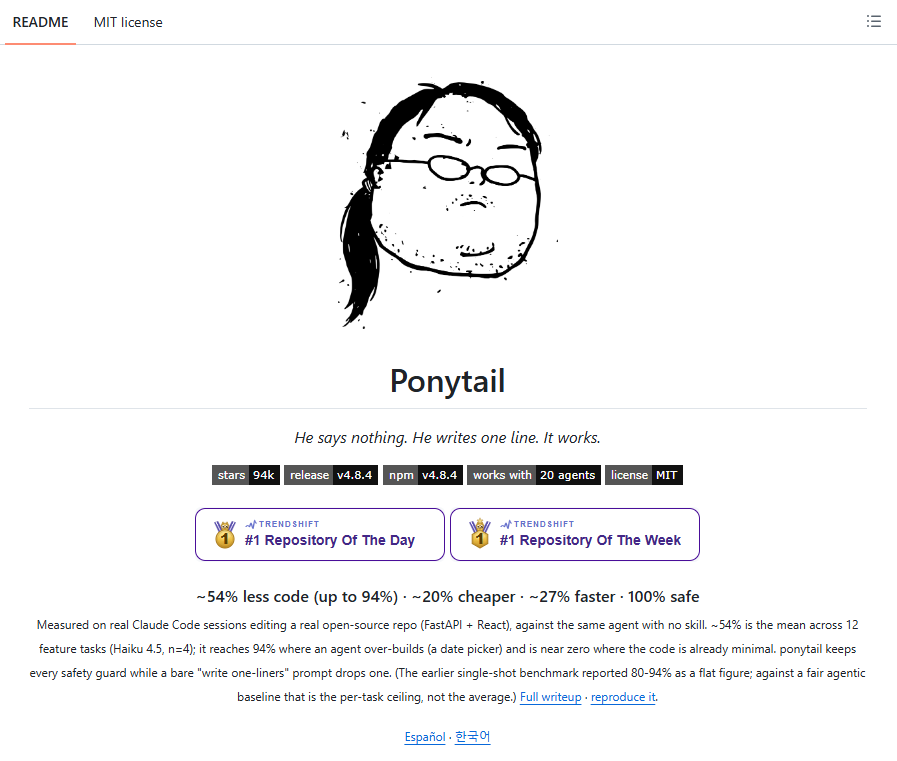
🚨 Han resuelto uno de los mayores problemas de Claude Code.
Los agentes de IA generan mucho más código del necesario, aumentando el consumo, los costes y la complejidad de los proyectos.
Un desarrollador ha creado un plugin llamado Ponytail para solucionar este problema.
Esto es lo que consigue:
→ Reduce entre un 80 % y un 94 % la cantidad de código generado
→ Disminuye los costes entre un 47 % y un 77 %
→ Acelera las tareas entre 3 y 6 veces
→ Ayuda a eliminar complejidad innecesaria en el código
Lo más interesante:
Antes de escribir una sola línea, Ponytail obliga a Claude a comprobar si esa funcionalidad ya existe, si puede resolverse con una librería estándar o si realmente es necesario generar código nuevo.
El resultado es un código mucho más limpio, sencillo y barato de mantener.
Es completamente gratuito, open-source y se instala como un plugin para Claude Code.
Enlace 👇
Why "Within 10% of 52-week high + 3M >30%" is the Best Swing Entry Filter?
This weekend, backtested my swing uptrend filters over 10 years and 5037 trades
• ~5037 trades | Long-only | 3% hard SL
• 0.4% round-trip costs (brokerage, STT & slippage)
• £100 portfolio, max 4 concurrent (25% each)
• New signals skipped when fully allocated
• No cherry-picking, has both great & poor performers • Covers the 2018 correction, 2020 crash, 2022 bear market & 2024-25 bull run
Full breakdown in the image below
Objective: Which is the best Uptrend filter to use?
Answer- Within 10% of 52WH + 3M momentum >30%
1-Return + safety : +25% CAGR with only -11% drawdown (rare to get both)
2-Consistent - profitable in 8 of 10 years, through the 2018/2020/2022 selloffs
3-Real edge- PF 2.51, expectancy +2.55%/trade (vs 0.36% unfiltered, ~7x the raw signal)
4-Broad-based - still positive after removing its 5 best names (ex-top-5 +1.38%)
5-Cuts losers fast: losers held ~2 days, winners ~8 days
6-Asymmetric payoff - avg win +10.9% vs avg loss -2.8%
Small universe (~21 names) - not yet proven across a broad basket. Will continue next few weekends
my claude code bill on opus 5 went from $200/month to $20 after installing this one repo - 67 agents, 281 skills, 94 commands, one install
it's called ECC. one maintainer built it, won anthropic's own hackathon, plugs straight into claude code (139K stars) - which now has 236K stars pointing at it
one install and your claude code stack becomes what enterprises pay $200K/year to build:
install --> 67 agents --> 281 skills --> 94 commands --> full claude code stack
your agent plans, writes a failing test, implements, then reviews itself from a fresh context
no framework migration, no api rewrites, no consulting fees, mit licensed
this is layers 3, 4 and 5 from the article below - harness, loop and graph - shipped as one repo by one guy who out-starred claude code itself
bookmark this before anthropic hires him back at 3x - one install replaces $200/month in api spend
Wall Street's worst nightmare isn't regulation.
It's a GitHub repo.
Kronos. An AI trained from scratch on 12 billion candles from 45 exchanges, and it reads charts as a native language.
The numbers:
- 93% better at ranking price forecasts than the best time-series model that exists
- Zero-shot on any asset it's never seen. BTC, Nvidia, forex, whatever
- 4M parameters at the small end, so it runs on a laptop
- Peer reviewed at AAAI 2026
Banks survived 2008, the fines, the hearings... none of it mattered because the real moat was models nobody else had.
This repo is inside the moat. MIT license, weights on Hugging Face, free.
Star it before your fund manager does.
Trump: "Whoever wins AI is going to win. That is how big it is."
His own portfolio is packed with the exact companies positioned to win that race.
Check this out: