How Much Exercise Is Enough to Live Longer?
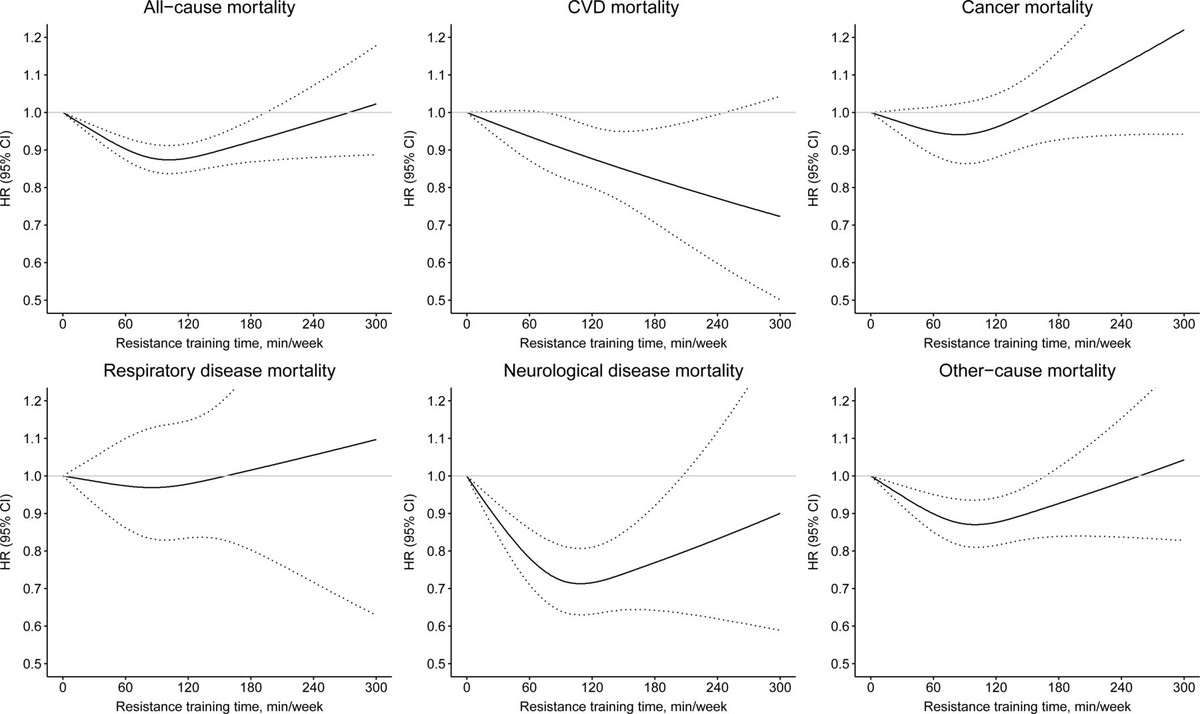
A major new study following 147,000+ adults for up to 30 years found that both strength training and aerobic exercise are linked to lower risks of death from all causes, cardiovascular disease, and some cancers.
✅The sweet spot for strength training is 90–120 minutes per week (about 15–20 minutes/day or 2–3 gym sessions/week).
At this level, compared with doing none, people had:
🔸13% lower risk of death from any cause
🔸19% lower risk of cardiovascular death
🔸27% lower risk of death from neurological diseases.
▶️More is not always better.
Benefits appeared to plateau beyond ~120 minutes/week of strength training, with little additional reduction in mortality risk.
▶️Aerobic exercise remains crucial.
🔸The greatest longevity benefits were seen in people who combined regular aerobic activity (walking, jogging, cycling or swimming) with strength training.
🔸Those who did both had up to 45–58% lower mortality risk compared with inactive individuals.
✅Practical prescription for adults:
🔸Aerobic exercise: 150–300 min/week of moderate intensity
🔸Strength training: 90–120 min/week, spread over 2–3 sessions
🔸Include exercises for all major muscle groups.
Sharing my experiences of running
I started regularly running in November 2020 (in the 50th year of my life). This is my 6th year as a runner. During this period, I have run more than 1000 10k runs and more than 150 half marathons.
Running has resulted in several health-related benefits. Notable ones among them include about 30 Kg weight loss (I weighed about 100 Kg before I started running) and reduction in resting heart rate to 40-45 bpm (from 70-75 bpm).
In this post, I will share my experiences (as well as my learning from published research studies) about running. Like, share, re-post, bookmark this post. Post your comments and queries below.
1/n
@semeonfrank@Doctors_GUILD THANKS DOC...what about hepatitis B infection spreading through saliva ? Significant risk ? Or moderate risk or its simply theaterical? Kindly reply, sir
@Madihealth2026@Doctors_GUILD THANKS DOC...what about hepatitis B infection spreading through saliva ? Significant risk ? Or moderate risk or its simply theaterical? Kindly reply, sir
@Chiragrx07@Doctors_GUILD THANKS DOC...what about hepatitis B infection spreading through saliva ? Significant risk ? Or moderate risk or its simply theaterical? Kindly reply, sir
@martzizannaki@Doctors_GUILD THANKS DOC...what about hepatitis B infection spreading through saliva ? Significant risk ? Or moderate risk or its simply theaterical? Kindly reply, sir
@drpankajroyal@Doctors_GUILD THANKS DOC...what about hepatitis B infection spreading through saliva ? Significant risk ? Or moderate risk or its simply theaterical? Kindly reply, sir
@PharmXOAB@Doctors_GUILD THANKS DOC...what about hepatitis B infection spreading through saliva ? Significant risk ? Or moderate risk or its simply theaterical? Kindly reply, sir
@Doctors_GUILD THANKS DOC...what about hepatitis B infection spreading through saliva ? Significant risk ? Or moderate risk or its simply theaterical? Kindly reply, sir
If you want healthy knees at 60,
you must train the muscles that protect them at 30.
Most people walk for fitness.
But walking alone doesn’t fully train the muscles that stabilize your knees.
Add these 5 exercises.
Just 15 minutes, 2–3× per week can make a big difference.
1) Copenhagen plank
Strengthens the adductors (inner thigh) critical for keeping the knee from collapsing inward.
2) Lateral lunges
Build inner thigh + hip strength and improve side-to-side stability.
3) Side-lying leg raises
Targets the glute medius, one of the most important knee stabilizers.
4) Glute bridges
Strengthens glutes and posterior chain, reducing knee load during walking and climbing.
5) Step-downs or squats
Improves knee tracking and joint control under load.
Total time: 15 minutes
Frequency: 2–3× per week
Small investment.
Huge protection for your knees.
Strong muscles protect joints.
Weak muscles overload them.
The smartest students at Harvard and Stanford aren't smarter than you.
They just stopped studying the way that feels good and started studying the way the brain actually works.
10 techniques their professors actually teach: