🚀 Excited to announce our new survey on Retrieval-Augmented Generation with Graphs (GraphRAG)!
How do graphs transform Retrieval-Augmented Generation(RAG)? By encoding relational and domain knowledge, GraphRAG is unlocking new possibilities across real-world applications! 🌐
📢Call for Papers: LLM for E-Commerce Workshop @ WWW'25 📅April 28-29, 2025 | Sydney, Australia 🌍
Explore how LLMs are transforming e-commerce: foundations, applications & systems.
📝Submit: https://t.co/aefgXj58W8 (by Jan 26, 2025 AoE)
👉Details: https://t.co/FYgm0suUrv
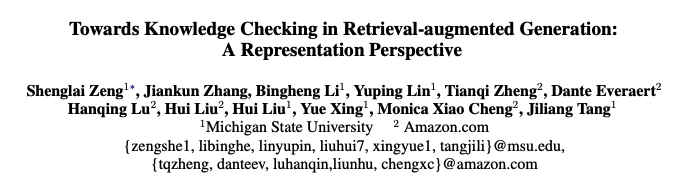
🎯 Detect & Filter RAG Contexts with LLM Representations
Excited to share our work on Representation-based knowledge checking in #RAG! https://t.co/DWgSLprITV
We show how LLM representations detect & filter misleading/unhelpful knowledge and improve performance.
✨ Excited to share our new preprint "Towards Understanding Jailbreak Attacks in LLMs: A Representation Space Analysis"! https://t.co/Qg7cfS7Dda
🔍 We delve into why some jailbreak attacks succeed by exploring harmful and harmless prompts in the LLM's representation space.
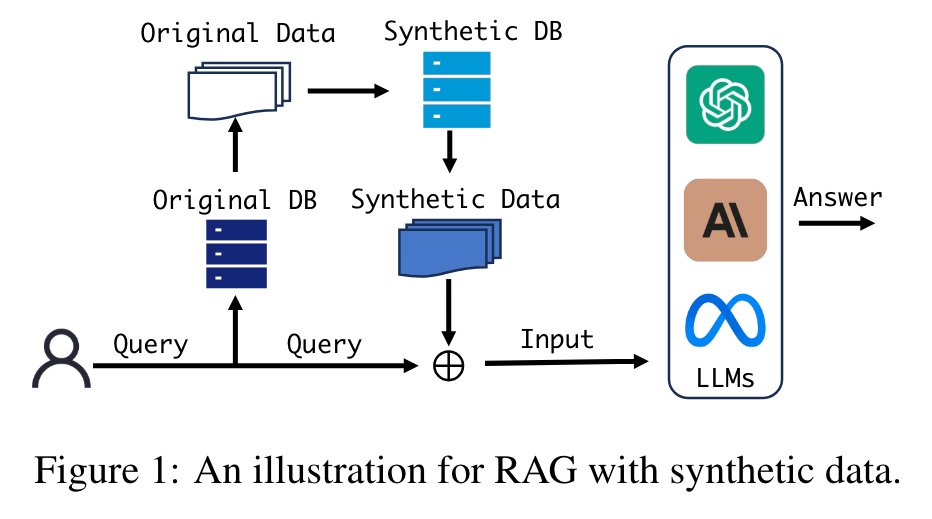
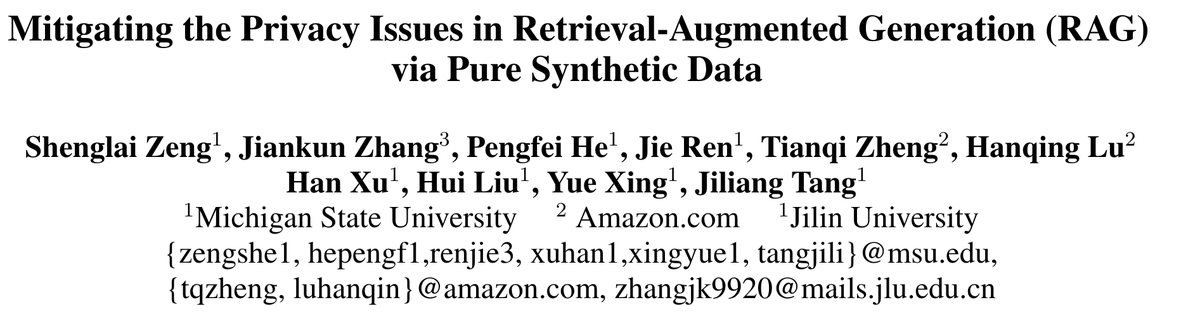
🚀 Excited to share our latest research on enhancing privacy in RAG systems! https://t.co/MSy5aj4IPE
Our paper introduces SAGE, a novel approach using synthetic data to protect sensitive information while maintaining high utility.
#AI#Privacy#MachineLearning#RAG#DataSecurity
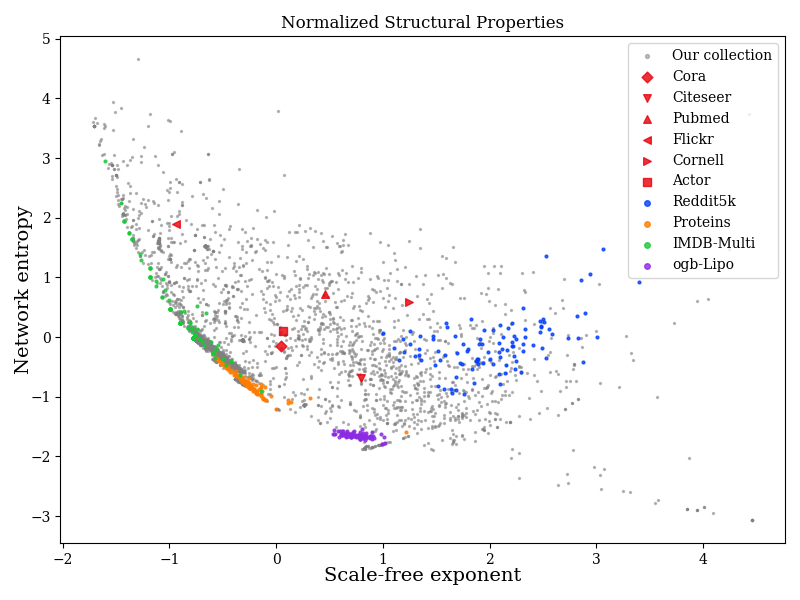
🙋♂️What is the wildest dream for graph foundation models?
🎯Graph across domains → a single model → all the downstream
🙋♀️Can we achieve that?
✅Yes! UniAug: Cross-Domain Graph Data Scaling with Diffusion Models
📃https://t.co/ofHT6Dus4C
https://t.co/bowIRXBTOo "A Data Generation Perspective to the Mechanism of In-Context Learning". We investigate the mechanism of In-context learning which helps ground debate on whether LLM can achieve intelligence to whether LLM can learn new data generation function in context
Exciting News! Our new paper on memorization in text-to-image diffusion is now available. We delve into the understanding of memorization via attention, and throw a light on the internal model behavior when memorization happens. Please find our paper at https://t.co/BEZ9EXfM2X
Our paper for LLM watermark is accepeted by NAACL findings! We proposed a new method to strengthen the robustness of watermark agains paraphrase using the semantics. This is very meaningful factor for the practical application! Please find the paper at https://t.co/P8y3duN5Lk
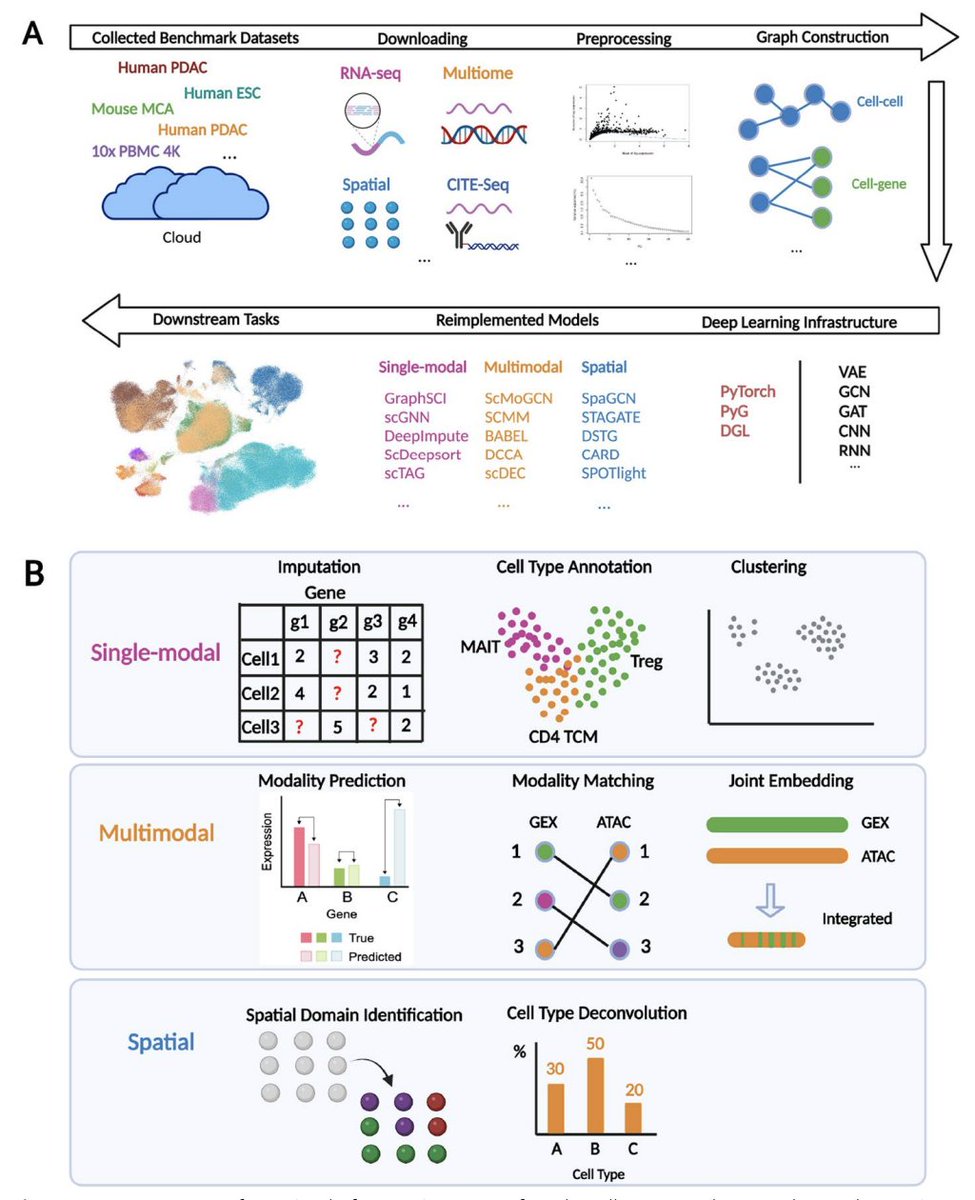
Exciting News! Our DANCE version 1, "DANCE: a deep learning library and benchmark platform for single-cell analysis" is now finally published in Genome Biology (@GenomeBiology ) 🎉 !!!
DANCE has impacted the field, and got 290+ GitHub stars 🌟 before its official publication!
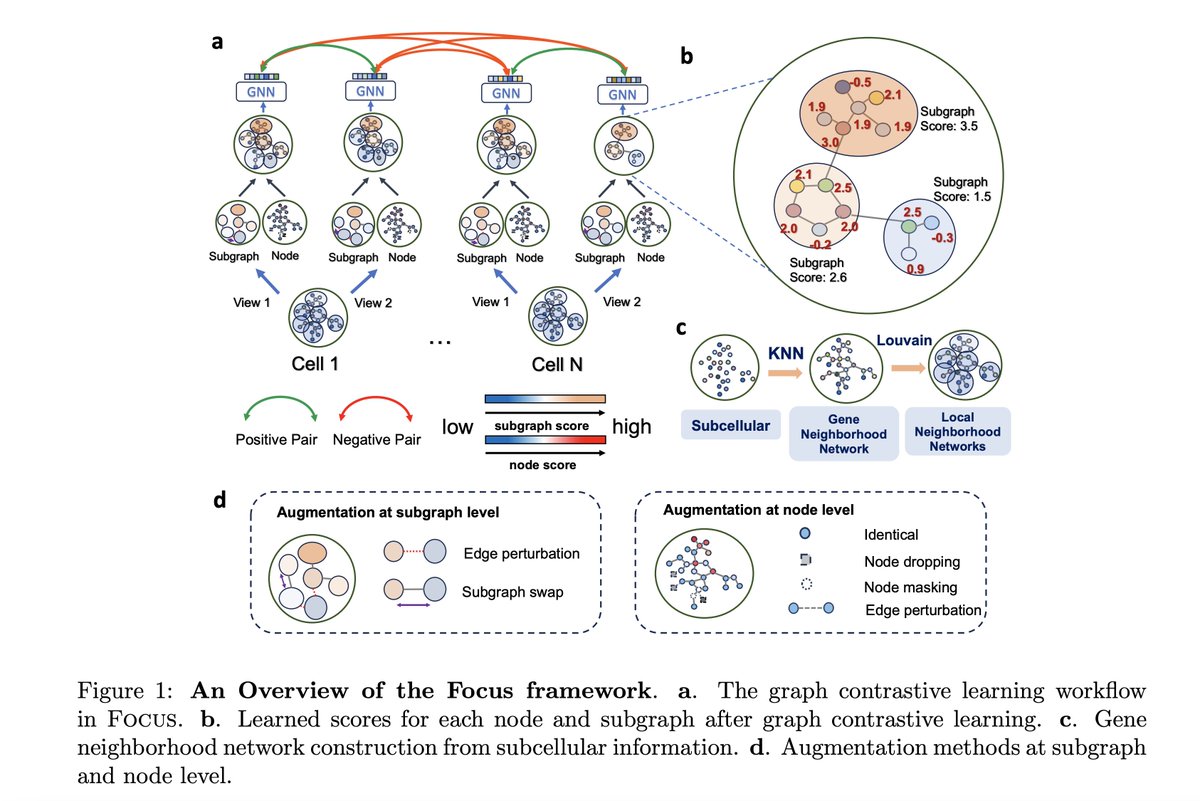
With the imaging-based spatial transcriptomics such as MERFISH, seqFISH, CosMx SMI, Xenium and others, have you ever wondered how we can leverage their subcellular spatial information? Check out our latest preprint on Focus by Qiaolin and Jiayuan @JiayuanDing , two talent students, to find out how we approach this problem: https://t.co/DddCrNZ70m. Focus is a state-of-the-art graph contrastive learning based approach to properly model RNA subcellular spatial distribution that dramatically improves cell type annotation and reveals critical molecular pathways that were not possible before. Specifically, Focus first constructs gene neighborhood networks based on the subcellular colocalization relationship of RNA transcripts. Next the subcellular graph of each cell can be augmented by adding important edges and nodes or removing trivial edges and nodes. Focus then aims to maximize the similarity between positive pairs from two augmented views of the same cell and minimize the similarity between negative pairs from different cells within a common batch. Guided by a limited amount of labeled data, Focus is capable of assigning cell type identities and revealing intricate cell type-specific subcellular spatial gene patterns and providing interpretable subcellular gene analysis, such as defining the gene importance score. Focus is still in its prototype stage but we are excited about this direction and will continue to improve Focus and extend it to many other settings. In the meantime, please let us know if you may have any comments or suggestions! As I just started my lab at Stanford, we are excited about many collaboration opportunities from the Bay area and others as well!
2/2 Discover the dual-edged sword of RAG technology in our paper and explore our code for innovative privacy solutions. #NLP#Privacy#AIethics
Paper: https://t.co/jqBir2yVZs
Code: https://t.co/Wg72zJeegt
1/2🚀Excited to share our latest #RAG#privacy research! We’ve uncovered two pivotal aspects:
1⃣Privacy challenges within RAG’s own data- up to 50% retrieval data could be leaked
2⃣RAG’s potential to safeguard training data-reducing the tendency of LLM outputing memorized data
🔒💡 Excited to share our latest #RAG#Privacy research! We've uncovered two pivotal aspects: 1️⃣ Privacy challenges within RAG's own data 2️⃣ RAG's potential to safeguard training data
🔍 Discover the dual-edged sword of RAG technology in our paper https://t.co/mcVPeRFgsy
See our new repo https://t.co/8flsvI4US7 including (1) theoretical guidance (2) existing benchmark datasets and (3) existing GFM summarization. The new seminar focusing on GFM will be on board soon!!!
2/2: We examine it from two distinct viewpoints: the copyrights pertaining to the source data held by the data owners and those of the generative models maintained by the model builders. 📚 Dive in now: https://t.co/HOeivRFPDr
1/2: 🚀Exciting release our latest preprint, “Copyright Protection in Generative AI: A Technical Perspective,” tackles the pressing issue of copyright in Generative AI. This work provides a comprehensive overview of copyright protection from a technical perspective.
You may know gene language models, but what about cell language models? We just published a blog on Valence Portal about our ICLR 2024 paper CellPLM: Pre-training of Cell Language Model Beyond Single Cells. Check it out📷: https://t.co/t86FoeKoPN
🌟 Exciting News! 🎉 Huge congratulations to our lab's esteemed alum, Wei Jin, for being honored at the KAUST Rising Stars in AI Symposium 2024 AND for being featured in AAAI-2024 New Faculty Highlights!🤖💡 Congratulations, Wei! 🏆